
It’s called the “East Lents Floodplain Restoration Project”. Discover why citizens who live and work along outer SE Foster Rd. say they’re cautiously optimistic about the city’s effort to reduce flooding …

Many people turned out to learn more about the East Lents Floodplain Restoration Project, and share their concerns
Story and photos by David F. Ashton
Remember early December rainstorms that caused outer SE Foster Road to flood and close for two days?
This flooding in the Lents Neighborhood is a symptom of a long-standing problem which the City of Portland’s Bureau of Environmental Services (BES) staff is working to resolve.
On January 22, BES staffers held an open house to discuss their plan to reduce flooding – the plan is called the “East Lents Floodplain Restoration Project”.

Lents neighbor Joyce Beedle talks with Marie Johnson, BES Program Coordinator for the Johnson Creek Watershed Program.
Extra channel to absorb storm surges
“We’re here to share with people the initial design work done,” Marie Johnson, BES Coordinator, Johnson Creek Watershed Program, tells us. “This is a project that will be built south of SE Foster Road, between the former Freeway Lands Company site and about SE 112th Ave.”
Looking at a proposed design map, we see they propose to build a new channel that snakes around existing properties. We ask if this project will impinge on established neighbors.
“Our design ideas take advantage of BES-owned properties,” explains Johnson. “We’ll use them to the extent we can – with the budget we have. It’s always been our assumption in this part of the project that we are working on BES property we currently own.”
Johnson again asserts that this is an early design. “There’ll be a lot more work on it as we go along.”
Timetable spelled out
The design work will happen over the next year or so, Johnson informs us, and then will go into the permitting process. Actual construction is scheduled for year 2010.

Here’s the early design project drawing for the plan floated by BES that will add an extension to Johnson Creek that is designed to absorb the higher levels of water produced by major storms.
Gives historical perspective on creek floods
Saying she’s witness to the history of the area, neighbor Joann Davis mentions that she grew up living close to Johnson Creek. “I now live within two blocks of where I grew up; my folks purchased in 1930 at SE 101st Avenue and SE Boise Street.”
While she doesn’t live directly on the creek, Davis says, “It affects my community. I remember when Johnson Creek used to flood much worse than it does now. A lot of the kids I went to school with were flooded out every year.”
Comparatively speaking, Davis goes on, “things now are very good. Flooding is just one of those things that happen. I think what BES is going to help. I’ve seen it help already.”

City of Portland Bureau of Environmental Services engineer Dave Whitaker answers questions posed by Lents neighbor Ed Fitzgerald about the East Lents Floodplain Restoration Project.
Thinks City takes it seriously
Lents neighbor Ed Fitzgerald says that, although he lives in the flood-prone area between SE 106th and 108th Avenues, south of SE Foster Road, “In the ’96 flood, we had a couple of inches of water in our house. We were indirectly affected by our last high-water episode. My house was okay, but I couldn’t get out for 12 to 15 hours, because Foster Road was flooded.”
Regarding the proposed solution, Fitzgerald comments, “I think they’re taking the flooding seriously. I’m not sure what the solution is, but they are looking at the problem. I’m interested in what they’re proposing, because their Brookside Project doesn’t seem designed to handle rain runoff like it is supposed to do.”
Expresses cost concerns
Wes Wolfe, a board member for the neighborhood association, says he’s just speaking for himself, and says, “I’m here because I’m real curious about the different proposed plans for this project. I don’t know what could go wrong with it; I think it may do the job. And it looks like they’ve learned from their other projects; I can see they’re getting better and better.”
A concern for one unidentified resident, who lives near SE 108th Avenue and Foster Road, is the cost. “It is expensive. It looks like there is a lot of overhead that is not construction costs.”
Shares her misgivings
Joyce Beedle, a long time Lents neighbor who lives within the floodplain area, says she thinks the finished project will be great.
But, “I have a couple misgivings. One is that I would like there to be more than 30 days for us to look at the plan and think about it, and come up with suggestions. It’s taken BES years to come this far, and 30 days seems a short response time.”
Another trepidation Beedle expresses is past communication problems with the BES. “We do have some history. Sometimes, we’ve had rapid response to our concerns; other times, things been pretty dismal. So my trepidation is, which way will this project go? We’ve talked about how desperately we want the BES to be responsible, accountable contractors.”
Nevertheless, adds Beedle, she’s hopeful: “Actually, really hopeful. We have really good communication going now. I’m looking forward to how cool it could make the neighborhood.”

“Can the City make water run uphill? Asks neighbor Chuck Glasco.
Questions water running uphill
“I know the City of Portland can do some wonderful things,” muses neighbor Chuck Glasco, “but I don’t think they can make water run uphill. It looks like the southern area of the project will turn into a pond, instead of emptying out where it ties into Johnson Creek.”
Glasco points out that the surface elevation at SE Foster Road is considerably higher than at the southern point of the proposed creek extension. “It looks like the elevation rise could be to 3 feet.”
We wanted to find the answer to Glasco’s interesting question, because we checked the topographical maps and what he said was true. But time ran out to learn the answer; the Lents Neighborhood Association’s meeting was starting in the same space.
Later, Scott Clement, BES Supervising Engineer went over the proposal with us and provided the answer.
“No, we can’t make water flow uphill,” comments Clement. “The general fall of the land in that area is, north to south, high to low. But the level of the creek doesn’t follow that topography. In this case, the fall of the creek is from east to west. Indeed, the water will be flowing downhill.”
BES to review citizen input
“We’ll take input from this meeting, and from the review of the pre-design reports, and consider that, in finishing the final design,” Johnson informs. “From there, we’ll hire a design firm that will go with a critique of the process and come up with a ‘30% design’. Then we’ll go back to the community and share the design of them. We’ll also think about construction impacts, and how we mitigate for those with the neighbors.”
Their web site isn’t up yet, Johnson says, but encourages people to call her at (503) 823-6199, or e-mail her at Marie.Johnson@bes.ci.portland.or.us, for more information.
© 2008 David F. Ashton ~ East Portland News Service
TV star Shannon Quimby’s project to recycle an old home into a brand-new one even includes the landscaping. See what she’s doing with trees that are in the way of the new construction …

Shannon Quimby, the “Q-Renew” star from the HGTV network, stands by a camellia tree’s root ball before it is moved 22 feet northward. She says moving it fits with her “reuse everything” philosophy – and saves money as well.
Story and photos by David F. Ashton
Shannon Quimby, the “Q-Renew” gal seen on the Home & Garden TV Network is sticking with her publicized mission to reuse everything while rebuilding of her home at 2022 SE Rex Street in the Westmorland Neighborhood.
She calls it the “REX (Reuse Everything eXperiment) Project”.
“I said I was saving and reusing everything,” Quimby tells us, “and I am including the six mature camellias.”
With the help of a half-dozen workers – and a gigantic crane – she’s transplanting the trees, on site in different locations.

Trees aloft! A giant crane easily lifts the trees to be replanted in another part of the yard.
Massive move saves money
“Isn’t this costing you a fortune?” we ask.
Quimby replies, “Actually it’s saving me money. If I had to replace all of these trees, doing landscaping, and if I had purchased these trees, it would cost over $25,000. To dig the trees, ball the roots, and move them is going to cost about $10,000. So I’m way ahead of the game. And, these camellias have been here for years and years. So not only am I saving money, I’m saving part of the neighborhood.”
City arborists told Quimby that the holly tree on the property was on their nuisance list and she could chop it down. “We did. But, now we’re milling it into an interior exposed column in the new family room and dining room area.”
You can follow her adventure – recycling an entire house and yard, board by board – at her web site: www.ShannonQuimby.com.

It takes one huge crane to lift trees weighing thousands of pounds – but that expense is only half the price of buying replacement trees, Quimby says.
© 2008 David F. Ashton ~ East Portland News Service
It didn’t swallow it up, but this sinkhole gave the crew a scare, as their truck started sliding down into the pavement. See exclusive photos here …

While the truck wasn’t buried, the crews had to scramble out, for fear it might disappear into a sinkhole. PWB photo
Story and some photos by David F. Ashton
The combination of cold weather, and old water main pipes, has caused water line ruptures across the city.
The event on January 30 gave Portland Water Bureau (PWB) workers a real scare, when they pulled up to see why water was gushing up from the pavement on SE 32nd Avenue, a block south of SE Powell Boulevard.
“As a crewmember backed his vehicle up to begin repair work,” says PWB spokesperson Jennie Day, “the ground caved in, taking the driver’s side of the vehicle with it.”
The driver emerged, unscathed, Day reports. “The vehicle, however, was not so lucky. It took two different tow trucks nearly two hours to pull it out of the sinkhole.”

Although it was damaged from the sinkhole episode, PWB workers kept the truck on-scene after it was pulled out of the street. “It’s got everything we need in it, and we had to get to work,” a crewmember explained.
Crew leaders believe that the integrity of the pavement was compromised when dirt under the street surface was washed away by gushing water from the break of an 8-inch water main. The crew had no way of knowing that the ground beneath the surface had given away.

Another “day at the office” for a Portland Water Bureau crew, as they repair not one, but two breaks in the water main. Yup, that’s the rescued truck in the background!
Residents on SE 32nd between Powell and Francis were without water service while crews repaired the line. Service was restored at 5 pm that afternoon, Day confirms.
© 2008 David F. Ashton ~ East Portland News Service
State Senators Rod Monroe, Brad Avakian and Portland City Commissioner Randy Leonard hosted the event – see what we learned when we stopped by …

State Senator Rod Monroe explains the intricacies of funding state highway improvement – such as outer SE Powell Boulevard.
Story and photos by David F. Ashton
Billed as a “Livable Communities Town Hall”, co-hosted State Senator Brad Avakian and Portland City Commissioner Randy Leonard, the event was scheduled to touch on issues ranging from land use to water resources, and renewable issues to public safety and emergency response.
Senator Brad Avakian had little to say – but surprise guest State Senator Rod Monroe wasn’t shy about speaking up, at the January 15 meeting held at the David Douglas High School library.
Randy Leonard spoke enthusiastically about the promise of bio-fuels, and how this new industry would help the state economically while reducing auto pollution.
Rod Monroe talked about the “Special Emergency Session” to be held by the Oregon legislature in February, calling it “an experiment” in annual sessions – currently prohibited by law in the Oregon State Constitution.
Many of the people present talked about their own personal concerns – the environment, low spending on education, and the upcoming elections. We were surprised to see a contingent supporting national candidate Lyndon LaRoushe espousing his fiscal policies. And, much of the conversation revolved around national issues, like the debt, spending, and foreign investment.
At times, the Town Hall sounded more like a political rally, as the trio blasted the Republican Party on the Oregon Kicker law, among other topics. Many of the state’s ills were blamed on Republican politicians.
Powell Boulevard concerns
A neighbor from the Centennial Neighborhood asked why SE Powell Boulevard, from I-205 east to Gresham, was still a two-lane road without sidewalks.
Senator Monroe took the question, and said he’d work with the City of Portland, until he was reminded that Powell Boulevard is a State highway.
“The problem is funding,” Monroe then explained. “There are a certain amount of federal dollars coming in; those dollars are minimal. The truth of the matter is, the amount of taxes and fees that are paid on each auto in the states of Washington or California. And our gasoline tax has not gone up for many years.”
Monroe went on, saying that Washington State has doubled the amount of money it collects – per cars driven, not population – than has Oregon, in the past few years. “You’ll notice a lot of work has been done in the state of Washington, but not in Oregon. We’re looking for ways to get projects going. They’re right at the top of my list. I’ve lived here all of my life and yes, [SE Powell Boulevard] is an absolute bottleneck.”

Portland City Commissioner Randy Leonard spoke enthusiastically about alternative fuels, and gaining greater financial support for outer East Portland schools. Senator Brad Avakian, a panelist, mostly listened.
Sees support for schools
Because we could attend only a portion of the session, we later asked Commissioner Leonard what he felt were the main issues that came up.
“What I took away from the meeting the other night,” Leonard replied, “was the overwhelming public support of the work Commissioner Sten and I are partnering on, to come up with the money to build David Douglas a new grade school using downtown urban renewal dollars.
“Both Senators Monroe and Avakian said they would support legislation in Salem next month to clear the way for us to give the David Douglas District the money needed for the school.”
© 2008 David F. Ashton ~ East Portland News Service
Sho Dozono drew on his East Portland heritage as he kicked off his bid to be Portland’s next mayor. Learn why this businessman says he’s the man for the job …
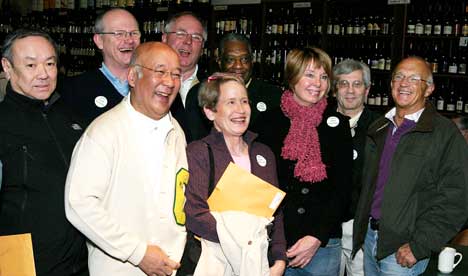
At Woodstock Wine & Deli, Sho Dozono poses for a photo with fellow members of the Cleveland High School Class of ’63.
Story and photos by David F. Ashton
It had been looking as if Portland City Commissioner Sam Adams’ bid for Mayor might not be seriously challenged. But on January 12, that scenario changed, as hundreds of supporters flocked to greet businessman Sho Dozono – at Woodstock Wine & Deli.
Although not a tall man, Sho Dozono was easy to spot, as he energetically worked the room like a man on a mission. He was wearing his white Cleveland High School letter sweater – and was constantly in motion, greeting one person, hugging another, and shaking the hand of yet another supporter.
Dozono dialogs
When we asked the vivacious candidate why he chose Woodstock to kick off his campaign, Dozono replied, “I went to Cleveland High School – I’m the class of 1963. I went to Buckman Elementary and Hosford Middle Schools; I am an Eastside product. I’m very proud of my roots here.
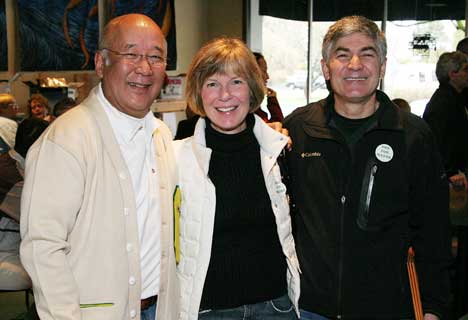
Newly-minted Portland mayoral candidate Sho Dozono stops to talk with supporters Margy Christy and Peter Hamilton.
“It feels good to have so many friends, not only from this neighborhood but from throughout the city of Portland and suburbs, here to support my campaign. They want me to be successful; they’re gathering signatures so I’ll ultimately be elected Mayor of Portland on May 20th of this year.”
A ‘public funding’ candidate
The signatures to which Dozono was referring are those needed, along with a $5 donation, to allow the candidate to quality for public funding for his campaign.
“We need to gather 1,500 signatures and donations before January 31 to qualify,” said his daughter, Stephanie Dozono. “Before today is over, we may be half way toward reaching our goal.” The day following this reception, Dozono’s campaign manager told us they had, indeed gathered 750 signatures within just the first week of the campaign.
Sees hunger for change
“I think there is a hunger for change in Portland City Hall,” Dozono went on. “The City can use a breath of fresh air and new leadership – not from an insider. The work that career politicians and insiders do, many who have worked there for years, is very important, but sometimes a fresh perspective is important too.”
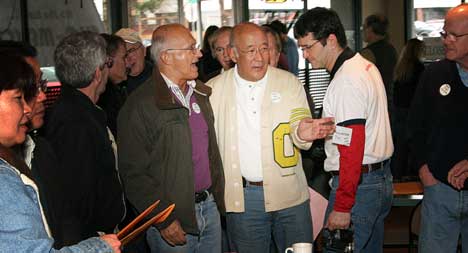
Dozono moves briskly around the room, shaking hands and thanking supporters.
Dozono said he’s been a businessman for 30 years. “At the same time, I’ve not been a bystander. I’ve been engaged in civic involvement. I’ve worked for six Mayors and five Governors – without any break. They’ve asked me to lead commissions, or chair committees.”
His civic involvement, Dozono said, has given him an opportunity to show how his leadership does get things done. “When I am elected Mayor, I intend to bring that collaborative spirit, especially between government and the private sector, into City Hall.”
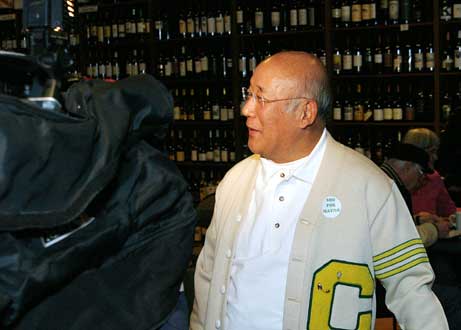
Ready to make a statement for TV? You bet! Dozono seems to enjoy the early stages of his run for the mayor’s seat.
For more information, see his web site at www.shoformayor.com.
© 2008 David F. Ashton ~ East Portland News Service
See how the latest medical technology gives expectant mothers (and family members) more than a sneak-peak at their soon-to-arrive new stars …

Jessica Fantroy shares with us her first experience of seeing her newest baby girl – weeks before she’s to be born. Rebecca Cunningham is operating the Phillips 4-D Ultrasound, as Chief Sonographer Tina Fery looks on.
Story and photos by David F. Ashton
Medical ultrasound imaging has been around for years. But, the blurry, grainy image – useful to medical experts – usually just looks like a blob on the screen of an electronic device.
But this week, thanks to Adventist Medical Center, we were invited to preview the miracle of life as East County resident, Jessica Fantroy, got her first glimpse of the live-action image of her third child, a soon-to-be born baby girl.
“This is my first time doing this,” Fantroy said as she saw a realistic, three-dimensional image of her unborn baby. “I always wanted to see what the baby looks like when it’s still inside me. It’s so clear. This is really nice.”
As sonographer Rebecca Cunningham moved the probe around the expecting mom’s tummy, we saw different views of the unborn infant as it stretched, curled up, and at one point, seemed to smile – long before its early April birth date. “This gives us a three-dimensional image,” commented Cunningham; “the ‘fourth dimension’ is motion over time.”
Vast improvement in imaging
“When I first started doing ultrasounds ten years ago,” added the ultrasound technician, “the two- dimensional images were really poor. This new technology is simply amazing. You can look at an organ – or in this case, Jessica’s baby – from many different perspectives.”
Cunningham pointed at the large, high-resolution color screen. “You can clearly see the umbilical cord going across the baby’s face.”
“Look, she’s sucking on the cord!” Fantroy exclaimed.
Unborn movie star
Cunningham pressed a button, and the machine – a Phillips IU-22 4-D Ultrasound – took digital photos and movie clips which can even be burned to a CD for the patient to take home and share.
“Grandma is waiting at home,” Fantroy told us. “She can’t wait to see these pictures. It’ll be fun to show everybody.”

With a stretch and a yawn, Baby Fantroy stars in her first movie.
Pictures promote bonding
We asked the clinic’s Chief Sonographer, Tina Fery, about the medical applications for this new technology.
“Moms always could feel the baby moving all the time,” Fery replied. “This now gives dads, and the family’s children, the opportunity see the baby as clearly as if they were looking at it in a bassinette. They’re able to connect, and bond, with the baby on a whole different level.”
Fantroy agreed, “Oh yeah. I can so clearly see my move. I can feel her move, and it’s really fun and interesting to see here in me.”
A medical benefit, Fery pointed out, is that practitioners can now clearly see the orientation of the baby. If it’s a problem pregnancy, they can better view abnormalities that will need medical attention when the baby is born.

Technologists say new moms love the new 4-D ultrasound technology.
A medical procedure
Although ultrasound imaging is not an invasive process, it is still a medical procedure, Ferys pointed out. “In our case, when a physician orders an ultrasound imaging session, the patient gets the benefit of this new technology. It doesn’t cost any more than we used to charge for a 2-D ultrasound.”
Currently, both Adventist Medical Center and Gresham Imaging Center are offering “4D ultrasound imaging”.
© 2008 David F. Ashton ~ East Portland News Service
See what citizens learned, when the Portland Office of Transportation unveiled the program they’ll be pitching to the City in February …

Sharon White, Portland Office of Transportation, listens to the concerns of a neighbor regarding a proposal contained in the “82nd Avenue of Roses High Crash Corridor Safety Action Plan”.
Story and photos by David F. Ashton
As it gets ready to present its proposal to the Portland City Council in February, the Portland Office of Transportation (PDOT) let neighbors and citizens have a first look at – and comment on – the 82nd Avenue of Roses “High Crash Corridor Safety Action Plan” in December.
At the open house, held at the Central Northeast Neighbors office, Rich Newlands, PDOT Project Management, explained, “We’re taking on this project because, if one looks at the accident history on 82nd Avenue of Roses, it stands head and shoulders above other comparable highways when it comes to vehicle and pedestrian accidents.”
Five of the top twenty crash-prone intersections in Portland, he added, are along this highway. “It is clear that this is a road on which our attention should be focused.”
Newlands said a committee has been meeting to develop the safety action plan since last spring.

An East Portland neighbor who lives near 82nd Avenue of Roses, Dave Smith, talks with PDOT’s Rich Newlands and Raphael Haou.
Seven miles of challenges
“Because 82nd Avenue of Roses runs from Clackamas County to the Portland International Airport, it provides planning challenges,” Newlands said. “We’re working with a stretch of road nearly seven miles in length – with several different neighborhoods bordering along it. There are a lot of different perspectives about what the problems are along 82nd Avenue.”
We asked why the City of Portland is taking steps to correct problems along a State-owned highway.
“You’re right,” Newlands replied, “82nd Avenue is under ODOT’s jurisdiction – but it’s still a Portland street. This project is very much a [city/state] partnership. Our counterparts at ODOT say they’re excited because we’re using a planning process they developed. This is the first application of it in the City of Portland. ODOT has funded the planning process and some of the improvements.”
Please see the end of this article for a summary of the changes proposed in the “82nd Avenue of Roses High Crash Corridor Safety Action Plan”.

Madison South resident Dave Smith is surprised to see a highway barrier at a place where he says it will interfere with vehicle traffic.
Project element surprises neighbor
Dave Smith, Madison South neighbor and head of the East Portland Block Captain program, stopped by the meeting. We noted a look of surprise on his face as he studied the plans.
“We live close to NE 82nd Avenue on Brazee Street,” Smith began. “I noticed an engineering proposal to put some kind of barrier or crossing at Brazee Street. It may interfere with automobile traffic. Safety might be better served by having the barrier on Russell Street, where there is a bus stop. That’s the place where kids from Madison High School are crossing the street.”
Smith said he was surprised at what he didn’t see: Improvements to NE 82nd Avenue of Roses at the MAX crossing. “The way pedestrians cross the street and traffic in that area, it is frustrating for those on foot, drivers – and police, who have to enforce safety issues around there.”

82nd Avenue of Roses Business Association president Ken Turner here talks with a neighbor about how the safety plan might affect area businesses.
Hopes plan won’t hurt businesses
Ken Turner, president of the 82nd Ave of Roses Business Association, also came by the open house.
“I applaud much of what I’m seeing here tonight – and the ideas and thoughts behind it,” Turner began. “I think this is a good idea.”
However, a component he found missing, Turner continued, “is how proposed traffic changes along 82nd Avenue would affect businesses in both positive and negative way. Businesses survive by how many cars can come and go from their business. If a customer can’t get into a business, or traffic makes it difficult for them to leave a parking lot, the customer won’t come back.”
82nd Ave. of Roses High Crash Corridor Safety Action Plan highlights
Safety issues
About 80% of the issues identified are regarding the safety for pedestrians and bicyclists. These include:
- Pedestrian and bike crossings at unsignalized intersections;
- Aggressive vehicle driving; and,
- Wrong way bike riding.
Proposed engineering solutions include six median pedestrian islands, located at:
- NE Wygant Street
- NE Brazee Street
- NE Pacific Street
- SE Main Street
- SE Cooper Street
- SE Francis Street
- SE Harrison Street
Locations for 59 new corner curb sidewalk ramps have been identified along the avenue.
Construct missing sidewalk between:
- NE Killingworth Street and NE Prescott Street
- SE Duke Street and SE Ogden Street
Carry out traffic studies at high crash intersections, such as
- SE Foster at 82nd
- Divison and 83rd
- Duke & 82nd, and
- Holgate & 82nd
Vehicle Speed Studies:
- Potential for relocation for pedestrian medians; and
- Installing additional warning signage
Other engineering solutions include:
- Moving bus stops
- Construction of Curb extensions
- Installing longer crossing lights
Proposed educational programs:
- “I brake for people” safety campaign
- Implementing “Portland Walks” video safety training for seniors
- Continue the “Safe Routes to School” program
- Media campaign visualizing motorists stopping distances
- Media campaign to discourage illegal bicycle riding on city streets
- Letter-writing campaign to property owners to maintain sidewalks
- Educational transit safety program
- Young drivers’ classes
- “Share the Road” traffic safety classes for violators
Proposed enforcement solutions
- Step up traffic enforcement
- NE Prescott to NE Fremont
- NE Glisan to NE Washington
- SE Powell to SE Duke
Enhanced enforcement regarding
- Jaywalking
- Motorists running red lights
- Aggressive driving, tailgating and speeding
- Motorist DWII
- Bicycle-riding violations
Install Red Light cameras at high-crash intersections.
More open houses are tentatively scheduled for January and February, Newlands said.
© 2008 David F. Ashton ~ East Portland News Service
Because folks showed up in record numbers, see how many food boxes were delivered for the “Sunshine Division” this year …

With open hearts, empty vehicles, and willing hands, volunteer drivers from all over East County line up to help the Sunshine Division deliver each-and-every food box to its recipient.
Story and photos by David F. Ashton
How many volunteer drivers does it take to deliver more than 450 food boxes to needy residents throughout East Portland?
We’re still not sure exactly how many vehicles showed up during the early morning hours of December 15; we’re guessing over 100 – enough to speed boxes containing a complete Christmas dinner (and then some) to East Portland residents.

Former precinct commander Cliff Jensen (in the center, facing us) comes to load his truck with Sunshine Division food boxes.
“I’m glad to help deliver boxes to the great folks in East Portland,” was the sentiment expressed by retired Portland Police Bureau East Precinct Commander Cliff Jensen. “We’re doing this to give back to the community. I grew up in Southeast Portland; this is our home.”
Another driver, Alden Lewis told us, “We thought it was a good cause. We read about it, and decided to let the kids participate. Young people need to know there are people less fortunate that we are, and we need to give them a hand.”

Again this year, Portland Police East Precinct Cadets help speed the loading process as cars pass through the precinct garage.
David Ward told us that he drove in from Troutdale to help make deliveries. “This is our 6th year making deliveries. We do a service project every year with our family. Seeing how grateful people who are in need and deserve a hand are, gives us a great feeling, because we helped.”

New police cadet recruits Trever Ethridge and Luke Guthridge put their backs into loading up cars on December 15.
“I saw there was a need for drivers and thought this was something I could do,” said Joe Stroud, a Parkrose resident. “I’m glad to help out during the holiday season.”
The current commander of East Precinct, Michael Crebs, said he was concerned there might be a shortage of drivers this year and was among the first drivers to start making deliveries. “When we returned for more boxes to deliver, we found that the community really responded to our request for drivers – and all of the boxes were already on their way. We thank you so much.”

Leading by example, cadet post advisor Sgt. Michael Gallagher works hard and helps keep the flow of food boxes coming to waiting drivers.
465 boxes delivered
In 2006, the lack of volunteer drivers made it difficult for all of the food boxes to be delivered in a timely fashion.
“But this year,” reported Portland Police Bureau East Precinct Sgt. Michael Gallagher, and Post Advisor of the East Precinct Cadets, “we had the perfect amount of drivers for the number of boxes that needed to be delivered. Our last driver took the last three boxes.”
Gallagher added that this charitable event depends on good-hearted volunteers willing to give up a couple of hours to help. “The Sunshine Division Holiday Box program is successful – but only because of the community’s help. We really appreciate the support of drivers who came out to help from all over East County.”
© 2007 David F. Ashton ~ East Portland News Service
You’ll never guess who the surprise carol-leader was at the 82nd Avenue of Roses Business Assn. Holiday get-together! And, you’ll see why many folks along the avenue say they have much to celebrate …

Entertaining guests at the 82nd Avenue of Roses Business Assn. Holiday Party is Frank Ryan, NW Senior & Boomer News. Frank’s singing a holiday song he composed, “A Valley Christmas”.
Story and photos by David F. Ashton
The table filled with deli roll-ups, fresh fruits, and baked treats, made the classroom at Portland Community College Southeast Center seem festive as members and guests of the 82nd Avenue of Roses Business Assn. met for a Holiday Party on December 18.

The association’s president, Ken Turner of Eastport Plaza, recounts the year’s successes along the avenue.
With plates filled and beverage cups brimming with coffee or fruit juice, folks sat down as association’s president, Ken Turner, spoke of the year’s highlights along the “Avenue of Roses.”
“Our first parade was a success,” began Turner. “There were doubters; and I was one of them, who doubted for a while as we went through the process of getting all the permits for the parade. But, on parade day, it didn’t rain, and we had a great turnout from participants and neighbors.”
Turner said some of the comments he heard from neighbors was revealing. “A man smiled and told me, ‘We’re watching history being made on 82nd Avenue’, This is something we can all be proud of.”
The upcoming 2008 edition of the parade already has secured one title sponsor, Eastport Plaza. “But, we need additional funds to cover the costs of putting on the parade. We’d welcome another title sponsor, and other support.”
It was also revealed that 2008’s parade will feature a major band, thanks to Richard and Gail Kiely of Homerun Graphics. Gail, we learned, is a founding member unauthorized rebel offshoot of the “One More Time Around Band” – the “Get a Life Marching Band”.

Nancy Chapin of The Support Group expressively reads the timeless holiday tale “The Night before Christmas”.

Nan Poppie, director of Portland Community College SE Center, tells the group about the school’s expansion plans.
SE Center celebrates fourth year
Nan Poppe, Ed.D., president of Portland Community College’s Southeast Center, at SE 82nd Avenue of Roses at SE Division, told the group, “This is a special time for us – it will be the four-year anniversary since we moved into our new educational center. I hope that you agree with us that this $25 million investment was worth it.”
Poppe informed the group that the campus serves 10,000 students per year, and launched into pitch for passing a proposed bond to benefit the Southeast Center.
“The bond would respond to two primary needs,” Poppe explained. “A library and science labs.”
She also said the campus needs a “flexible building to bring more technical programs out here. In fact, we’re looking to lease a facility to teach welding until we can build a building. There is a tremendous need for welders in Portland.”
Additionally, Poppe told the group the college hopes to gain funding to build a small auditorium. “We love being a community partner, and want to have community events. A 150-seat auditorium would facilitate working with community groups.”

East Portland Chamber of Commerce’s incoming president, Rich Sorem, of Stewart and Tunno Insurance, announces the 2008 Avenue parade plans.
Chamber floats parade plan
Rich Sorem, the 2008 president of the East Portland Chamber of Commerce told the group, “Look for us; we’ll have float in the Avenue of Roses Parade next year. I’m looking forward to that.”
Overall, Sorem stated, a goal for the chamber’s board and membership is to “reach out to all organizations and find common goals to build a consensus and have a large voice at city hall regarding issues we all find important.”

Both of them feigning surprise at the encounter, Ken Turner welcomes Portland City Commissioner Sam Adams to the holiday gathering.
Commissioner Sam greets gathering
Walking into the gathering, almost on cue, was Portland City Commissioner Sam Adams.
Portland is a city of small neighborhood businesses, Adams reminded the group. “84% of businesses that exist in our city employ 10 or fewer employees. We are a city of entrepreneurs.”
Adams pointed out how, by business groups working with City Hall, 2007 featured three milestones: A grant to support the Alliance of Portland Neighborhood Business Associations, the city’s first ever; a reduction in business taxes for small businesses; and changing the city’s tax structure to encourage venture capital firms to move into the Portland area.
“No doubt about it,” Adams added, “we have a lot of work to do to continue to make Portland a place where entrepreneurs and small business folks can thrive. We’ve shown ourselves what is possible. As we look to a new year, we recommit ourselves to the mission of the success neighborhood businesses in the City of Portland.

Before leading the group in song Commissioner Sam Adams thanked members of the association for their efforts to enhance the image of 82nd Avenue.
“I’m thankful to have great business associations, such as yours, working at making this city a better place each and every day. On behalf of Mayor Tom Potter, and the City Council, thank you for the work you do, and your volunteerism. Next year will be even better.”
At the meeting’s conclusion, Nancy Chapin and Sam Adams led the group in singing the timeless holiday song, “White Christmas”. All this, and the commissioner sings well, too …
© 2007 David F. Ashton ~ East Portland News Service
She’s not saving just a lighting fixture or faucet – read how Shannon Quimby plans to save every piece of a dilapidated house to build a brand new home on the same lot …

“This is the first step toward the ‘rebirth’ of this house,” says Shannon Quimby as she starts dismantling the home on SE Rex Street.
Story and photos by David F. Ashton
Sellwood’s “queen of recycling and reusing”, Shannon Quimby, is famous for sharing her “Q-Renew” projects with a nationwide audience in books, articles, and on TV’s Home & Gardens Network. She’s also a former Board member of the SMILE neighborhood association in Sellwood and Westmoreland.
“My whole purpose, what I’m all about, is being a responsible homeowner by recycling and reusing,” says Quimby.

Shannon Quimby, flanked with the architects for the project, Peter Brevic and chief architect, Laura Migliori, have created the plan for a new house that will incorporate every piece of the original home they’re dismantling on the site.
As she stands, crowbar in hand, at the site of her latest and perhaps most ambitions project on Nov. 28, Quimby quips, “Well, I’ve really done it this time! I’ve found the greatest challenge of my career – to take a dilapidated house and attempt to reuse 100% of it in my new home construction project.”
Recycling an entire house
She says it all started as a remodeling project of a modest 660 sq. ft. house in Westmoreland, at 2022 SE Rex Street. “From the foundation on up, we found out the house couldn’t be saved. I didn’t want to bulldoze it and put it in the dump. More than half the content of landfills is construction waste.”
Quimby says she speculated, “What if we recycled the entire house into a new one at the same location?”
Thus was created the “REX Project“, Quimby tells us, at the project’s groundbreaking – or we should say “housebreaking” – gets underway.
“It’s on SE Rex Street so we’re calling this our ‘Reuse Everything eXperiment’,” notes Quimby.
A new construction concept
As far as she knows, Quimby says, never before has each and every part of a building been recycled into a new structure at the same location. “Even the landscaping will be reused. The camellias, laurel wood – everything will be reused in the same form, or different.”
Everything, even the foundation, siding, and lumber will be used in the new house, assures Quimby. “We’ve even had an idea of what we’ll do with the lath and plaster. We haven’t figured out everything – we’re asking for help from the community to help us meet our goal of 100% recycling. I’d like to see all the dumpsters at remodeling and building sites in our neighborhood disappear. My goal is to see all homeowners and contractors take this approach.”

At the REX Project kick-off, Shane Enicott, Rebuilding Center Deconstruction Services, says he’s fascinated by Quimby’s 100% material reuse concept.
Regional educational project
Shane Enicott’s crew from Rebuilding Center Deconstruction Services has the job of dismantling, sorting, and storing – on site – the REX house.
“METRO says 75% of a structure can be recycled,” reports Endicott. “We can normally save 85% of a house. But when Shannon said she wanted to save the entire home, from the roof into the basement, it opened our eyes to more possibilities to what could be done. This project can be an education for the whole region, perhaps the world.”

Even though the home will be larger, Quimby says they plan to reuse and recycle all landscaping on the site. Two weeks after this photo was taken, the house was completely dismantled.
Open for idea exchange
Although you might see this project highlighted on HGTV, the project isn’t a closed movie set. “We’re inviting the community in to suggest ways we can reuse everything – even the “Hot Wheels” race track mounted on the living room ceiling.”
Additionally, the site will be open for what she calls Saturday Seminars, as the house is being rebuilt. She plans to hold “Kids’ Classroom” sessions so young students can watch – and participate in – this unique project.
Ambitious schedule set
Quimby says the project must be completed by June, 2008. “And, we’re already on board to be featured in the Oregon Builder’s Association ‘Ultimate Open House Tour’ in April. We hope to be 80% completed by then, but still be able to show how materials are being reused.”

Check back; we’ll keep you updated on the progress of Shannon Quimby and her REX team.
As the work gets underway, dry rotted wood is uncovered. It doesn’t phase Quimby. “It can be composted into the soil. There are some things we already know how we’re going to reuse; other things, right now, we don’t have a clue. But we’re going to do it.”
© 2007 David F. Ashton ~ East Portland News Service
Come underground and see exclusive photos of your sewer-bill dollars at work …

How far is 160 feet down? Yes, those are people standing at the bottom of this shaft!
Story and photos by David F. Ashton
Portland’s “Big Pipe Project” to divert sewage out of the Willamette River isn’t news – the West Side project has been completed, and is currently in operation. But the opportunity to travel 160 feet underground to see this giant tunnel dug on Portland’s east side caught our interest.
Our tour began at the contractor’s East Portland offices in the Portland Opera building, located just south of OMSI.
“We are at the Opera Shaft location,” Steve Marriott, director of Portland’s Bureau of Environmental Services said as he began our orientation.
“This shaft is where we inserted ‘Rosie’, the Tunnel Boring Machine (TBM). It is driving north toward Swan Island.”

Our tour guide, Shane Yanagisawa, explains the equipment used in the massive project.
Brief history of sewers
Marriott stated that about 1,000 cities across the nation were built with a “combined” sewer system. The raw sewage and stormwater were collected in the same system, and sent into the river for disposal.
“When the sewage treatment plant was built in the 1950s,” Marriott went on, “they also constructed interceptor pipes to convey a lot of that flow to the treatment in North Portland. They didn’t size these pipes big enough to handle the runoff from every single rainstorm. At the time, they considered that having a clean river in the summer was good enough; it provided a huge improvement in water quality.”
But in the 1990s the city agreed to a 20-year program to address the chronic wintertime problem of combined sewer overflows.
Portland is ahead of most cities in solving this problem Marriott said. “Many other cities have yet to address the problem.”

This machine – the separator – divides mining spoils into piles of gravel, pebbles, sand, and the mining slurry that is returned to the tunneling machine.

This conveyor belt system takes the excess sand and gravel from the tunnel to barges which remove it and dump it in Ross Island lagoon.
Tunneling support system
Our first stop on the tour was seeing the technology that supports excavating tons of sand, dirt, and gravel, and sealing a pipe – all 160 feet underground.
Our tour guide, Shane Yanagisawa, lead planning engineer with Kiewit Bilfinger-Berger, walked our group over to a three-story tall building on the project site, just east of the Opera Shaft.
“This is the separator,” Yanagisawa explained. “Everything that is cut by the mining machine is mixed with slurry made up of water and bentonite clay. It is pumped to the surface where it is separated in into big chunks, small rocks, sand, and slurry. The slurry is pumped back down to the TMB.”
The rocks and sand are barged from a conveyor belt south of OMSI to fill in the lagoons once mined at Ross Island.

The most visible portion of the project to folks in Inner SE Portland is the Opera Shaft crane. It lifts and lowers all parts and supplies for the project.

These pre-cast concrete segments form rings that stabilize the tunnel section just dug by the TBM. The disks to the left of the ring segments are some of the TMB’s cutting heads.
Paving the pipe
After the TBM pushes forward, cutting a section of tunnel, it is lined with a series of 25 identical, pre-cast concrete ring segments, and finished with one key segment that locks the ring in place. A special grout is injected into the soil around the rings to help seal the pipe.
These ring segments are made on site, using some of the spoils from the tunneling operation. They – and all other equipment and supplies – are lowered down the Opera Shaft by a huge construction crane, perhaps the most visible evidence of the construction project in East Portland.
Yanagisawa continues, “This operation is a continuous process. Everything has to be working at all times – the TBM, slurry plant, separator, grout plant, ventilation system and ring manufacturing.”

Even Portland City Commissioner Sam Adams is required to wear safety gear, including the snappy yellow toe protectors we all slipped on our boots.
Commissioner Adams endorses progress
Portland City Commissioner Sam Adams, joking that he is “The Sewer Commissioner”, exited the elevator, coming up from his tour of the project, as we were preparing to descend.
“Hopefully the calisthenics portion of the safety orientation wasn’t too strenuous for you,” he kidded.
“This is the first time I’ve had the opportunity to tour the east side project. This is an effort to reduce, by 94%, the sewer overflows into the Willamette River. We will have spent $1.4 Billion, when all of the tunnels have been dug and pumping stations have been installed. We’re about 66% complete on the overall project.”

The Loki train hauls personnel and equipment from the central shaft to the trailing end of the TBM.

When the Eastside Big Pipe goes into operation, this pipe will be carrying pressurized, raw sewerage. We prefer to tour the pipe in its pristine state!

As we speed toward the trailing end of the TBM, we pass endless sections of Big Pipe rings.
Going down
Our group gets into a construction elevator affixed to the side of the shaft for our ride to the bottom. Along the walls of the 67′ diameter shaft are the electrical conduit that powers the TMB, incoming and outgoing slurry pipes, and a large air ventilation duct.
On the bottom are train tracks, on which runs a “Loki” – a squat but powerful diesel engine and passenger cars.
Once aboard, we rumble northbound, heading toward the end of the line: the TBM rig. The tunnel is temperate and dry; we see segments of the concrete liner rings along the way.

Members of this press junket marvel at the size of a machine that cuts a 26-foot-diameter tube far underground.

This is a view of the “trailing gear” that feeds supplies and power to the TBM in the distance.

Tunnel manager Greg Colzani says today is just another day at “the office” – but much quieter, since today the machine isn’t running.
The TBM at rest
Because this was a system maintenance day, the TBM was silent when we exited the train, about a mile north of the Opera Shaft.
Greg Colzani, tunnel manager tells the group that the TBM is about 30 feet long; but the equipment behind it, including the devices used to set the ring segments in place, is about 70 feet long. As it inches forward, the 100′ long assembly is pulled along with it.
“The TBM has entered the Alder Street Shaft, where the old ‘Corno’ building once stood” Colzani comments. “Standing here behind the machine, we’re right below the Montage Restaurant.”

This is the back of the TBM. Ahead of it lies more soil and rock to bore through, 160 feet below SE Alder Street.
Southbound trip begins in 2010
From this point, the crew will keep mining north to the Swan Island pumping station. “When we reach that point,” Colzani said, “We’ll take the machine apart. We’ll haul it back to the Opera Shaft, and reassemble it for its trip south. It will tunnel about 8,000 feet to our [southernmost] shaft at SE McLaughlin Boulevard and SE 17th Avenue.”
And, when it arrives there in 2011, Colzani said, another giant crane will be built there to lift out the TBM, including the 160-ton main bearing.
A large, but smaller, tunnel will be bored south a short distance to the intersection of S.E. 18th and Insley, and the “Insley Collector” which collects sewage from Inner Southeast Portland will be connected to the “Big Pipe” with this new, final tunnel.
That will complete the project that Commissioner Adams said he considers to be a “100-year project that will prevent all but the worst overflows into the Willamette River. And keep the sewer system functioning for the next century.”
© 2007 David F. Ashton ~ East Portland News Service
Can yet another City-sponsored committee improve livability in outer East Portland? You’ll see what some of the participants think … right here …

The David Douglas School District boardroom is nearly filled with delegates and observers, as the East Portland Action Plan Committee holds its first meeting.
Story and photos by David F. Ashton
The East Portland Action Plan Committee, a project co-sponsored by Multnomah County and the City of Portland, has held its first meeting earlier this month.
“This effort is designed to look strategically at near-term opportunities to improve livability, as well as long-term strategies to address issues in East Portland, generally east of I-205,” said the organizer, also East Portland Liaison for the Portland Planning Bureau, Barry Manning. “The committee includes a mix of elected officials, agency representatives, and eighteen community members working together on problem-solving and improvement strategies in East Portland.”
Governmental officials on hand who participated included Portland Mayor Tom Potter, Multnomah County Chair Ted Wheeler, and State Representative Jeff Merkley, Portland City Commissioner Erik Sten; METRO Counselor Robert Liberty audited the meeting.
In addition to elected officials and governmental staff members, eighteen members from the business, faith, education and neighborhood communities also been appointed to participate in the forum.
Looks to identify livability solutions
Manning stated that some of the anticipated outcomes of the East Portland Action Plan include:
- Validation of high priority livability issues in East Portland;
- Direction to initiate near-term actions that can be accomplished within one to two years;
- Identification of longer-term actions to be implemented through respective agency work plans; and,
- Commitment to follow through.
Struggling to deal with increased density
As once run-down parts of the city have gentrified, the City’s less affluent have been forced to migrate to outlying areas in outer East Portland.
As neighborhoods continue to change due to ever-increasing density, many citizens have expressed concern about reduced quality of life in their outer East Portland neighborhoods. Along with higher-density housing crowding once semi-rural areas has come increased crime and the lack of services, infrastructure, and amenities, to serve the burgeoning population.
Issues identified and potential actions
After two hours of roundtable discussions, the panel members had developed a list of concerns that include:
- Schools, Families, Housing: Develop a partnership and specific strategies with school districts serving East Portland to address school facilities issues.
- Community Safety: Develop partnerships to intensify the city’s public safety and social services responses.
- Community Organizing: Develop and fund methods to improve public participation, and broaden the base of community involvement in East Portland.
- Transportation Needs: Refine transportation priorities for East Portland, and explore budget proposals necessary to fund them.
- Land Use Planning: Explore and implement land use code changes to address infill development issues and lay the groundwork for longer range planning.
- Business Enhancement: Identify strategies for improving the business climate in East Portland, focusing on specific strategies for different areas.

Multnomah County Chair Ted Wheeler and Portland city Commissioner Erik Sten say they’re in agreement with the goals of the project.
Officials pledge help
Portland Commissioner Erik Sten said he’s pleased with the project, and very pleased with the large turnout of committee members and the public in general to the December 1 meeting. Sten pledged to find City funding to help out with the project.
Multnomah County Chair Ted Wheeler also commended the committee, the meeting, and the progress; but said he couldn’t offer financial support, citing the County’s tight budget.
“We want to see something immediate happen like you folks do,” summarized Portland Mayor Tom Potter. “We’re going to work to make sure some of these needs are met. All the assets of the cities, like our bureaus, will provide technical support, so you aren’t left stranded. We believe in this process. Rather than just take our word for it, wait and see what happens.”

Eighteen community members, along with governmental officials, say they’re working to solve some of outer East Portland’s most pressing issues.
Cautious optimism noted among participants
Judith Huck, owner of Classique Floors, told us, “I think the City and area agencies are looking to East Portland to see what we really need. They’re listening to us to see what really needs to be done out here. We’re struggling out here.”
Asked if she thinks this will provide concrete results, Huck smiled and said sincerely, “I have great hope.”
Opportunity to make a difference
Dr. Karen Fischer Gray, Superintendent, Parkrose Public Schools, commented, “The meeting was an excellent way for all of the super-stakeholder groups to get together and focus on East County planning. Everybody, to an extent, is on the same page about economic development, overdevelopment of housing, educational needs. This is a real opportunity for people to make a difference.”
Expresses concerns about housing
Hazelwood Neighborhood Chair Arlene Kimura said, about the meeting, “This is a very good first step. If we can do at least a portion of the things we set out to do – those are going to be big, giant steps. I do hope we can come up some critically-needed first-action items. That will demonstrate the sincerity of this effort. It will show it isn’t just a bunch of people sitting around the table.”
Asked for what she most hopes will come from this program, Kimura replied, “To really look at where they’re clustering the housing in relation to where the services are located. Changing our land use patterns and popping into housing in the middle of neighborhoods is not helpful. We’ve got to look at neighborhoods as a whole, and not just as housing developments.
I know people need housing, but we have to temper that with the fact that people have to be able to live and get around their neighborhood.”
Interested in transportation and education
Speaking for himself, James Chasse a board member of Board of Powellhurst Gilbert Neighborhood Association and land use chair, summarized his feelings: “It’s about time. It is a great opportunity for people in East Portland to be involved and hopefully see some action taken in the community to address some of the issues that have come up in the last ten years.”
Chasse added that his greatest concerns for outer East Portland are transportation-related issues and overcrowded schools.
Endorses new process
Brian Heron, Pastor, Eastminster Presbyterian Church, and with the Foster Family Care Network, said it is good for the community to envision a new process for dealing with issues in outer East Portland.
“The best part of the meeting,” stated Heron, “is the fact that so many people, from so many walks of life, are here representing the community. It’s not so much what has come out if it today, but the fact that we we’re all together in the same room. We’re ready to talk. The concept that stood out for me was building community. The community is so diverse; and at the same time, we’re dealing with diverse issues like poverty, and broken families, and lack of stability.”
Ethnic diversity a concern
Mike Vander Veen, Ministries Coordinator at Parklane Christian Reformed Church, agreed with Heron, but added, “And yet, there is a certain lack of diversity here today. There are a lot of white faces at the table. Even though we’re all coming from different perspectives, I saw limited participation of people of color. I’d like to see more ethnic inclusion. It was great we had a member of the Slavic community here. Diversity in the community was a value many people shared.”
Vander Veen added that he’s most concerned about finding was to protect our outer East Portland educational system. “In eastside schools, we still have music, arts, and PE, in addition to good quality academics. But it looks like education may be at risk. Its important! Children are the future of our community.”

East Portland Liaison in the Portland Planning Bureau Barry Manning, and METRO Counselor Robert Liberty, listen and respond to comments made at the meeting.
METRO Commissioner Robert Liberty told us after the meeting, “The most important thing was that this meeting was held. Next important thing was to see who came from the community and government. It is great.”
While Liberty characterized some of the data as being “a little daunting and disturbing”, he added that, from METRO’s perspective, this is perfect timing. “We’re talking about how to implement Plan 2040, we’re looking at investments. I think we need to look for answers to questions about where people of modest means can find a place to live in the region. It isn’t just an eastside phenomenon.”
More meetings to come
The committee is scheduled to meet monthly through June 2008.
The next meeting of the East Portland Action Plan Committee is scheduled for January 10, 2008, 6:00 to 8:00 PM, location to be announced. Contact the Bureau of Planning at 503-823-7965 for more information.
© 2007 David F. Ashton ~ East Portland News Service


