Finally, this unlicensed driver is behind bars – but not for driving without a license. Find out why she’s in jail now … and see our exclusive photos …

The never-licensed driver of this car wasn’t about to stop – until cops flattened her car’s tires.
Story and photos by David F. Ashton
After an alleged shoplifting spree at a Beaverton Marshalls store, about 6:20 p.m. on August 20, the driver of the red import sedan takes off from the parking lot, trying to ditch the local police.
She’s seen weaving through traffic on Highway 217 before Beaverton officers lose sight of the car, and put out a regional broadcast to Portland- area jurisdictions. A sharp-eyed Portland Police Bureau Central Precinct cop spots the car coming through Portland on I-5.
The officer follows it north on I-5, then east on I-84, then south from the NE 68th Avenue exit – as the driver cuts through Roseway, Madison South and Montavilla neighborhoods.
Pursuit allowed to continue
“Because the car remained on lightly-traveled surface streets in outer East Portland, and was not traveling at excessive speeds, supervisors allowed the pursuit to continue,” says Portland Police Bureau spokesman Sgt. Brian Schmautz.
Although the cops flatten three of the car’s four tires using a spike strip at SE Washington Street and SE 92nd Avenue, the driver doesn’t stop. Only when a patrol car bumps the wobbling car into a curb at SE 92nd Avenue and Clay Street, using the “Pursuit Intervention Technique”, does the car finally grind to a halt.

Officers sort out clothing and other articles they suspect were stolen from the Marshalls store in Beaverton.
Find stolen booty … and a baby
Two females are taken into custody. But, as officers begin to search the car, they find more than just the allegedly-stolen merchandise.
Officers are surprised to find a three-year-old baby loosely seat-belted in the back seat of the car – not in a child’s car seat. At the scene, we hear a sergeant remark that officers couldn’t see the child in the back seat during the chase.

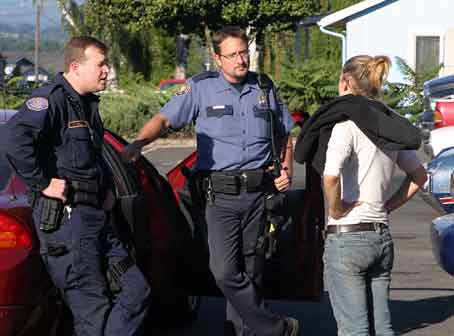
Cops check on the 3-year-old, who was in the back seat of the fleeing car. There were no injuries in this incident.
The driver of the car is identified as 24-year-old Kendrareen Hudson. She tells cops she lives in Beaverton; records indicate Hudson is a Salem resident.
Driver never licensed, but often ticketed
Authorities say Hudson hasn’t ever had a driver’s license. But that hasn’t stopped her from driving. She’s been cited 43 times for driving without a license – many times in Portland.
Further, on 17 occasions, Hudson failed to appear in court for these tickets.
Multnomah County Detention Center indicated that Hudson was in custody on several occasions, charged with crimes including theft and assault.

Cops say the statutes prevent putting
chronically-unlicensed drivers, such as
Kendrareen Hudson, behind bars.
Finally, off the roads
Although Hudson has walked away from many of her crimes without any jail time, she’s currently being held in the Washington County Jail because one of her charges, “Attempting to Elude a Police Officer”, is a felony.
“She was also charged with one count of Reckless Driving, and multiple counts of Reckless Endangerment,” reported Schmautz.
The 16-year-old passenger was turned over to Beaverton Police; the 3-year-old was taken into state custody.
© 2007 David F. Ashton ~ East Portland News Service
Is “street sex” truly as rampant as neighbors claim? See what we learned from riding with cops – and the impact of Portland City Council allowing the Prostitution-free Zone ordinance to expire …

Driving up NE Sandy Blvd. officers spot Gina outside of a tavern near the corner of NE Prescott. Street. “She was excluded from this area last week; we need to talk with her,” Officer Sparling says.
Story and photos by David F. Ashton
In the first installment of this series Portland Police Bureau East Precinct Commander Michael Crebs described how officers use Prostitution-free Zone (PFZ) and Drug-free Zone (DFZ) ordinances. (CLICK HERE to read Street Sex: Part 1)
However, at midnight on September 30, the Portland’s PFZ and DFZ ordinances will – as Mayor Tom Potter and the Portland City Council members characterize it – “sunset”.
But the term “sunset” is just a nice way of saying the city fathers are taking away a valuable policing tool by letting it die, neighbors and business people in outer East Portland tell us.
Also in last week’s installment, neighbors told their horror stories about going on “condom and needle patrol” every morning.
On prostitution patrol
To find out of neighbors and businesses along NE Sandy Blvd. and 82nd Ave. of Roses are blowing what they call the “prostitution problem” out of proportion, we ride along with Portland Police Bureau East Precinct officers Lacey Sparling and Heath Kula, late on a Saturday afternoon.
Sparling and Kula are assigned to operate a “prostitution mission”. Their assignment is arresting prostitutes and customers – and taking into custody prostitutes who are violating their police order excluding them from the PFZ.
As we ride to the patrol zone, Kula notes they’ve made more than 80 arrests during their mission.
Sparling shows us a thick stack of papers listing individuals who, under the PFZ ordinance, have been forbidden to tread 82nd Avenue of Roses and NE Sandy Blvd. – except to conduct legitimate business.
“By now,” Sparling adds, “We recognized most of the girls we’ve excluded. In a couple of weeks, we’ve gone from half a page, to over four pages of exclusion listings. We’re going out looking out for the regular girls.”
Prostitutes solicit in broad daylight
Although we ride in a fully-equipped – but totally unmarked – patrol car, officers don’t have to hide in the bushes or sneak around corners.
Even those prostitutes who have been excluded from “working” an area stand and walk brazenly in the afternoon sun, soliciting business. Our first contact comes minutes after we go on patrol.
In Parkrose, Gina talks with officers, trying to explain why she’s hanging around an area from which she’s been officially excluded.
“Camper” on Sandy Blvd.
At NE Sandy Blvd. and NE Prescott Street, the officers spot familiar faces. They pull into the parking lot of a popular watering hole.
The young woman, Gina, doesn’t notice as we pull up; her boyfriend wanders off, leaving Gina to talk with police. Gina heads back into the bar – but the establishment’s manager meets her at the door and tells her, “You’re still working; you’re not welcome in here. Don’t come back.”
Sparling says the couple claims their car broke down when they were visiting Portland a few weeks ago from Eugene and they don’t have money to fix it. Currently, they’re “camping” in a wooded area on the border of The Grotto.
They ask Gina if she has any drugs or money with her. She says she doesn’t do drugs, and “my stupid boyfriend takes the money. Every cent I get, he takes it all”.
Gina was originally arrested for flagging down a car and getting in, ostensibly, for sex. She tells officers she doesn’t actually perform a sex act. “I tell them we’ll do something, but I take their money and run away,” Gina reminds officers.
Kula asks, “When you get $50 or $100, why don’t you just take the bus back to Eugene?”
Gina starts crying and blurts out, “I don’t know. I’ve got to help my boyfriend. He handles the money.”

Officer Sparling takes Gina in custody. The suspect will be taken to the Portland Justice Center for booking, then she’ll be released.
Gina doesn’t implicate her boyfriend, who has now moved west, across NE Prescott St., and is leaning up against the Ace Tavern. He looks unconcerned that his “girlfriend” is being handcuffed and taken to jail.
The first time they arrested Gina, Sparling says, as we drive away, she was an attractive young lady. “Now, only weeks later, she looks to be in her late 30s. This life really ages them.”
It takes nearly an hour to fill in four forms during the arrest. “All of the paperwork is necessary. As police, we’re trained to accurately document the arrest.”

Officers see Loretta “on the stroll” – trying to flag down a potential customer along SE 82nd Ave. of Roses – directly across the street from Vestal Elementary School.
Along the 82nd Ave. of Roses “stroll”
Driving along NE 82nd Avenue of Roses, officers spot another subject. The woman appears to be “on the stroll” – a street phrase meaning a prostitute is seeking business.
“Isn’t that Loretta?” Kula asks
Sparling checks the sheet and photo gallery she holds. “Yes. This gal, after we arrested her, she was working out here [again] eight hours later,” she comments. “Her PFZ exclusion is still active.”
“She can be in the PFZ exclusion zone for services, food, shopping and medical attention,” Kula explains. “We must have ‘probable cause’ that she is violating her variance.”
Officers pull into a parking lot. Loretta pauses by a bus stop, but doesn’t get on board. She loiters, and walks slowly.
“Look, she’s waving at passing cars right now,” Kula points out.

Expressing her displeasure for being interrupted during her Saturday afternoon stroll, Loretta tries to explain why she’s violating her PFZ exclusion order.
Loretta looks at first angry, then frustrated as the officers get out of the car at 82nd Avenue of Roses and NE Everett St, right across the street from Vestal Grade School. She recognizes the officers, saying, “You two again!”
It takes the officers about 45 minutes to fill in a sheaf of paperwork, including an inventory of personal property. A patrol officer takes Loretta to jail for processing.
The value of prostitution missions
Because they’re often back on the street – sometimes within the same day – we ask officers if such prostitution missions really do any good.
“The neighbors say we are helping. And, we’ve arrested a couple of guys who are dangerous – or at least scary,” Sparling says. “We got them off the streets, at least for a while. And, when we send a gal to jail, we may have saved her from an assault, at the very least. There are creeps who prey on these gals.”
Sparling tells of a runaway 17-year-old who almost immediately got hooked up with a pimp. “The guy was a registered sex offender, had a record of rape and prior ‘compelling’ [coercing women into prostitution] cases against him. It felt good to get her away from this guy.”
Tries to “date” officer on patrol
Asked if the problem of street prostitution is as bad as it appears, Kula tells of a time when a prostitute came up to their unmarked patrol car.
“We weren’t trying to pick her up. We were watching a decoy [undercover officer] working a mission. She came up to the car and made a ‘date’ [offer to have sex for money] with me through the passenger window. She didn’t see that the sergeant and I were in uniform. She opened the door and got in the back seat! She jumped out, but we arrested her.”
Sparling adds, “Last week, another girl was about to get in our car. She jumps back and says, ‘Oh, never mind.’ We told her, No, there is no ‘never mind’.”

After refusing to acknowledge that she’s been read, and understands, her rights, Officer Sparling takes Lynae into custody on a Parkrose side street.
Flagging ’em down on Sandy
As we head northeast on Sandy Boulevard, officers point out a woman waving to cars at NE 104th Ave. at the Pacific Pride gas station. There’s nothing covert about her behavior.
We watch as a car slows down. The woman points, indicating the driver should go south on NE 114th Avenue. We pull into the gas station and watch her get into the car.
Kula follows the car; it goes north on NE Wygant Street. Kula turns on the red and blue lights and hits the siren.
“Look at the two of them talk,” Sparling points out. “They’re trying to get a story together to explain away what they’re doing.”
After the car turns north on SE 112rd Avenue, it pulls to a stop. Sparling gets the woman out of the car, Kula talks to the driver, a man who shows him ID with a Salem address.
Says they’re “going to get a taco”
The suspected “john” admits to Kula that he’d never met the woman before. “But he told me they were just heading out to get a taco,” reports Kula. “I ask if it seems odd that he’s going for tacos with a stranger he just picked up. He says the gal was going to take him somewhere to get a taco.”
As Sparling tries to take the woman, Lynae, in custody, the subject becomes very verbal. She appears to be very intoxicated; Lynae was holding a plastic cup half full of a liquid that appears to be a mixture of cola and liquor.
Sparling recites the Miranda Rights to her three times; each time, the woman says she doesn’t understand her rights.
Lynae tells Sparling that she owns a shop at NE 112th Avenue and NE Sandy Boulevard, and that a girlfriend arranged to have a friend – whom she didn’t know – give her a ride, to “somewhere“.
Sparling responds, “I can’t discuss this with you; you won’t acknowledge your rights; we have nothing further to talk about. You’re going to jail.” Even while sitting in the back of a patrol car, Lynae is very animated. She talks, shouts, hoots, and screams, as she bobs back and forth in the seat.

As Lynae’s “new friend” stammers out stories that don’t make sense, Officer Kula prepares him for a ride to jail.
The suspected john, now standing with Kula, is told he’s about to ride to jail with his new “friend” – who continues to shriek and curse at, and to, all who face her direction.
His fate becoming clearer, the man now becomes more candid with Kula, and admits he saw her flagging him down, and that the woman offered sexual services when she got in his car.
As Kula takes his handcuffs off, he warns the man, “We have a good memory for faces, and we’re keeping your name in our notes. If we ever see you here, looking for sex, you’re going to jail and your car will be impounded.”
The man looks pale and shaken as he slowly walks back to his car.
“He has no criminal record,” Kula tells us. “We were able to observe the woman’s behavior, specifically, soliciting him. It is very difficult for prosecutors to make a case against a suspected customer.”
Praise from neighbors
A neighbor leans out the window of his home and thanks the officers, saying, “Hey, we really appreciate it. It’s gotten really bad around here.”
Sparling comments, “It isn’t unusual for neighbors to come out and thank us. They say they’re tired of prostitutes working on their street and the undesirable traffic it brings. They’re tired of cleaning up the condoms and needles.”
Kula adds, “Although it may not seem like we’re having an effect; but I think we are helping improve the livability of the community.”
Next week:
It looks as if PFZ and DFZ ordinances are certain to expire without hope of a reprieve. What do politicians, neighbors and cops have to say about the situation?
Read STREET SEX: Part 3 – Life after Prostitution-free Zones right here, next week.
© 2007 David F. Ashton ~ East Portland News Service
Will NE Sandy Boulevard and 82nd Avenue of Roses be “open-for-protection” zones, now that the city ordinance restraining sex-on-the-street has expired? See what the cops say – and what some neighbors are doing about the situation …

Statistics show that primarily Caucasians are arrested for prostitution, such as the accused woman shown here, talking with Officer Lacey Sparling before the woman was sent downtown for booking.
Story and photos by David F. Ashton
In areas of outer East Portland where street prostitution flourishes, neighbors and business people say they’re astonished and dismayed that the Portland City Council allowed Prostitution-free Zone (PFZ) and Drug-free Zone (DFZ) ordinances expire – without even a hearing.
In addition to saying the “laws have not been effective”, Mayor Tom Potter also stateed that he was concerned because “data indicates a disparity in how the Drug Free Zone law has been enforced.”
A lengthy press release from the Mayor’s office, says that Mayor Potter commissioned Campbell DeLong Resources Inc. to conduct an independent analysis of how the law was being enforced, and whether it unfairly targeted minorities. The report’s summary: “… enforcement [is] focused on the poor and minorities — especially African Americans.”
Prostitution statistics: Mainly Caucasians arrested
Last week, we asked John Campbell, Campbell DeLong Resources Inc., if his study included statistics regarding Prostitution-free Zone enforcement.
“Our study was regarding Drug-free Zones,” Campbell tells us, “There was some discussion about Prostitution-free Zones. It was not assigned as a project.”
Official Portland Police Bureau statistics show that in 314 total PFZ arrests, 173 persons arrested were classified as “White”; 141 persons arrested were classified “non-White” – a category consisting of Black, Hispanic, Native American, and Asian persons.

Valerie Curry, Argay Neighborhood Association chair introduces a meeting of citizens who say they’re struggling to rid their neighborhoods of prostitution and drug dealing.
Beyond Exclusion Zones
As the ordinances expired, some neighbors got angry. Other neighbors got busy.
The Argay Neighborhood Association, chaired by Valerie Curry, organized a special meeting, open to everyone living and working in the affected area, on Saturday, September 29.
We were surprised to discover one of her guest speakers was John Campbell, the person who headed the Mayor’s race-disparity DFZ study. “The fact is, the PFZ and DFZ ordinances have expired. We can spend our time together complaining about it, or, decide what actions to take,” Campbell began.

John Campbell tells a group of neighbors in outer East Portland about how he combated crime in his North Portland neighborhood.
Started as community activist
Campbell told the group of 72 people assembled at Portland Fire & Rescue’s Station 2 that he got “fed up” with drug houses on his NE Portland street during the 1980s.
After leading a neighborhood effort to clean up his block – during which two of his cars were blown up in front of his house – Campbell says he started developing citizen involvement training programs. He went on to develop nuisance abatement manuals and rental property landlord trainings addressing drug issues.
“The [United States] Constitution says we don’t want police raiding homes based on one complaint,” Campbell states. “This was the beginning of my education. It takes steps, taken by many neighbors, to solve problems.
“At first, people try to prove ‘the system’ doesn’t work. We get mad and say we need new mayor, new city counselors, or a new police chief.
“But eventually, some neighbors come to the realization that the ‘cavalry isn’t coming over the hill’ to fix [their problems]. They then realize that they are in charge of their destiny. I call it ’empowerment through resentment’!”
After a neighbor, or group of neighbors, realize they are “in charge”, Campbell explains, it takes more than “table pounding at neighborhood association meetings” to get things done. “It takes leadership of others.”

Campbell writes a list of neighborhood issues suggested by the meeting’s attendees.
Steps toward neighborhood change
“Neighborhoods don’t solve problems like the ones you face, overnight,” stated Campbell. “There is no solution that will solve their problems within a week. I can offer you some steps to help change. It takes dedication to make it work. There is no magic fix.”
Campbell’s list of suggestions include:
- Work with landlords to improve their facilities and tenants. “Don’t assume the landlord is evil. They usually want good tenants and happy neighbors.”
- Report all crime. “Don’t think someone else called the police.”
- Remove graffiti immediately. “Leaving it up says, ‘It is OK to do it here.’ Catching them comes second; clean it up first.”
- Take away the opportunity for crime. “Don’t leave anything of value in your car and lock it. Keep your porch lights on all night long.”
- Know your neighbors. “How many neighbors’ phone numbers do you have? If you don’t know your neighbors, it isn’t George Bush’s fault.”
Suggests unique neighborhood patrol
To combat street crime, like prostitution, Campbell suggests that neighbors begin a “foot patrol”.

While Campbell’s suggestions for fighting crime apply to theft and vandalism, neighbors ask how, specifically, they can combat prostitution.
“In Portland’s Overlook area, we felt uncomfortable with the ‘Junior Cop’ model – you know with orange jackets and walkie-talkies. Instead, we formed the ‘Neighborhood Garbage Patrol’. We wore t-shirts and walked the streets with garbage bags. It didn’t take long for neighbors to come out, talk and then walk with us.”
Crime reduction through environmental change
Returning to the topic of prostitution, Campbell says it takes three elements:
“You need a perpetrator with intent, a place where the crime can take place, and a victim. I call it ravenous wolves, sitting ducks, and dens of iniquity.
“We can arrest the prostitute, but we haven’t changed the situation that allows her to work there. How can we change the environment? This is the problem to solve,” Campbell says.

Portland Police Bureau’s East Precinct Lt. Kevin Modica tells the group, “Call me. Communicate with me. Here’s my phone number …”
Law enforcement without PFZ and DFZ ordinances
Present and listening during the meeting is Lt. Kevin Modica, a 22 year veteran of the Portland Police Bureau.
The first thing Modica does, when he’s asked to speak, is to give out his cell phone number. “Communicate with me. I’m not going to get grumpy. We’ve been made aware it is an issue, more than ever before.”
Modica tells the group that the Police Bureau is dedicated to enforce the law. “We’ll engage all law enforcement techniques we have at our disposal. And, we’ll measure the results of our efforts and adjust our strategies.”

Modica describes the enormity of the “cycle of prostitution” as he puts it.
However, the lieutenant warns, “The cycle of arrest, release and rehabilitation doesn’t always cure the problem. We’re dealing with an ingrained, systemic problem. I’m not going to make idle promises on a Saturday afternoon. But, we are developing a strategy.”
Writing down license plates of customers, and descriptions of prostitutes who frequent their neighborhood helps, Modica says.
“All laws are an infringement of liberty,” Modica explains. “Every time we stop somebody, we’re infringing on their liberty. We need to make sure we’re talking to the ‘right’ person. We need to know we’re charging into the ‘right’ house.”
Police officers efforts supported by the Commander
The PFZ was a good tool,” Portland Police Bureau East Precinct Commander Michael Crebs told us a few days ago. “Now, we have one less tool in our ‘toolbox’. But, we, as a bureau, will continue to enforce laws.”
Crebs says police are developing a specific program to combat street prostitution — the results of which will be evaluated every 30 days.
Asking for help from the community, Crebs says, “If you see a drug or prostitution activity, you must call the police so we can respond. Even if an officer can’t arrive on scene immediately, we will check the area.”
Crebs reminds us that all “calls for service” are documented. “These call records help us identify crime trends. The more calls received, service calls received for a type determines how police resources are allocated.”
Next week:
Is prostitution a “real” crime? We ask the District Attorney’s office to talk how vigorously they prosecute street-level prostitution – and why.
Read STREET SEX: Part 4 – The Prosecution Rests …Or, Does It? right here, next week.
© 2007 David F. Ashton ~ East Portland News Service
Is the crime of prostitution really prosecuted in Portland – or is it just “winked at”, and not pursued in court? You’ll get the straight answers right here …

When an individual is arrested for prostitution, either selling sex or being the customer, their first stop is here: the Justice Center in downtown Portland.
Story and photos by David F. Ashton
So far in this series, we’ve documented how street-level prostitution affects the quality of life for those living and working along 82nd Avenue of Roses and NE Sandy Boulevard.
We’ve shown you how law enforcement has used the now-expired Prostitution-free Zone (PFZ) ordinance – and good, solid policing techniques – to mitigate the problem, by arresting as many street-sex customers and vendors as possible.
And, you’ve seen how, since the demise of the PFZ ordinance, business people and neighbors affected by prostitution have been told to organize and be vigilant against the crime, by reporting activity and organizing neighborhood watches.
Is prostitution really prosecuted?
As we gather news in the community, citizens have commented to us that it seems street-sex crimes aren’t vigorously prosecuted.
To find if that is true, we approach the Multnomah County District Attorney’s office, and are directed to two top-level deputy district attorneys who speak candidly about how prostitution cases go through the court system.
Gateway into the legal system
We first speak with Wayne Pearson, Senior Deputy District Attorney, Multnomah County District Attorney’s Office. He’s a 35-year veteran of the DA’s office; our research shows he’s nationally-known for his contributions to community law studies and reports.
Pearson tells us that his section of the DA’s office handles incoming misdemeanor cases “not involving domestic violence”. These are cases involving charges of DWII, misdemeanor assault, resisting arrest, and – yes – prostitution.
We ask if cases involving prostitution are prosecuted with the same vigor as other cases.
“Our function is to prosecute the all cases that come into our office,” Pearson states. “All of them.”
Through the legal system
A prostitution case comes into their office after a police officer investigates a situation that appears to be involved in prostitution, makes an arrest, and writes a report.
The prostitution suspect is then booked into jail, and appears in court the following day.
Pearson says the police officers’ reports go to the District Attorney’s office for review.
If the facts of the case are, Pearson says, “beyond a reasonable doubt” that that the individual has committed prostitution or related crime, a formal complaint is filed with the court.
However, if the facts presented in the report fail to meet the “reasonable doubt” test, the case is returned to law enforcement, with appropriate instructions; usually a request for more – or more detailed – information.

People arrested for engaging in prostitution usually appear for arraignment at a courtroom located in the Justice Center.
First day in court
On the day the alleged prostitute makes the appearance in court, the defendant is served with a copy of the complaint, and arraigned.
“From here, the case can go in many different directions,” Pearson reports. “The defendant either pleads guilty and gets sentenced, or pleads not guilty and requests a trial.”
Frequently, when the defendant is charged with more than one offence, they plead guilty.
“The cases that go to trial are where the defense attorney feels there are solid, litigable issues,” Pearson says.
If the defendant pleads guilty, or is convicted in a trial, he or she is sentenced by the court.
Affected neighbors irked by “revolving door justice”
We tell Pearson that neighbors – especially those who live in areas with high rates of street prostitution – say they are frustrated about seeing the effects this kind of activity on their street.
“When the rule of law seems to have lost its meaning, I can see why they’d say they are frustrated,” responds Pearson. “Until a misdemeanor affects an individual, it probably doesn’t get a lot of thought by the average citizen.”
Pearson reminds us that, since the early 1970s, police have arrested both the prostitute and their customer. The DA’s office prosecutes the cases. Judges pass sentences. “A good question to consider is ‘why is prostitution still there, in those neighborhoods; ie, what facilitates the street side prostitution at a specific location?‘”

Many trials take place here, at the Multnomah County Courthouse.
Order in the court
To learn more about prostitution cases that go to trial, Pearson suggests we talk with the Multnomah County District Attorney’s Chief Deputy in Charge of Misdemeanors, Fred Lenzser.
Sharing his experience prosecuting prostitution cases, Lenzser speaks candidly about cases that do go to trial court.
“First, most of the cases ‘plead out’ – that is, they plead guilty; the judge sentences the individual,” Lenzser says.
Appearance of innocence impedes prosecution
We ask, “What are the major impediments to successfully prosecuting a prostitution case in front of a jury?”
“Precursors to the act [of soliciting prostitution] may look innocent. The accused may be standing at the bus stop, walking up and down the street. It may look innocuous,” begins Lenzser.
“Using the information we have from the police reports, we have to recreate the scene for the jurors with the evidence we have. We have to get jury members to understand exactly what is happening.”
The reason for this, Lenzser tells us, is that of jurors may not be familiar with the street prostitution environment. “People tend to process situations based upon their own experiences. If they haven’t processed a concept, it is hard for them to believe.”
This is important, he says, especially when the accused tells the court they were just walking to a bar, waiting for a bus, or waving to a friend – a friend who stops on a busy street, rolls down their window, and talks with them before they hop in the car. “They can come up with semi plausible excuses,” he adds.
‘Sympathy factor’ helps johns
Another factor when prosecuting a case against customers of prostitution, comments Lenzser, “is the sympathy factor. “If the ‘john’ has a criminal record [especially for repeat prostitution offences], his background can’t be brought up at the hearing.
“The jury does hear how the ‘john’ holds a job, supports his family, has a great wife and goes to church. [This kind of testimony makes] it hard to believe that the individual was really doing what they were accused of doing. It’s like a Driving While Intoxicated case; most everyone has had a drink or two before driving. They give the drunk driver the benefit of a doubt.”
Prostitution: Illegal, or ‘between consenting adults’?
We ask Lenzser if jury members typically consider prostitution to be a crime.
“There are a lot of people who say, because the act is between consenting adults, they don’t see the act of prostitution as a real crime. If their minds are made up, they are excused as potential jurors,” explains Lenzser. “For those who are undecided, we ask the jurors to make decision on a particular case based on the law, not their opinion.”

Unless a person has been negatively affected by street-level prostitution, they may feel sympathy for the accused prostitute or john, officials say.
Successful at prosecutions
Quizzed about their conviction rate in prostitution cases, Lenzser reminds us that most cases don’t get tried; they are resolved by a plea.
“Cases go to trial because there are ‘tryable’ issues presented,” he adds. “We don’t keep statistics, but I’d say I’d say we win more than we lose.”
Conviction doesn’t always mean a harsh sentence
When an individual is convicted of prostitution at their trial, he or she isn’t immediately hauled off to jail – even though the prosecuting attorney may have presented a buttoned-down case, we learn.
“Sentencing is up to the judge,” Lenzser tells us. “And, the judges have a wide range of possible sentences they may hand down.”
One of the considerations is the number of jail beds available. “With jail-bed space limited, judges have to consider community safety priorities.”
A prostitute who has been arrested, or convicted, several times for selling sex, may get jail time.
But, street-sex customers, especially the ones arrested for the first time and who have no records, typically walk free, Lenzser notes. “Most ‘truly first time’ offenders are likely to get a fine, probation, or community service.”
Solving the prostitution problem
If juries tend to consider prostitution customers to be “sympathetic characters” and judges don’t “throw the book” at them…if there isn’t room to lock up repeat offending prostitutes…how can the impact that sex sold on the streets be lessened, in affected neighborhoods?
Thus, the question that DA Pearson raises, ‘Why is prostitution still here?’ appears to be right on target.
In our next installment …
Our city’s officials claim that “enhanced treatment” is the solution to our city’s vice problems.
We’re digging to find out exactly what kind of treatment is being administered. Be sure to look for STREET SEX: Part 5 – Treating prostitution problems … or its symptoms?
© 2007 David F. Ashton ~ East Portland News Service
Why has it taken a month to present the story about how street prostitutes are helped to escape ‘the life’? You may be as surprised as we are by the answer …

Under the Portland’s “Project 57”, when a street prostitute is arrested, they go to jail – but not for long. They stay only until their arraigned or bailed out.
Story and photos by David F. Ashton
Although popular with affected residents and business owners, both Mayor Tom Potter and Commissioner Randy Leonard say the Prostitution-free Zone (PFZ) and Drug-free Zone ordinances were ineffective and unfair.
“I haven’t been in favor of the ordinances,” Leonard tells us after the ordinances expired. “Even if they are constitutional, I don’t think they solve the problem. When we designate an area to be an exclusion zone, prostitutes move to another area.”
A better idea is to provide treatment, Leonard says. “Our Project 57, in which we rent 57 jail beds from the county to hold chronic offenders, has reduced recidivism among the top 300 repeat offenders by 71%.
Project 57 primer
“Project 57” was established to keep crime offenders, who pose the greatest threat to public safety, in jail.
Prior to Project 57, those arrested, were given citations-in-lieu of custody (not unlike a traffic ticket), released, and then expected to appear voluntarily for their scheduled court appearances.
A disproportionate percentage of those arrested failed to show up in court for their arraignment. The benefit of the new program, officials say, is that under Project 57, those arrested stay in jail until they are “recoged” (released on their own recognizance), or bailed out (by a bail bondsman) of jail.
Also, as a joint Portland/Multnomah County “Quick Facts” report, dated June 2007, says, “those who actually appear in Court for their arraignment have a greater likelihood of making subsequent appearances to complete adjudication of their charges and begin benefiting from whatever rehab services that may be available within the court system.”

While treatment while in jail may help prostitutes change their lives, they often are back on the street within 24 hours.
A third benefit, the report says, that “Immediate incarceration upon arrest, even for short periods of time, creates a disruption in an offender’s criminal behavior that COULD deter the arrestee from future criminal activity.”
Little jail time served
Because it is judges who sentence those who are arrested to jail, not the police, the police say street-level prostitutes spend very little time in jail when they are arrested.
“Anyone arrested [for a Project 57 offence] is taken to the Portland Justice Center for booking,” says Portland Police Bureau East Precinct Commander Michael Crebs. “They are ‘in jail’ as long as it takes them to be booked, and make bail. If they can’t make bail, they are held until their arraignment. Practically speaking, it can be from about eight hours to a couple of days before they are released.”

Multnomah County Chair Ted Wheeler agrees that specific treatment for prostitutes is a good idea.
In search of treatment
Multnomah County – not the City of Portland – is in charge of administering all treatment and rehabilitation programs.
Before a recent public meeting, we ask Multnomah County Chair Ted Wheeler if the county provides rehabilitation or treatment services for prostitutes.
“As far as I know,” Wheeler says, “there are no services specifically targeted toward prostitutes for alcohol and drug treatment. This is a serious issue; it seems like a gap in the services we provide to the community.”
We suggest that many prostituted women have “pimp problems” that overshadow their drug problems.
“I couldn’t agree with you more,” Wheeler responds. “For a long time, we’ve looked at prostitution solely as a public safety issue. There is no question in my mind that people engaged in prostitution are also victims in their own way. There is an affirmative obligation for the community to reach out to them and help them see a better way.”

Multnomah County Mental Health and Addiction Services Division director Karl Brimner says his department is looking into what services may be provided for prostitutes.
Top treatment director speaks
Chair Wheeler suggests we contact the Multnomah County Mental Health and Addiction Services Division to learn more. After a telephone introduction, the division’s director, Karl Brimner, M.Ed., agrees to meet with us.
“Since we’ve talked on the phone, I’ve talked with my staff,” begins Brimner. “The county certainly offers mental health services to everyone. Adults, kids, families, whatever the need may be.
“When we are talking about situations related to prostitution, there are a number of variables into why women are involved. And, it is predominantly women who are involved.”
The division director says that when women call in and ask about something more specific than just some of the mental health services, they are directed to agencies – some not funded by the county – that provide services to individuals who may be involved sexual situations, including prostitution.
Little treatment while in jail
We ask if inmates are required to undergo any kind of treatment while in jail.
Brimner replies, “There may be some treatment available for people while they’re in jail, but most of the programs are after the discharge. It might be outpatient services or residential services.”
He adds that judges frequently make this treatment a condition of release, particularly if they are going on probation.
We ask, “When women who are convicted of prostitution go to jail, they are typically in the grips of their pimp. How might we help them break that control – break the cycle?”
Brimner replies, “It does get back to similar areas to domestic violence; the cycles that occur there in unhealthy relationships. Where domestic violence is part of the problem, there are services available.
“If a woman has been arrested for prostitution and has identified some areas, like domestic violence, or alcohol and drugs, or wants to see a mental health counselor – these can all be conditions of release as well. This would help the person deal with the problem, so they’re not recycling back into the criminal justice system.”

County treatment division director Karl Brimner says there is little treatment – of any kind – available to jailed drug addicts or prostitutes.
Hard questions; few answers
We learn there isn’t a specific program in which a judge can say, “As part of your conditions of release, you will take and complete the prostitution aversion program”.
From interviews we’ve had with organizations now disbanded, we tell Brimner it seems unlikely that a prostituted woman will take action to seek help.
Because most prostituted women are enmeshed in their domestic situation, we continue, they’re too afraid, or too strung out on drugs or alcohol, to call and ask for help.
We add that professionals have told us that jailing prostitutes may help them escape “the life” – not as punishment, but giving them a “time out” to think about their lives and situations. Jail gets them away from their pimp, drug dealer or both.
We get to our question: “How can we connect prostituted persons with helpful programs – when they are in jail – to give them the opportunity to make a choice without pressure from their pimp?”
“That is a good point, David,” Brimner responds. “One of the things we’ve talked about, among our staff members in the last few days, is that I want to make sure the folks in jail who deal with mental health issues are aware of the programs that are available. A woman serving some jail time has the opportunity to think about potential options and get the support to do that.
“We know that when folks are leaving the jail setting it isn’t always easy for them to pick up the phone and make the call for help. If there could be some kind of intervention as part of the discharge process it would be important. Or, maybe providing available service contact information would be helpful where appropriate.”
Good help is hard to find
In closing, Brimner gives us a list of three organizations that work with prostituted women.
“One is New Options for Women. It is counseling and assistance services for women and girls involved in a variety of aspects of the industry, including prostitution.”
When we called New Options, we learn the program lost its funding from Multnomah County during the summer, and has disbanded.
“Another is called Rehab Sisters,” Brimner states. “It is involved in counseling and support for those who work in the ‘sex industry’.”
Rehab Sisters’ telephone number has been disconnected; there is no new number. Through extensive Internet and directory searches, we find no listing for this organization.
“The third is Sex Worker Outreach, run through the Portland Women’s Crisis Helpline.”
When we contacted them, we’re told that they don’t operate a rehabilitation program; they run a crisis-referral service. However, the person in charge Sex Worker Outreach has not returned our calls.
Taking on the responsibility; putting it nowhere
While PFZ and DFZ ordinances put a bandage on the neighborhood-impacting symptoms of the problem by allowing police to exclude street sex vendors – we agree that the laws do not solve the problem.
We agree that taking habitual offenders off the street and jailing them under Program 57 is a good idea – but police say they’re back on the street as soon as they make bail or are arraigned.
And, we certainly agree that court-mandated treatment is a necessary step to help prostituted women change their lives.
County Chair Ted Wheeler told us, “As you point out, a number of those women don’t want to be that life. Some of them are being held in that field against their will. The threat of physical violence – we know that; that is factually the case. From my prospective, this is a vulnerable population we should be targeting to help.”
But, with the both the City and County turning their pocketbooks inside-out, showing they have limited resources; it appears as if help won’t be coming anytime soon.
No customer diversion programs
Perhaps you’ll recall how a “john” told officers he picked up the prostitute so they could “go have a taco together.” Intent is difficult to prove; it is extraordinarily difficult for cops to catch street sex “in the act”. Thus, most “johns” – the customers of prostitution – are never prosecuted.
Until they closed two years ago, the Lola Greene Baldwin Foundation ran court-mandated educational programs for “johns”. They, too, lost their county and state funding.
As their co-founder, Joseph Parker, told us in a 2005 interview, “Johns are addicted to using prostituted women to fulfill their fantasies. It is less about the sex act – but much more about having absolute power and control over another human being.”
It’s up to you
Sadly, this tragic problem is “out of sight; out of mind” for most Portland residents – they simply don’t care.
But, for the neighbors who go on their daily “used condom and needle patrol” missions; shoo their children away from the front windows of their homes; and, feel unsafe on their own street as “johns” and “hookers” conduct their business as usual, the quality of life in “their Portland” continues to sink.
Until the citizens of Portland tire of the vice that grips outer East Portland neighborhoods along NE Sandy Boulevard, and along 82nd Avenue of Roses, and elect leaders who feel their discontent, street prostitution will flourish.
© 2007 David F. Ashton ~ East Portland News Service
How the blaze got started remains a mystery. But, see how fast action by our firefighters limited damage to this adult entertainment establishment on NE 82nd Avenue of Roses …

It took only minutes to put of the fire – but the circumstances sure made firefighters wonder how and why it started.
Story and photos by David F. Ashton
Thanksgiving Day evening, things heated up a bit too much at “The G-Spot” adult establishment at 3400 NE 82nd Avenue of Roses. Firefighters were called to put out a blaze in the house-turned-business.
By the time we arrive at 7:52 p.m., 82nd Avenue of Roses is closed to traffic; fire engines from stations 2, 12, 19 and 28 – plus a paramedic unit and command vehicles from Districts 3 and 4 are scattered across the usually busy street.

It didn’t take firefighters long to put out flames; damage was limited to the business’s front parlor.
Stepping around a fire engine, we see firefighters coming in and out of the charred front door of the business – an established listed as both a book shop and lingerie store.
“It was a ‘room and contents’ fire,” Battalion Chief of District 4, Ed Fitzgerald, tells us. “No one was present. The fire was in the front room. Our crews got water on it quickly.”

While they didn’t find anyone in or around the building, the Battalion Chief says the sign was on – and the door was unlocked. Here the two Battalion Chiefs talk with a Portland Police Officer about the fire.
Prompt action saves building
The call came in at 7:33 p.m. and crews started dousing the flames at 7:38 p.m.
“We were more concerned about the upper story; the possibly of fire extending into the attic space,” says Fitzgerald. “But we’ve checked the building carefully. It’s all clear.”
We ask if anyone was injured, or was removed from the building
“Nobody is around,” Fitzgerald replies. “We did a complete search. No one was there; nobody was around [the structure].”
“So the business was closed?” we ask.
“We don’t know if the establishment was open or not; there wasn’t anyone around,” answers Fitzgerald. “The door was unlocked.”
We watch the firefighters wrap their hose lines in the near-freezing cold for a few minutes, as a Portland Fire & Rescue fire inspector suits up, grabs his gear, and heads into the building’s charred parlor.

In the near-freezing weather, firefighters clean their equipment, wrap their lines, and get ready for the next call.
Fire of human origin
We call Portland Fire & Rescue’s public information officer on duty, Kim Kosmas, for more information.
“The building loss is set at $100,000, content loss is listed at $50,000.”
Regarding the cause, Kosmas reports that the fire is still under investigation, but adds, “The report indicates that there was a human factor. Someone used a lighter to ignite some flexible plastic.”

The Portland Fire & Rescue Battalion Chief of District 3 calls for the fire inspector after the firefighters have removed their equipment and done the overhaul (looking for hot spots) from the fire.
© 2007 David F. Ashton ~ East Portland News Service
As it turns out, it wasn’t a calamity. But see how Gresham and Portland crews worked together to make sure a leaking railroad car didn’t turn into a catastrophe …

Traffic along NE Sandy Boulevard, from the eastern edge of Portland well into Gresham, was closed – and some areas were evacuated – while a leaking rail car was investigated by HAZMAT agencies from both Portland and Gresham.
Story and photos by David F. Ashton
The members of Portland Fire & Rescue’s and Gresham Fire Department’s HAZMAT (Hazardous Materials) Teams didn’t seem to notice the pelting rain, occasionally turning to sleet, when they were called out Sunday night, January 6.
The emergency radio calls indicated that a railroad tank car, traveling eastbound on the tracks that parallel NE Sandy Blvd., was leaking. The crew on a westbound train said they saw vapor coming from the tanker.

HAZMAT crews from both Portland and Gresham, working with officials from the railroad, developed a plan of action to determine the whether or not a tank car was leaking – and the potential hazard it might entail.
Portland and Gresham crews scramble
Because the potential hazardous materials spill was spotted in Portland about NE 158th Avenue – the train finally stopped in Gresham, just west of NE 182nd Avenue – HAZMAT crews from both cities rushed to the site.
For several hours, NE Sandy Blvd. was shut down, and bus service was rerouted. Boeing Aerospace workers waited at roadblocks to report for work, as the HAZMAT team members checked out the potential leak.

Crews get ready to sample materials they may find when they inspect the rail cars in question.
Running down the possibilities
Grant Coffey, HAZMAT Coordinator for the City of Portland, was on-scene taking charge of the event. He’s a good man for the job: Coffey came up through the ranks of Portland Fire & Rescue, led PF&R’s HAZMAT team for many years, and now teaches the subject at the college level.
“We’re checking the manifests for the cars,” Coffey told us. “The product in one of the cars is probably granulated powder. Another is plastic, and acrylic, in liquid form. It’s got a 30-day inhibitor, so it’s probably not going to be a problem – especially at this [low] temperature, even without the inhibitor.”
The concern then focused on just one of three tanker cars: “It’s filled with 183,000 pounds of phenol. That’s an organic solvent used in industry. This product gives off a white, maybe a pinkish, vapor.”
It’s not like chlorine gas, ammonia, phosgene, or chlorine, Coffey told us. “It’ll kill you if you fell in a pool of it, or ingested it. But it’s not extremely hazardous.”

After careful analysis, HAZMAT crews clear the incident.
Better to be safe …
While we were at the scene, the crews brought back the information that all was safe, and they started allowing workers to travel to their jobs, and traffic to resume, on NE Sandy Boulevard.
“Why all this response?” we asked.
“Better safe than sorry,” replied Coffey. “The idea is to take every precaution. If there were a hazardous situation, we need to be well on top it before anyone – or the environment – could be hurt.”
© 2008 David F. Ashton ~ East Portland News Service
See how Portland Fire & Rescue’s prompt response kept a burning van from setting this disabled woman’s home ablaze …

Thanks to a neighbor’s prompt call to 9-1-1, and fast response from Portland Fire & Rescue Station 25 and Station 11, this van fire didn’t turn into a tragedy.
Story and photos by David F. Ashton
The victim of a late-night fire on December 11 sat on a bench in her yard with her cane in hand as she watched Portland Fire & Rescue (PF&R) firefighters wrapped up their hoses and stow their equipment on their rigs near the modest home at SE 57th Ave and SE Carlton St. in SE Portland.
“I just got home from Wal-Mart,” she told us. “I pulled into the driveway, smelled smoke and and heard something. When I looked there was fire – and I mean a LOT of fire – coming out of my car. My cordless phone in my house didn’t work because the power was out; my neighbors called 911 for help.”

A fire investigator looks over the burnt van while firefighters gather their gear.

The fire burned so fiercely, it melted the overhead electric power and it fell into the street.
Three-minutes response saves home
At the scene, District Four Battalion Chief Todd Kethley said when crews arrived, “There were heavy flames coming from a van parked in the driveway.”
The fire was so intense, Keathly reported, the blaze melted the electrical power line overhead so that it dropped into the street. “Initially, this was a hazard for our firefighters.”
When the chief checked the call information on his truck’s mobile computer, he found it came in 11:38 p.m.; the truck from Station 25 arrived on scene within three minutes; and, they turned command over to the firefighters on Engine 11 who arrived a minute later.
“Fortunately, the flames from a van did not extend to the house,” pointed out Keathly. “We’ve checked the house and it appears okay. Portland General Electric just arrived and they’re working to restore electrical service.”
As homeowner got up to go back into her house, she said, “I sure do appreciate our firemen. They just saved my home from burning up.”

Even though her van is toast, the homeowner says she’s thankful firefighters saved her home from going up in smoke.
© 2008 David F. Ashton ~ East Portland News
Although he doesn’t consider himself a brave man, learn what Russell Dugan did when high winds whipped this house fire into a major conflagration …

Here, in the darkness of the early morning hours, Portland Fire & Rescue’s photographer Dick Harris captures firefighters at work, dousing wind-whipped flames at this outer East Portland house fire on March 12.
Story and daylight photos by David F. Ashton
His hands, blackened from the ashes of the home in which he once stayed, led him to apologize for the soot, as we shook hands at the conclusion of our interview. Behind him stands the charred shell that was once a modest outer East Portland home.
Yet, some neighbors are calling this man with the dirty hands, Russell Dugan, a hero.
Rescues roommate from blaze
“I’ll tell you what happened,” Dugan begins. “There was a big fire here!” he says as he tries to force a smile on his face to hide the distressing ordeal he’s endured.
“I woke up early this morning, and heard my roommate yelling,” recounts Dugan. “I could smell smoke and see fire. The dining room was engulfed in flames. The only exit I had out was the front door.”
We learn Dugan’s roommate is physically disabled, as Dugan continues: “I grabbed him, and went out the front door. I pushed him out the front door, and went back inside to get the dogs. I got one of the dogs out, and collapsed at the front door – there was too much smoke to go back in for the other dog.
Dugan says he then carried his roommate out into the front yard, clear of danger. “The house was engulfed in flames. The wind made the fire a lot worse. It picked up the fire and carried it over and burned part of the back-end of the neighbor’s house.”

Firefighters drench burning cars in the driveway between the burning home and the neighbor’s home to the north. PF&R, Dick Harris photo
Firefighters clock a four-minute response
Portland Fire & Rescue (PF&R) spokesman Lt. Allen Oswalt reports that when the fire crew pulled up 5200 block of SE 104th Avenue at 3:09 a.m. – four minutes after the alarm went out – they reported heavy smoke obscuring the scene.
“They made their way down the street, driving through smoke so thick it was hard to see the road, or what exactly was on fire,” Oswalt tells us. “The east wind was blowing the smoke from the fire and keeping it at ground level.”
When the crew of PF&R Engine Company 11 broke through the smoke, they reported in to dispatch, “One house is fully involved, [there are] multiple vehicle fires, and fire exposure to the neighboring house.”
“Because of the amount of fire, and because it had spread to cars and possibly the neighboring house, a second alarm was called to bring additional firefighters to the scene,” relates Oswalt, adding that 53 firefighters, with eight engines and two trucks, were called to fight the fire. We observe that the damage to the neighboring house was limited to the south wall of the home.

By the light of day, the devastation caused by early-morning blaze is clearly evident.
Working smoke detector saves lives
Oswalt says that one of the occupants of the house told investigators that a working smoke alarm had alerted him, and he woke his roommate, and they both escaped.
The man Dugan rescued, who officials say is man in his 60’s, suffered non-life- threatening first and second degree burns, and was transported to Emanuel Hospital.
The Oregon Trail Chapter of the American Red Cross was called in to assist the occupants with housing, clothing, and the other needs that they will have for the next several days.

If firefighters had been slow to respond, two or more homes could have been destroyed by the wind-whipped flames.

After finding two wallets in the burned house, Dugan says he’s amazed.
Praises firefighters’ response
In his hands, Dugan holds two wallets – still intact – and a pair of usable eyeglasses.
“I’m really grateful that there was no loss of life except for one of our pet dogs,” he says. “The fire department did a good job getting here quickly and did a great job of saving what they could in the house. What is salvageable, I don’t know yet.”
© 2009 David F. Ashton ~ East Portland News
Find out all about the Portland Police Bureau’s “Plan to Address Racial Profiling”, and why the meeting to discuss it was held at the East Portland Community Center …

Portland Police Bureau Chief Rosie Sizer talks with the facilitator of the “Plan to Address Racial Profiling”, held in outer East Portland.
Story and photos by David F. Ashton
Portland Police Bureau’s “Plan to Address Racial Profiling” was scrutinized at a public meeting, in order to give citizens an opportunity to address their concerns.
If you’re not aware of this document, CLICK HERE to see a PDF of the 36-page report.
Before the meeting began, we asked Portland Police Bureau (PPB) Chief Rosie Sizer why the East Portland Community Center was chosen for the meeting on April 2.
“East Portland is one of the most racially diverse, economically diverse, and youthful parts of our city,” replied Sizer. “I hope to have a real dialogue, and get some feedback. I hope people will see that they can find ways to help facilitate the realization of the elements of the plan. I want to continue this engagement. We’re very lucky to be working with the Office of Human Relations, and the Human Relations Commission to move this plan forward.”

Chief Sizers calls the meeting to order and tells of how the document came into existence.
History of the “Plan to Address Racial Profiling”
When she was appointed interim chief of police about three years ago, Sizer said it was brought to her attention that the PPB had not “reported on contact data selection. This is data we take when we conduct traffic or subject stops. People have wanted this information.”
She said it has been about two years since the data was reported at that time.
“Then, we developed a partnership with Oregon Action. We talked with people and held ‘listening sessions’. Police officers and community members – especially community of colors – talked about their experience regarding traffic stops, and more racially-charged issues. (To learn more about the Oregon Action organization, CLICK HERE.)
“Clearly, in the history of Portland, there’ve been a number of those incidents. There has been historic tension between the Portland Police Bureau and communities of color. We’ve had very frank and respectful conversations.”
Based on these meetings, Sizer said Oregon Action published a report.
The Mayor at the time, Sizer continued, committed to swiftly completing a plan based on the report. “The plan was wildly optimistic – optimistic and good-hearted – but optimistic. This committee met for over two years. During this time, we identified elements of an idea to be used in the Racial Profiling Plan.”
Four areas of progress outlined
Sizer said the bureau’s “Plan to Address Racial Profiling” published in February, 2009, points how they plan to “make progress” in four principal areas:
- Recruiting – developing a more diverse PPB workforce.
- Engagement – working with communities of color to the mutual benefit of that community and the police officers’ only contact with that community during 9-1-1 emergency calls. “You can get a very perverse look at the world by responding to 9-1-1 calls. We’re looking to engage in more creative and collaborative ways,” Sizer noted.
- Training – developing training policies and practices.
- Data collection – making sure the data collected reflects the nature of the contacts.
“Much of the Racial Profiling Committee data has been debated,” Sizer acknowledged. “I think many of us on the committee, over time, came to the realization that we may never know what the best data is, or what all the data means. But there are certainly things we can do to improve the situation for community members and police officers alike.”

Maria Lisa Johnson, Director of the Portland Office of Human Relations, asks the group to make suggestions and outline challenges they see with the plan.
Discussion groups comment
With that, Sizer introduced Maria Lisa Johnson, “the director of the city’s smallest bureau, the Portland Office of Human Relations.”
Present, along with the citizens at the tables, was a facilitator from the Office of Human Relations, a member of the Human Rights Commission, and a member of the upper command staff of the Portland Police Bureau.
“The goal is to go through some of the strategy we’ve identified [in the Plan] to make things better in our community,” Johnson explained. “And then, to work through two principal questions: ‘What suggestions do you have to make things better in our community oversight, and what suggestions do you have to strengthen our approach to the proposed strategies? And, what challenges do you see in the strategies, and why?'”
Results from the feedback sessions have not yet been published. Johnson said that a web presence for commenting on the plan has not been established – but citizens can call their office at (503) 823-5510, or use their online response form: CLICK HERE.

Citizen Kevin Foster sits with Northeast Precinct Commander Jim Ferraris, East Precinct Commander Michael Crebs, and participant Sean McShane, as they discuss the Plan.
© 2009 David F. Ashton ~ East Portland News
See exclusive photos of the SERT callout that shut down a large portion of Lents and Powellhurst-Gilbert neighborhoods, and learn about the progress of the investigation …

We find every street blocked off, as SERT and district officers comb the blocks looking for suspects who officials say shot a Vancouver cop in the chest.
Story and photos by David F. Ashton
Not often does a crime that takes place in Vancouver, Washington, affect the lives of outer East Portland citizens.
But, on April 15, a good-sized portion of the Powellhurst-Gilbert and Lents neighborhoods were locked down as Portland Police Bureau district officers – and members of the Special Emergency Reaction Team (SERT) – searched for a gunman who they think shot Vancouver Police Sgt. Jay Alie in the chest about 9:30 p.m. that night.
According to Vancouver Police Department Public Information Coordinator Kim Kapp, the incident started in Vancouver Heights when a neighbor called 911 reporting several individuals hauling pillowcases full of loot from a home to a white, 4-door vehicle with Oregon plates.
“Sgt. Alie spotted the vehicle driving through the neighborhood at a high rate of speed,” stated Kapp, “and attempted a traffic stop.”

Illuminated by street lamps, and the lights from nearby convenience store, a member of the SERT team heads out to back up East Precinct district officers during the manhunt that continued throughout the night.
Suspected thief takes a shot
As he exited his patrol car, one of the passengers of the suspect vehicle opened fire, and shot Alie in the chest. Fortunately, he was wearing a bullet-resistant, ballistic vest, and the injury was minor.
The white sedan took off and headed south, into Oregon, on I-205.
Talking to us near a roadblock on S.E Holgate Boulevard near SE 112th Avenue, Portland Police Bureau spokesperson Detective Mary Wheat filled us in on what happened next. “Our officers followed up on information that the suspect vehicle might be in the area of S.E. Portland. They spotted the possible suspect vehicle in the area of SE 114th Avenue and Pardee Street. Two possible suspects fled on foot from the vehicle.”
The suspected thieves and cop-shooter didn’t get far; Wheat said two subjects were taken into custody a few minutes later, and detained.
Despite the arrests, police kept the neighborhoods quarantined until they removed their roadblocks about 6:30 a.m. on April 16. We learned from an official who was at the scene that police were looking for additional suspects; whether or not they were located was left uncertain.

The neighborhood was in “lockdown” until dawn of the following day.
Suspects’ identity remain a mystery
“The two individuals have been arrested and booked on charges unrelated to last night’s incidents in Vancouver,” Kapp told us at deadline. “Charges regarding the burglary and shooting will be referred to the Clark County Prosecutor’s Office for review. Due to the ongoing nature of the investigation, the names of those individuals are not being released at this time.”

Officials say the crooks took a shot at this man, Vancouver Police Sgt. Jay Alie; he has been released from the hospital, Kapp said, and did not sustain serious injuries because of his bullet-proof vest.
Wheat added, “Detectives continue to process evidence, and several search warrants are being served related to this ongoing investigation. The Vancouver Police Major Crimes team is working closely with the Portland Police Bureau. No further information is available.”
© 2009 David F. Ashton ~ East Portland News

This apartment building has seen more that its share of fire, neighbors say.
Story and photos by David F. Ashton
The sound of smashing glass awoke Parkrose resident Ted Wentz in the wee hours of April 9. “Transients use our street to go between The Grotto and NE Sandy Blvd. I thought they were breaking beer bottles in the street again.”
But when Wentz looked out the window, he saw the four-plex apartment building at 4415 NE 88th Avenue ablaze.
“Flames were coming up from the lower level, and the smoke and fire was just shooting up over the balcony – just like a giant barbecue or bonfire,” exclaimed eyewitness Wentz. “I grabbed the phone and called 9-1-1. They kept asking for the address; I gave them mine and told them ‘It’s right across the street, about a block from your fire station [#12] just south on Sandy Boulevard’.”
After he hung up, Wentz said he ran across the street. “I saw the garage next to the neighbor’s house, directly across the street from me, starting to smoke because of the heat. I hooked up her garden hose and started spraying water on her garage.” His effort kept the fire at bay until firefighters arrived.
Official records show the first call reporting the fire came in 2:37 am; Engine 12 pulled up at 2:40 am. “When firefighters arrived, they reported fire coming from the doors, windows, and the roof of the building,” confirmed Portland Fire & Rescue (PF&R) spokesman Lt. Allen Oswalt.

Crewmembers from PF&R Station 12 – here, from the next day’s shift – examine the fire damage, and take note of the work their fellow firefighters did 12 hours earlier.
Resident rouses occupants
Wentz said he saw someone rousting the residents, making sure everyone was out of the house. “I understand he was visiting his son, and is a sheriff somewhere; he must have dressed quickly.”
Oswalt said that as firefighters made a quick attack on the fire, other crewmembers searched for trapped victims. “Reports from occupants that all of the residents were accounted for allowed firefighters to concentrate their efforts on limiting the fire’s spread.”
As the firefighters were getting their hoses ready, Wentz recalled that a resident yelled, “There’s a propane tank on the side of the building!” Firefighters grabbed it and moved it out of harm’s way.
“The flames were just amazing,” Wentz said. “When they cut into the roof, flames shot out. Somehow the flames got all the way from the lower level into the upper unit, and all the way out the roof.”
Oswalt commented, “The fire found its way into the attic; a tough place to fight a fire. Firefighters cut holes in the roof to douse the fire from above; others worked in the apartments below, by pulling the sheet-rock ceilings down to give access to the underside of the roof structure.”
Dog makes a break for it
In the early moments of the conflagration, Wentz said, the occupants of the unit above burning apartment were trying to coax their dog from its kennel. “But, as soon as they opened the door that leads to the stairs, the dog took off and ran south toward The Grotto. She and her boyfriend ran after the dog and found it. They asked us to keep the dog in our fenced back yard until things calmed down.”
The blaze was so intense, it took a full half hour for firefighters to get it under control.

All of this damage; all of this loss was caused by a careless discarded cigarette, officials say.
Third fire at structure
This is not the first fire at this location, Wentz told us. “When they were building it, somebody lit the Porta-Potty on fire.”
The next fire occurred, he said, “When a girl, living in the lower, north unit, got a smoking can or ashes too close to the side of the building. It lit the apartment’s siding on fire.”
This time, according to PF&R’s Oswalt, “Fire Investigators have determined that the fire was accidentally caused by ‘improper disposal of a cigarette’. One of the occupants had discarded a cigarette into a cardboard box, which ignited and spread to a sofa, and then to the structure.”
As a result of the fire, Oswalt told us, two of the units suffered heavy damage from the fire and smoke, and the other two units were moderately damaged. “Firefighters used plastic sheeting to cover the belongings in the units, in an attempt to limit the damage to the occupants’ possessions.”
Red Cross to the rescue
The Oregon Trail Chapter of The Red Cross sent four volunteers to the scene. Because there were a total of eleven displaced residents, workers set up a temporary emergency reception center at the nearby Howard Johnson Hotel to assist the occupants.
“I saw the Red Cross come here, and found out that they were helping these people with a place to stay, some clothing, and food for a few days,” commented Wentz. “That’s really great; I didn’t know they did that. I might just be giving them a donation.”
- Find out more about the Oregon Red Cross by visiting their website: CLICK HERE.
Lesson to be learned
Never missing an opportunity to provide fire education, Oswalt commented, “All smoking material should be disposed of in a non-combustible container, preferably metal, with a tight-fitting lid. Residue from ashtrays should also be disposed of in a metal container with a tight- fitting lid.”
There were no reported injuries. The monetary damage estimate is unavailable at this time.
© 2009 David F. Ashton ~ East Portland News
 click here to subscribe