
Through a combined effort of involved citizens, Portland City Commissioner Randy Leonard and the Water Bureau, a 50-foot high plume of water can again be seen rising above Reservoir #6. See all this, and a sample of Leonard’s poetry here ‚Ķ

Looking east at Portland Water Bureau’s Mt. Tabor Reservoir #6, we see the fountain spouting 50 feet into the air ‚Äì for the first time in a decade.
Story and photos by David F. Ashton
The event on November 18 was a reinstatement of an East Portland landmark‚Ķa statement about a city bureau’s new attitude‚Ķa poetry reading‚Ķ and a knighting ceremony, all rolled into one!
Portland Water Bureau’s Mt. Tabor Reservoir #6 ‚Äì just north of SE 60th Avenue ‚Äì is actually a giant reservoir split into two pools. The pools are divided by a concrete wall; each stores up to 37 million gallons of water. The pools were constructed with a fountain on each side.
We’re told freezing weather damaged some of the fountain installations that were originally built in 1911 as part of the reservoir system. Water Bureau Operating Engineers will manually turn off the fountain whenever severe winds or winter cold threaten.
Pageantry before (water) pressure
As the fountain was being readied for reactivation, Jay Fyre, Portland Water Bureau’s Southeast Operator, opened the gates, allowing an unobstructed view of the pool.
The Portland City Commissioner in charge of the water bureau, Randy Leonard, stepped forward to address the gathering crowd of about 200 neighbors.
Leonard told us, “What is important about this event is it shows the Portland Water Bureau is in the process of reclaiming its history, and finding itself and its roots.”
Portland Water Bureau Administrator David G. Shaff joined Leonard as the event began. Leonard said Shaff should be up front, because it was his birthday.
“It’s been a decade since this fountain ran,” Leonard began. “It is wonderful to reintroduce it to community. The Water Bureau has worked hard to restore trust and confidence in the bureau. Our historic traditions had been lost. Some have said this is ‘the new Water Bureau’ ‚Äì I’d argue with that. I’d say this is the ‘old’ Water Bureau that people respected for so long.”
The Commissioner thanked Friends of the Reservoir for their help. The group is said to be making monuments that reflect the city’s connections to the reservoirs.

Commissioner Leonard puts his feelings into words by sharing an original poem at the fountain’s re-commissioning.
Commissioner’s poetry
“I have a predilection for history ‚Äì especially history that helps explain who we are,” Leonard continued. “I looked for a poem about why people are connected to their water supply. I couldn’t find anything. So, I wrote a poem:
Mt. Tabor’s Fountain
The water falls to the lake so lone,
It gathers from the peaks about our home.
It begins its journey through majestic pipes,
With simplicity, captures nature’s immutable might.
We gather at its feet to watch its rebirth,
A glorious spouting from the magic earth.
It gathers again, to begin one last journey,
To the home if its people, the fortunate many.

Jay Fyre, Portland Water Bureau Southeast Operator, and Floy Jones, founding member of Friends of the Reservoir, open the valve that turns on a 50-foot high geyser in Reservoir 6 at Mt. Tabor. No pumps are required; the water pressure is supplied from Reservoir #5 located further up Mt. Tabor.
Reservoir friends pleased
“We’ve worked for years to save these Portland landmarks and wonderful engineering structures,” is how Floy Jones, founding member of Friends of the Reservoirs, put it to us, after she helped open the fountain’s valve.

Floy Jones, founding member of Friends of the Reservoirs.
“This is an important day, the culmination of requests we’ve made. It’s been a long journey to bring back the beauty and glory that has been part of these reservoirs for years.”
To her, personally, Jones continued, turning on the fountain signals that the Portland Water Bureau has taken a positive turn. “We went through an era in which there was a lot of mistrust of the bureau. I spent years of my life researching contracts and documents. It means we’ve turned the corner. In Randy Leonard, we have a leader who cares our water and history.”

Randy Leonard is “knighted” by Cascade Anderson Geller
The knighting of Sir Randy Leonard
As the water shot into the air in the background, Cascade Anderson Geller approached Leonard, ready to “knight” him.
She told the group, “This fountain is gravity fed; it takes no resources. It was designed and made during the movement, so many years ago, to combine utility and beauty. Restoring this fountain honors our ancestors who gave us these wonderful public works.
“I knight Commissioner Randy Leonard with stalks of yarrow ‚Äì it symbolizes courage and leadership throughout the centuries. I’m knighting him as ‘Champion of Portland’s Water System’.”
© 2006 David F. Ashton ~ East PDX News
On our tour during the storm, we expected to see massive damage from the 60 mph winds. See what we found, instead …

The high winds pushed over many trees rooted in rain-soaked soil. This tree, on NE 111th Avenue, pulled over a utility pole.
Story and photos by David F. Ashton
Major storms blowing through our area in early November, days apart, blew tree limbs into yards and roads, flooded low spots in streets, and alarmed a lot of East Portland residents and business people.
While an outer East Portland man was trapped in his truck after a tree in his yard pulled down power lines, and other incidents darkened as many as 2,000 homes for several hours, surprisingly little damage was done by the howling storms.

This MAX stop at 148th Ave. and E. Burnside St. was dark, and traffic was warned to be careful by burning flares.
On Sunday evening, we snaked throughout blacked out intersections on SE Powell, from SE 162nd Ave. westward past SE 136th Ave.

Making our way through Eastmoreland, we expected to see some of the mighty American Elms toppling. All we found was a large branch that fell off a conifer on SE Woodstock, just east of SE 28th Avenue.
Predictions for a wild winter
The weather service predicts more storms in the Pacific that will find their way inland to Portland over the coming months.
Make sure you have plenty of blankets, flashlights – and an auxiliary power source for your computer so you can keep reading East PDX News – when the power goes out!
© 2006 David F. Ashton ~ East PDX News
The Oregon Clinic’s Gateway facility officially opens its doors. See why its physicians are proud to welcome patients to their new offices ‚Ķ
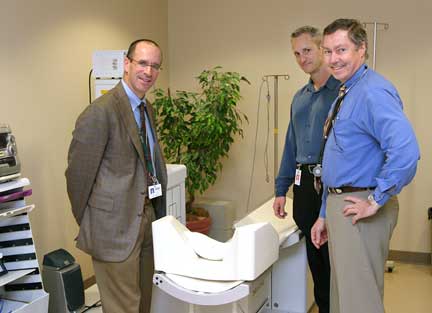
At the official opening of the Oregon Clinic in Gateway, Dr. Lou Libby, MD, Co-president, Chris Roemer, nuclear medicine technologist, and cardiologist Brad Evans, MD, show us their cardiac nuclear medicine camera.
Story and photos by David F. Ashton
A year ago, the ground on which The Oregon Clinic’s Gateway facility now sits was a parking lot for MAX and TriMet.
November 3, staff members, managers, financiers and medical providers at the new facility celebrated its opening for patient care.
Shortly after we arrived, we became reacquainted with Dr. Lou Libby, MD, co-president, chief medical officer of The Oregon Clinic. “We are celebrating this new facility that will benefit the citizens of East Portland.”
Sixty physicians will have moved their practices into the modern brick-faced building. “Until now,” Libby said, “they’ve been crowded, elbow-to-elbow, in cramped offices in different buildings.”
Libby described The Oregon Clinic as a “one-stop clinic” for patients with complex diseases. He said they’re proud that the building is patient-friendly and environmentally sound. And, it’s right on the MAX and TriMet bus lines.
As we toured the building, we stopped in the cardiac nuclear medicine area, and met nuclear medicine technologist Chris Roemer and cardiologist Brad Evans, MD.
“This ‘camera’ is used to evaluate blood flow to the heart,” Dr. Evans told us. “With this non-invasive device, we can see if they’ve had a heart attack, if they are experiencing low blood flow, and see the pumping motion of their heart. It quickly tells us a lot.”
One-stop clinic
The new Gateway facility brings together specialty practices, including pulmonary health, critical care, sleep medicine, cardiology, thoracic and cardiovascular surgery, gastroenterology, and herpetology.
“We have rehabilitation services, such as physical therapy, on-site,” Libby informed us. “The facility also has durable medical equipment suppliers on hand who provide items such as wheelchairs and oxygen systems, in conjunction with Providence Medical Center.”
Completing the clinic are a Providence laboratory, radiology and CAT scan, and MRI and X-Ray services.

Enjoying some of the hospitality at the opening ceremony of The Oregon Clinic’s Gateway facility are Steve Maxwell and Steve Gray of Key Bank, and Dr. Kayleen Shiiba, MD.
Crossroads location important to patients
“This location is ideal for us,” Libby continued, “because Gateway is the crossroads of East Portland. When we looked at relocating many of our practices, we found this location is central to where many of our patients live‚Ķand, it is right where two major freeways intersect, right on the MAX line, and at a TriMet bus hub ‚Äì this makes it easy for patients to get here.”
A commitment to community care
Libby said the founders and managers of the clinic are committed to helping people from all walks of life.
“We’ve always been committed to caring for the Medicaid and Medicare patients. We’ve helped patients without insurance since we began operations twelve years ago. We maintain the philosophy to never exclude patients based on their ability to pay.”

Physicians, service providers, financiers, and dignitaries gather at the official opening of the new Gateway facilities of The Oregon Clinic.
As Libby prepared to welcome those who had gathered at the reception, he told us, “We want to continue to provide excellent service to the people of East Portland. We have some of the best doctors in Portland ‚Äì and now, we have one of the very best facilities in Portland. If you need good medical care, consider the physicians at The Oregon Clinic.”
© 2006 David F. Ashton ~ East PDX News
Amid the blowing rain and water-filled roads, see the story of a driver who felt compelled to help a helpless motorist …

With water up to his floorboards, the unlucky driver in the blue car discovered the penalty of driving through water too deep: a dead car.
Story and photos by David F. Ashton
Most residents of East Portland just stayed inside when while the wind blew the rain sideways, earlier this week.
Fortunately, there were only minor reports of homes damaged by falling trees or flooding during what some called the heaviest rain in a 24-hour period in over a decade.
Low car + high water = dead vehicle
While we were out surveying East County, looking for weather-caused problems, we encountered flooded traffic lanes on Powell Boulevard. Near SE 72nd Avenue, a large SUV hit the water, hydroplaned, and ended up climbing the curb. The only real damage appeared to be the driver’s pride.
When we checked SE 92nd Avenue, about a block north of Powell Boulevard, we discovered that this particular low spot was severely flooded.
We noticed a white Toyota, sitting motionless in the southbound lane of SE 92nd Avenue. Thoughtless drivers of high-riding vehicles plowed past the disabled car, sometimes drenching it with a rooster-tail of rainwater runoff.
“I was at the top of the hill,” its driver, a damp Evan Clothier, later explained; “and I saw a Geo Metro go through the deep water just fine. But my car just ‘died’, and there I was.”
We watched a Jeep drive past the dead-in-the-water compact car slowly. It backed up, and the driver got out. A young man got out, his pants rolled up. He had a long tow strap in hand. He conferred with the driver of the waterlogged car. Within minutes, the Jeep had pulled to Toyota to safety, leaving it in a nearby parking lot.

“Good Samaritan” Larry Cusick told us he didn’t mind getting soaked when he helped pull the waterlogged car to safety.
‘Karma bank’ deposit
We asked the Jeep driver, Larry Cusick, what he was doing out on such a stormy night as was November 5th.
“The bad weather kept us in all day,” he explained, “and we were getting ‘cabin fever’. My girlfriend and I decided to go for a soft drink at the 7-11 Store.”
Why did he stop and get out of his dry Jeep to help?
“Because I figure it is good karma. Someone might stop and help me out someday, eh? They were stuck. I don’t mind. It’s just water.”
Clothier, the rescued driver, said, “What a great guy! I really appreciate this guy’s help. I don’t know him, or anything.”
© 2006 David F. Ashton ~ East PDX News
You may be surprised to learn that Mayor Tom Potter has called for bringing all Portland schools into one district; that he’d like the city’s surplus funds set aside in savings; and, read his promise that he’ll look into ways to limit the growth of porn in Parkrose ‚Ķ

Portland Mayor Tom Potter, a member of the Lions Club, listens to concerns of a Roseway Lion at this October meeting.
Story and photos by David F. Ashton
It isn’t often that the mayor of a major city, like Portland, schedules an address to a civic club.
But, members of the Roseway Lions Club were pleased to hear the mayor deliver a “state of the city” address. And several members looked surprised by his proposal to combine all Portland-area school districts at the October 24 meeting at Steamers Restaurant and Lounge in Parkrose.
Club president, Lion Melinda Palmer got their meeting underway, and Lion Ron Huddleston introduced the mayor.

Lion Ron Huddleston introduces Mayor Tom Potter to club members meeting at Steamers Restaurant in Parkrose.
“Overall,” began Mayor Tom Potter, the city has been doing well.”
Parading Portland’s awards
“We’ve been awarded as the ‘Most Dog Friendly’ city in the US. The ‘O’ celebrated this by creating a graphic, putting my head on the body of a dog.”
Portland was also cited as being the “Cleanest City in America”, Potter added. “We take pride and effort to make sure it is clean, and the most environmental city in the U.S. We have decreased the hydrocarbons by 13 percent since 1990. We encourage people to use public transportation. 24 percent of the city’s power is wind power. In five years it will be 100%. And, we endorse sustainable building practices, like disposing off storm water on-site instead of letting it flow into the rivers.”
Calls for Portland “Rainy Day” fund
Turning to finances, the mayor reported, “We’re in good financial situation. The city has an $18 Million surplus,” he said. “We’re having a discussion on how to spend the money. My hope is that we’ll save some if it for a rainy day. Every government entity needs a rainy-day fund.”
The city’s population is growing, Potter informed the group. Unlike Los Angeles, Portland has grown by five percent while LA has lost by the same percentage. The city has been most successful in attracting those age 18-35, Potter added. “Creative types, like industrial designers and people involved in the arts.”
Wants to help 1,000 homeless
During the past 18 months, the mayor reported getting 900 homeless people off the streets and into permanent housing. But, he added, there are still 1,000 who need permanent homes.
“Most people are not homeless because of what they’ve done. 60% of our homeless have some kind of mental disorder or problem. Some self medicate with street drugs. We’ll be a better city if we can get them off the street rather than letting them wander around.”

Mayor Potter delivering a “state of the city” address to the Roseway Lions club.
Housing prices shift city’s population
Turning to affordable housing, the mayor decried that, for many working people, housing is unaffordable. “What we’ve seen in the past ten years is a migration from inner- to outer-Portland. Many people, including minorities, are moving out to the suburbs looking for housing they can afford.”
Potter pointed out that Portland has six school districts. Only one of these, Portland Public Schools, is seeing a drop in students. He noted David Douglas, Parkrose, Reynolds and Continental are all growing, due to the population shift eastward.
“In these districts, we’re asking for school-building funds on the November ballot. You may not have children in schools, but you did once. Your district needs your support.”
Kids “Bill of Rights”
“My top priority is children. If we don’t take care of our children, they won’t be able to take care of the city in the future.”
The city’s top executive outlined four pillars of his Children’s Bill of Rights:
-
Roof over their head ‚Äì “One major reason children don’t succeed in school is because their families don’t have stable housing. They fall behind when they change schools.”
-
Full stomach ‚Äì “We need to make sure they have enough good, wholesome food to eat. As we’re here [at this Lions Club meeting], we’re eating our lunches. But one in five children will go to bed hungry in Oregon.”
-
Quality Education ‚Äì “Our children need the best education possible to prepare them for life. By helping them succeed at the start of their life, it increases the chance they’ll succeed later in life. From my experience as the Police Chief, I know that when kids graduate from high school, they’re less likely to get into crime or go on welfare.”
-
Caring Adults ‚Äì “During my first year after retiring, I ran a homeless youth shelter. I met the kids who live on the streets. I realized they committed criminal acts to survive. 80% came from abusive families with parents who were addicted to drugs, alcohol and tobacco. They, and their children, had a lot of medical problems. Caring adults give our community good, caring children.”
A city, or a society, the mayor concluded, should be measured by how well they take care of their very young, their very old, and people who can not care for themselves.
Suggests combining Portland school systems
When Mayor Potter asked for questions, a member said he was confused by the “school situation”, asking, “Why are some of our schools closing; yet we’re being asked to pay for a bond to build new schools?”

Members of his audience raised eyebrows and shuffled in their seats when Potter floated the idea of combining all of Portland’s school systems into one. Club president, Lion Melinda Palmer, listens intently.
The mayor explained that Portland has six school districts. “We’re starting talks on consolidating our school districts. [Districts] gaining population need money to build schools. The districts losing students and closing schools need money to pay their teachers. Some facilities close because of age or asbestos; others close because of lack of students.
“We need to cut down on overhead of operations.
“This idea [of school district consolidation] will not go over well with the districts. They are independent political bodies, their boards are elected. We cannot tell them what to do. But we can bring it up before the citizens.”
Mayor vows to ‘look into’ proliferation of adult-oriented businesses
Lion Eileen Stocker asked the mayor why the city can’t limit the number of Sandy Blvd. corridor sex shops.
“The number of sex shops and strip clubs in our neighborhood keeps growing,” Stocker said. “We already have too many, and we’ve just added another one ‚Äì a block away from an elementary school. Can the City Council develop a program to help keep the number of sex businesses from growing? Our kids grow up thinking this it’s normal to have sex shops on every street.”
The mayor said he’d driven around Parkrose before the meeting and observed the proliferation of adult-oriented businesses.
“I agree with you on this. The city did pass an ordinance regulating these businesses, regarding location, signage, and so forth. But, the Oregon Supreme Court threw it out, citing the first amendment of the state’s constitution. They’ve given this wide latitude.”
A member piped up, “Another honor you could add to your list is, I believe, we’re the only city in the country to have live sex acts on stage.”
“You have a good point,” Potter responded. “I will go back and make sure the neighborhood associations are sent up-to-date information about the current law. I don’t know if they can do it or not, but I’ll recommend the License Bureau look into it.”
Meet the Roseway Lions
Interested in being of service to fellow Oregonians? If you live or work in the greater Parkrose area, Roseway Lions invite you to meet them at one of their noon meetings on the second and fourth Tuesday of each month.
You’ll get a great lunch for a reasonable price. They meet at Steamers Restaurant, 8030 NE Sandy Blvd. (east of NE 82nd Ave.).
© 2006 David F. Ashton ~ East PDX News
Although their streets were crowded with motion picture production trucks, neighbors said they enjoyed watching “the stars come out” in Sellwood ‚Ķ

At the intersection of SE 11th Ave. and Marion St. in Sellwood, a crew sets up a motion picture camera next to an “Atlanta Business Chronicle” news box. Wait ‚Äì Atlanta? Yes; this is movie magic in action.
Story and photos by David F. Ashton
A few blocks of east Sellwood became “Hollywood on the Willamette” during the first week in October.
“Into the Wild”, a major studio motion picture, is being directed by Sean Penn, and it stars Emile Hirsch, Vince Vaughn, Marcia Gay Harden, William Hurt and Catherine Keener. The movie is being shot in several Oregon locations, including Astoria, the Cascade Mountains, and yes – even Sellwood.

Marcia Gay Harden stops outside her dressing trailer to give a fan her autograph.
Trucks, trailers, generators and transportation vans clogged SE 11th and 13th Avenues, along SE Marion and Linn Streets, when we visited the movie’s outdoor set.
Frank Hildebrand, a producer of the film, took a moment to speak with us about his project. “I thank the neighbors for cooperating with us; everyone has been extremely friendly. We’re thrilled to be able to make this motion picture here in Oregon.”

Packed with trucks carrying production equipment and supplies, SE Marion St. looked more like a Hollywood back lot than a residential street.
The principal actors were seen only for the brief moments when the cameras were rolling. However, the streets were filled with technical crew members and “atmosphere people”, the local “extras” one sees in the background of some shots.
Brush with stardom
Neighbor Bill Bahrenburg, tipped us off about the production’s location ‚Äì something which producer Hildebrand confided to us he’d wished had been kept secret.
Bahrenburg had a front-row seat; William Hurt’s “star coach” was parked in front his home on the 1100 block of SE Linn St.
“It is pretty exciting,” Bahrenburg told us, “to have a major Hollywood production filmed here in our sleepy little corner of Sellwood. The fact that we can’t park by our house is an inconvenience, but it is outweighed by the opportunity to see the Hollywood machine in process.”

Neighbor Bill Bahrenburg snapped this photo of Sean Penn as the director scurried about his Sellwood set.
It’s not every day that one walks out his front door, he said, and sees William Hurt coming out of a trailer. “Or spots Sean Penn directing a scene just around the corner, or hears Marcia Gay Harden screaming that her wardrobe isn’t in her trailer. It seems surreal. It took them hours to set up a scene that will probably get 10 seconds on the screen.”
An unexpected pleasure, Bahrenburg said, was meeting and chatting with many of his neighbors where were watching the production. “I got to meet so many people I’ve seen when walking the dogs, but never spoken with. This production was good for community building.”

Waiting to be called into action, area resident and “background player extraordinaire” Jennifer Gill is in costume, ready for her next assignment.
Production moves to Reed
When shooting ended in Sellwood, a giant construction crane on the Reed College tipped observers to the next “location” filming. The crane held up part of a set used in the production. What looked like a massive structure from the camera’s point of view was, in reality, a flimsy two-dimensional set suspended from a rope.
Hundreds of students and faculty members from the college served as “extras” on the set of this particular shoot.
Within a day, the crew had moved on. But, the memories left by the production will linger for quite some time, we suspect.
© 2006 David F. Ashton ~ East PDX News
Learn why the director of the state’s largest independent flu shot provider says why you should get your shot now ‚Ķ

Reporter David Ashton heeds the advice of Steve Allred, Nurse Practitioner and Clinical Director of GetAFluShot.com, and takes his flu shot medicine.
Story and photo by David F. Ashton
Ouch! No one likes getting a shot! But medical experts say that the shot’s momentary discomfort can prevent days of illness, or death, when the flu bug comes to visit.
Flu immunization vaccine has been in short supply for the past three years. We checked in with Steve Allred, Nurse Practitioner and Clinical Director of GetAFluShot.com, about this year’s supply.
“Vaccine outlook is good,” Allred told us. “We’ve already received a large shipment, and have launched our community flu shot clinic sessions.”
Both in Portland, and nationwide, Allred said, more vaccine than ever before will be available. “There aren’t the shortages we’ve had to deal with for the last couple of years. Anyone who wants a flu shot can get one.”
We asked about the quality of the vaccine. “We’ve always gotten top-quality vaccines,” he said. “The question in past years has been the quantity. Some of the manufacturers are slow in getting product out. Some providers won’t have vaccine until in November.”
Timing is right
October through December is the best time to get a flu shot, Allred explained. “But, the CDC says even in January, those who are not vaccinated can benefit from having a flu shot.”
Flu shots can be lifesavers
Influenza affects as many as twenty percent of the population every year.
“A flu shot reduces the likelihood of contracting Influenza by 70% ‚Äì 90%,” stated Allred. “Without it, healthy adults tend to be laid up sick for a week or so. Often, they pass it on to their kids, who take it to school and infect other families.”
But people with chronic health conditions, the clinical director said–such as diabetes heart disease–increase risk from complications including pneumonia and meningitis, which can lead to death. “Influenza is a nasty disease that kills about 35,000 Americans every year.”
Allred has studied influenza and vaccinations since the company started providing community vaccinations in the early 1990s, continuing every year. “It varies season by season, but I’d guess we give as many as 80,000 flu shots every year.”
One way to find a flu shot is to check www.getaflushot.com for a clinic near you.
“Regardless where you get your flu shot, do consider getting vaccinated,” Allred concluded.
© 2006 David F. Ashton ~ East PDX News
Look here and you’ll get the story about the Westmoreland Casting and Model Yacht Pond’s restoration. Will the “Milk Carton Races” come back? Read this story and find out ‚Ķ

Neighbors come to see the water spray into the Westmoreland Casting Pond as it fills for the first time in five years.
Story and photos by David F. Ashton
For half a decade, the Westmoreland Casting Pond and Model Yacht Basin was dry.
And, for a time, it looked as if this unique water attraction, on which construction began 70 year ago in Southeast Portland, would simply be filled with dirt and forever lost.
But on September 29, we were on hand to see this historic pond refilled. Neighbors who watched the water spraying into the Casting Pond all said they were pleased, but for differing reasons

When he was a lad of 12, Fred Rigutto says he watched a vacant field being turned into a casting pond by an army of WPA workers ‚Äì and he’s glad it will again be filled with water.
Saw history being dug by hand
“I’d say it was 1937 when I saw them start to dig the pond,” recalled lifelong neighborhood resident Fred Rigutto, as he took a break from his morning walk.
“I must have been 12 years old. It was a WPA project. Some workers would dig, others would shovel dirt onto piles, others put it into wheelbarrows, and others shoveled it into trucks and drove it away. They kept a lot of people working here.”
Rigutto smiled as he recounted seeing the pond filled for the first time, watching casting contests and model boat enthusiasts captain their yachts. “In the winter, they’d drop the water level, it would freeze, and we’d go ice skating. It is truly unique. I’m glad they kept it; I don’t know of another like it in the country.”

Neighbor, and pond advocate, Neal Paddison dreams of running his model watercraft here once again.
Boater’s passionate dream restored
Neal Paddison couldn’t hold back his smile. He said he was born and raised in Eastmoreland, and now lives in Westmoreland, only blocks from the casting pond.
“We formed a neighborhood of people who were determined not to lose the casting pool.” Paddison explains, “I was appointed to the citizens committee working with Portland Parks & Recreation to develop a new master plan for the park.”
But his hobby, Paddison told us, “really, it’s my passion, is building radio- controlled model ships. The Pond is a ‘dream venue’ for model boating. The beautiful park setting, a calm, reflecting pool; you can’t beat it. There’s enough room for electric and steam craft to be running on one side of the pond, and model sailboat clubs to race on the other end.”
From a practical standpoint, Paddison added, the smooth concrete bottom allows captains to safely retrieve distressed watercraft wearing hip waders.
Teddy Roosevelt credited
“When they first lost the water supply,” Paddison related, “they talked about making this historic Portland landmark into a soccer field. The pond was completed in 1939; it will soon be 70 years old. I don’t know of any other urban casting pond, anywhere.”
Paddison said President Teddy Roosevelt was an avid fly fisherman. “We’r e told he personally made sure this particular WPA project would be built here in Portland.”
Rights to transfer water solves problem
“We are filling the pond ‚Äì without drilling a well ‚Äì by transferring unused water rights from Eastmoreland Golf Course,” explained Jeff Milkes, SE Services Manager for Portland Parks & Recreation, as he watched water flow into the pond.
He added, “We had to coordinate with the state fish and wildlife department to assure the whole ecosystem wouldn’t be interrupted by our using water from Crystal Springs.”

This 15 hp pump draws 200 gallons of water from the Crystal Springs creek every minute. In the spring, they’ll install a 40 hp pump to draw out water for irrigation, saving the city thousands of dollars in water bills, and keeping the pond free of stagnation.
Future irrigation use pays for pond plumbing
Because it will be used as an irrigation retention pond, this move will save citizens hundreds of many thousands of dollars in payments for city water, Milkes said, as he introduced us to the park bureau’s irrigation specialist, Mike Carr.
The water is being pumped out of Crystal Springs Creek, Carr said. “We have a 15 hp pumping system with a foot [intake] in the creek. A 4″ line brings water to the new pump station at the south end of the pond. The water is pumped into a 3″ line that takes the water to the north end of the pond.”
The pond holds 2.8 million gallons of water, said Carr. At 100,000 gallons a day, it took less than a month to fill the pond.
In early in 2007, park officials say they’ll install a second pump system that will supply up to 400 gallons per minute to the park’s irrigation system. “We’ll draw from the south end of the pond, instead of using costly city water. During our driest weather, we’ll be able water the entire park in an eight-hour period.”
An additional benefit of this system is, according to Carr, the clarity of the water. “By pumping water in to one end, and out the other, the water won’t have the opportunity to stagnate.”
No ‘Milk Carton’ races scheduled for 2007
“As far as we’re concerned, we’d love to see events like the Milk Carton Races return to the park,” Milkes told us. But it appears it won’t happen this next June at any rate.
Unaware that the Casting Pond was being refilled with fresh water, Rick Jarvis of the Portland Rose Festival told us, “There are no plans to revive the Milk Carton Races because of the efforts being put into the 100th year celebration. We haven’t closed the door for the future; we love have as many community- and business-sponsored events as possible.”
Milk carton races or not, thanks to the dedication of neighbors and the diligence of the parks department, it looks as if a unique Portland landmark is back–to bring visitors to Westmoreland Park for many years to come.
© 2006 David F. Ashton ~ East PDX News
Surprisingly, the neighborhood’s last two tree toppling events haven’t killed anyone or destroyed property. But you may be shocked to read the prediction of southeast Portland’s official tree inspector ‚Ķ

Eastmoreland resident Tim Clark looks at what remains of his American Elm tree that “failed”, taking out all utilities to neighbors on his street.
Story and photos by David F. Ashton
The canopy of elm trees that line the streets of Eastmoreland provide a lush, cool green oasis on a hot summer’s day. When autumn rolls around, the turning leaves brush the streets with rich colors of red and yellow. And, in the winter months, the outline of the branches against the winter sky look like a blocks-long jig-saw puzzle.
But when these trees start to fail, huge limbs fall, crushing anything below them. Sadly, and perhaps frighteningly, such failures of these massive trees are sharply increasing.
On evening of September 20, Tim Clark and his wife were at their home on SE 28th Avenue, between Crystal Springs Drive and Lambert Street.
“I was inside, talking on the phone,” Clark tells us. “My wife steps outside to start her walk and calls to me, ‘Honey, quick! The tree is going to fall down!’ I went out, thinking a little branch was going to fall off the tree.”
100′ tree splits, darkens neighborhood
But, as they looked the elm tree on their lawn, Clark says they could see it was slowly splitting down the middle, making a deep cracking sound.
“I said ‘Run. Run as fast as you can.’ I saw squirrels, a cat and leaves flying as it crashed to the ground. I didn’t know how many other trees it was going to take with it ‚Äì or how many houses or cars it would damage. It was frightening.”
As it turned out, the half of the tree that failed came down, as Clark says, “in the perfect direction, into the street, missing a car by inches.”

Utility workers labor to restore electricity, telephone and cable service to this street in Eastmoreland.
However, the falling giant did snap a utility pole across the street, and missed that neighbor’s home by inches. Crews scrambled to replace damaged electrical feed lines, a transformer, and telephone and cable wires. “We had our lights back on by 10 p.m.,” Clark remembers.
Branches, extending off the standing half of the tree, fully shaded the second story of Clark’s two-story Colonial style home. “Our bedroom is right under those limbs,” Clark continues, “so my wife slept downstairs that night. I slept up there, but not very well, wondering what it would be like if it came down in the middle of the night!”
According to a city arborist, this was one of the largest elm trees in Eastmoreland. After it split, the rest of the tree was found to be unstable; it’s been condemned.
Other Eastmoreland elms split

Two city crews worked late into the night to cut up, chip and haul away the limbs that fell from this Elm on SE Tolman St.
Three weeks earlier, on August 31, about four blocks north, another elm failed. It was on SE Tolman, just west of Reed College Place.
“I came home a little after 6 p.m.,” is the report we hear from neighbor Shay Michael. “We were in our patio and heard what we thought was firecrackers. The cracking sound sounded louder and louder so we came out front and saw the street completely blocked by this fallen tree.”

Clearly visible from the side, one can see where the co-dominant stem on this elm failed. The branches completely blocked SE Tolman St. for most of the night.
This elm failure missed hitting a car parked in a driveway by less than a foot. Surprisingly, there were no injuries or property damage from this incident.
Why great elm trees fail
According to Portland City Arborist in charge of southeast Portland, Ned Sodja, many of these elm trees fail because they have have co-dominant stems. “In other words, it’s like each tree has two or three ‘trunks’ that grow together. But, they’re attached only weakly to one another.”
At the trunk, these “co-dominant stems” are hidden by what he calls “included bark” that wraps around the circumference of the tree trunk, hiding the stems from view. Splitting is not evident till failure occurs.
“Elm trees will always have failures,” continues Sodja. “This time of year, the trees have grown, and opened a full canopy. The summer heat dries out the trees. Then, the added weight of rain causes them to split apart at their weakest point and fail. This winter, if we have any icing, we’ll see more– many more–such failures in Eastmoreland.”
Predicts increasing elm failures, damage
As these trees age, they continue to grow, Sodja explains. As they grow, the weight adds more stress, pressure that tends to rip co-dominant stems apart. Expect to see more trees splitting in the near future.
“In these cases, the damage has been minimal. I’ve seen many vehicles and structures damaged by trees that fail.”
Sodja recommends that homeowners hire an arborist to inspect their trees and get an evaluation of their condition. “If it is on your property, and not the right-of-way, the expense is minimal compared to potential damage caused by a failing tree ‚Äì especially with the size of trees that are in Eastmoreland.”
At the least, the city arborist suggested homeowners start making their own visual inspection of larger trees in their yards. “Especially look at your trees after a big rain storm or wind storm. See any splits or changes? Hear any unusual cracking sounds? Feel any changes in the ground indicating the tree may become uprooted? These are signs of serious potential problems.”
Sodja to the rescue
Many of Eastmoreland’s mighty elms grow on the tree lawns. “If you have concerns about a tree in your right-of-way, call me. I’d rather come out and take a look than be called out to see the damage caused by a falling tree.”
You can reach City Arborist Ned Sodja at (503) 823-4440.
© 2006 David F. Ashton ~ East PDX News
Read this and see why some of the top P.I.R. drag-racers’ jaws drop when this former Datson 1200 silently slinks up to the starting line ‚Ķ

John “Plasma boy” Wayland, the owner of this 100 mph electric dragster, says petro-fueled racers snicker when his battery-powered car rolls up to the line ‚Äì until smokes them at speeds of over 100 mph.
Story and photos by David F. Ashton
We’d never seen a “cruise-in” like this before, at the Village Inn restaurant in the Gateway/Mall 205 area. And this car show ‚Äì featuring a dozen electric cars ‚Äì was drawing quite a crowd.
“We created this event,” John “Plasma boy” Wayland, explained to us, “to raise public awareness about electric cars. We’re showing that electric cars aren’t a fantasy or a dream. They’re real, right here, right now.”
Wayland rhapsodized about the benefits of driving vehicles that don’t run on fossil fuels. “We run on American-generated electrons. I drive an electric car almost exclusively. Why use gas or diesel when you can hum around on electricity?”

This 1921 Milburn, an electric car made in the USA, looked like a horse-drawn carriage, but had been modified to run on batteries instead of horsepower.
Electron-fueled drag racer
Wayland motioned us over to his “modified” 1972 Datsun 1200 Sedan.
“When we go to PIR or Woodburn and roll out to the drag race starting line, a lot of people are surprised to see an electric car,” Wayland told us with a sly smile breaking over his face. “Jaws drop when we run it. We pull up to a standard, fuel-gulping car on the line as they smoke their tires. We glide up silently ‚Äì and then smoke OUR tires. At the green light, my car pulls its front tires off the ground for the first 50 feet.”
After winning a race, Wayland said one of two things happen: Either the opponent is so embarrassed they lost to an electric car, they slink off and go home. Or, they come over, and shake hands, and want to learn more about electric-powered vehicles.

Wayland loves showing off his “ampere-sucking” drag racer while he talks up electric vehicles as a good alternative to gas-powered transportation.
Wayland rattled off his drag racer’s statistics: “The old Datsun had a 69 hp, 4 cylinder engine. Now it is a electronic, wheel-standing electric drag car that does the quarter-mile as fast as a Dodge V-10 Viper. Doing 0 – 60 in 3.2 seconds, it’s pretty quick. In the eighth-mile, no one can touch it. It hits 106 in the quarter mile. Top speed? Unknown!”
An all-electric driver
“This isn’t my regular car,” Wayland confided. “We drive two electrics and one hybrid. Look: Most people do most of their driving in town. Doesn’t it make sense to stop polluting, stop supporting foreign oil producers, and use the great technology that’s now available?”
Want to learn more? See Wayland’s website at www.plasmaboyracing.com, the national site at www.nedra.com, or the Oregon Electric Vehicle Association. www.oeva.org, a non- profit statewide association.
© 2006 David F. Ashton ~ East PDX News
Celebrate a library’s birthday? Look at this article and see GIANT lions invade the main reading room. And, you’ll discover why this mid-county library touches so many lives ‚Äì and how things might change of the library’s bond measure fails ‚Ķ

Midland Library’s 10th anniversary celebration got underway with the help of two fanciful lions from the Northwest Lion Dance Association.
Story and photos by David F. Ashton
The reading room is normally very quiet. But today, a ceremonial drum pounds out a desk-shaking rhythm, waking dozing library patrons from their dreamy reveries on September 16 at Midland Library.
Children gasp and adults smile as two giant, fanciful lions dance their way from the entrance of the library, through the stacks and around the computer tables toward a stage by the ceiling-high windows facing Midland Park.
This joyous chaos, courtesy of the Northwest Lion Dance Association, marks the opening of the library’s 10th anniversary celebration.

Molly Raphael, director of the Multnomah County Library System, came to welcome patrons to this branch’s birthday celebration.
Library director welcomes all
The Director of the Multnomah County library system, Molly Raphael, takes the stage, and tells the throng that it was on this date that the newly rebuilt Midland Library branch was reopened 10 years ago. “The building more than tripled the space of this branch,” she says. The original branch ‚Äì and its entire parking lot ‚Äì would easily fit within the new building, she adds.
The director tells the group that Midland Library is, at 24,000 sq. ft., the largest and the second-busiest branch in the system.
“This branch is a valuable community resource,” Raphael tells us after her brief remarks. “It is located at the crossroads of east Multnomah County. It brings in people from all over the area. And, it brings people together, of diverse backgrounds, to participate in programs and attend community meetings.”
In addition, Raphael adds, it is also a partner to the schools. “Many students come in after school. We have many programs that reach out to young people. And, we offer many great family programs as well. We also serve our older citizens by helping them learn computer skills and other activities.”
Cake and crafts

Before crafting their own crowns in the activity room, Gateway-area residents (and library patrons) Naomi, Amanda, and Hannah Whitlock are enjoying Midland Library birthday cake and punch.
Overseeing the birthday cake cutting ceremony, Branch Manager Carolyn Schell is bubbling with enthusiasm as she tells us, “We’re having a wonderful time commemorating this building’s reopening. Here, we celebrate the diversity of our neighborhoods. This event shows that everybody is welcome to the library.”
Throughout the afternoon, visitors enjoy multi-cultural performances which include a Vietnamese Dance Team, Ballet Popotle performing Mexican folk dancing, and the band Americanistan presenting music from the Middle East. Along with the entertainment, kids enjoy craft time: making crown-like hats to wear and take home.

Sara Cunningham helps Tyler build a birdhouse at one of the Jane’s Park Group tables, in Midland Park behind the library.
Jane’s Park Group celebrates park
A group of neighbors, “Jane’s Park Committee”, helps take care of Midland Park, located behind the library and parking lot. Volunteers, including Boy Scouts from Troop 828, help kids build their own birdhouses.
In addition, committee members display information about the park, and community groups are on hand to drum up support for their efforts.

Girls can hammer too! Gregory Zolp looks on as his daughter, Ashley, builds her very own birdhouse.
Funding concerns
We buttonhole Raphael about what might happen if bond Measure 26-81, a five-year “serial levy”, doesn’t gain voters’ approval.
“Over half the county’s library system funding comes from the current levy, which is about to expire.”
We learn this measure isn’t a new tax, but a vote for continuation of an existing property tax that supports library operations and maintains services.
“Let me put it this context,” the director continues, “think about what would happen if you woke up and found you had just 45% of your income in your house. With less than half of our household income, you’d have to change the way your family lives. This would be a pretty dramatic change. We’ll work with the community, but I can imagine libraries closing, or, or at least, having hours drastically reduced.”
We ask Raphael might happen, specifically, to the Midland branch. “It remains to be seen,” she replies.
If passed, Measure 26-81 will levy $0.89 per $1,000 of assessed value. This means a home assed at $150,000 pays $133.50 per year.
The Midland Library is located at 805 SE 122nd Ave., a block south of SE Stark Street. Be sure to visit Midland Park, located behind the library’s parking lot. For more information, call the library at (503) 988-5392 or visit the library’s website at www.multcolib.org.
© 2006 David F. Ashton ~ East PDX News
The smiles you’ll see on this family’s faces tell the story. Read this story and learn how a group turns low-income renters into homeowners ‚Äì but makes participants work long and hard for the privilege ‚Ķ

Celebrating one of sixteen new homes in Lents is (back row) Steve Messinetti, executive director Portland Habitat for Humanity, new “sweat equity” homeowners Thomas and Luda Le, Bill Goodale; (front row) homeowner’s kids Jasmine and Taylor Le and Carol Goodale. The Goodales are the Le’s Habitat for Humanity “family supporters”.
Story and photos by David F. Ashton
The day for moving in to their new home has been a year in the making for the Le family. And, “making” isn’t a figurative term. We’ve followed the activities of the Le family as they’ve lifted walls, hammered, and painted their home at the newly-completed Portland Habitat for Humanity project.
The coming winter season, foreshadowed by wind-blown rain at the project’s Sept. 14 dedication party, made the Le family all the more eager to cozy into their brand new town home, just off SE 82nd Ave. of Roses in the Lents Neighborhood.
A home built with love
Thomas Le smiled and invited us into his family’s new home on SE Lambert St. He told us he’d been accumulating his “sweat equity” by working on his and other Portland Habitat for Humanity projects since 2003.
“This home is built with love,” Le told us. “A lot of volunteers went out of their way to help us build our new home. Our children will have a place to call home; they’ll have their own rooms. I think it helps children do better in school when they know they have a home of their own.”
“It was fun and exciting,” Thomas’ wife, Lyudmila, confided. “I did hammering, putting up walls, and painting. I feel real ownership. I think we will have a better family life here.”

Young Taylor Le welcomes us into his family’s new home.
Opportunity, not a hand-out
When we came upon Steve Messinetti, Executive Director Portland Habitat for Humanity, he reminded us that only a year ago, the two of us were standing together in a vacant field. “Within days, sixteen families, 65 people, will be moving into their decent homes here. It was made possible by 30,000 volunteer hours, and generous donations of individuals and firms.”
The organization’s mission, Messinetti reminded us, is helping hard-working, but struggling, families move out of substandard housing and into a decent home. “Even more important, they’re buying the home and investing in their futures ‚Äì and the futures of their children. So, the kids that move into this house will have financial stability, and eventually, equity that gets passed on to them.”
It works like this, Messinetti said: All Habitat families put in 500 hours of “sweat equity” toward their home, and purchase their home at cost with a zero-interest, 1% down payment mortgage. Their mortgage payments, based on 25% of their income, pay into a revolving “Fund for Humanity” used to build more homes in the Portland area.
Messinetti said they’re planning to build more houses in the Lents neighborhood; they’re currently negotiating for property. “And, we also received a commitment from the Portland Development Commission to fund the buying of more land in Lents over the next three months, to build ten more houses this coming year. We will build wherever we are able to get affordable land in a decent community.”
Dinner in the rain

Large tents, filling the development’s driveway, kept celebrants dry at the project’s dedication and dinner.
The rain showers and chilly wind didn’t dampen the dedication ceremony for this new housing development. The local owners of Romano’s Macaroni Grill restaurants, “Waterloo Restaurant Ventures”, paid to have huge tents erected in the project’s driveway.
During his brief remarks at the dedication ceremony, Messinetti told the assembly this project came in on time, and $10,000 under budget.

A full, three-course dinner was served, under tents, by the franchise owners of Romano’s Macaroni Grill, and the restaurants’ employees and managers.
More than 200 people, including new homeowners, friends, Portland Habitat for Humanity volunteers, sponsors and donors tucked into full-course hot dinner provided by Romano’s Macaroni Grill.
“Why this generosity?” we asked of Barry McGowen, the CEO “Waterloo Restaurant Ventures”.
“We’re a locally-owned company,” McGowen told us. “We believe it’s important to give back to the communities our restaurants are rooted in. Habitat for Humanity executes their mission well; they bring decent homes to people in our community. I, and the thousand team members we employ, understand this. We’re honored to be part of this great program.”

Habitat for Humanity volunteers Bob Bothman and his wife Jacquie.
At dinner, we sat with Habitat for Humanity volunteers: Civil engineer and retired director of ODOT Bob Bothman and his wife Jacquie. In addition to Portland-area projects, the couple told us they also work each year on projects outside the area, most recently in Kirgizstan, New Orleans, and New Zealand.

Ray Hites, board member of Lents Neighborhood Association
A familiar face present was that of Ray Hites, board member of Lents Neighborhood Association. “In the past, I worked with Habitat for Humanity projects in Portland,” Hites said. “When they came to Lents, I couldn’t pass up to opportunity to help out. It makes homeownership affordable to good people. Given that many people here are low income, I think encouraging more home ownership helps make the neighborhood more stable. Home owners have an investment in the neighborhood.”

New homeowner Thomas Le speaks at the Habitat for Humanity dedication.
Thomas Le was chosen to speak at the dedication ceremony. “I’ve finished [my sweat equity hours], but I still put in a little more time to help others. This is good program. This is wonderful: People, gathered together, with open hearts, building communities. I don’t see this very often. Even though we have different backgrounds, we all help each other like a big family.”
If you are interested in becoming part of the Portland Habitat for Humanity “family”, or would like to become a homeowner under their program, find out more at www.pdxhabitat.org; or call them at (503) 287-9529.
© 2006 David F. Ashton ~ East PDX News


