Discover how a Pacific Northwest boy grew up to command spacewalks and pilot NASA missions to the International Space Station …
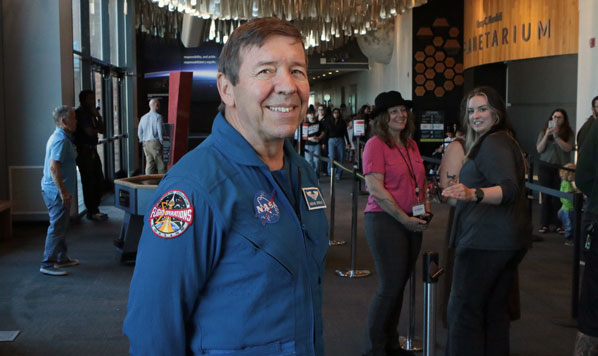
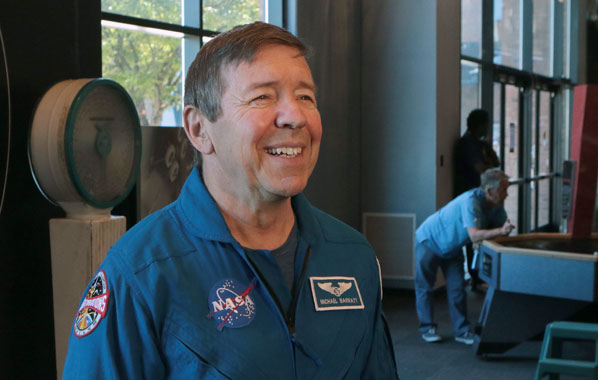
Dr. Michael Barratt smiles as he begins to tell us about his spaceflight career, and his return to his hometown museum, outside the OMSI Auditorium.
Story and photos by David F. Ashton
NASA astronaut Dr. Michael Barratt made a triumphant return to the Oregon Museum of Science and Industry (OMSI) for a free public presentation entitled, “From OMSI to Orbit: Meet Astronaut Dr. Michael Barratt”. Speaking to appreciative crowds across the weekend afternoons of October 3 and October 4 in the OMSI Auditorium, the veteran space traveler shared stories from his lifelong career in spaceflight, and spoke of NASA’s upcoming lunar exploration plans.
Prior to taking the stage, Dr. Barratt stood in the hallway, dressed in his official NASA flight suit, as the audience lined up nearby in front of the Auditorium, speaking with East Portland News to reflect on his deep Pacific Northwest root,s and his lifelong connection to Portland’s science center.
“Being at OMSI is definitely a homecoming for me,” Dr. Barratt shared. “I was an OMSI kid, self-professed. My mom volunteered here. I took classes; I built a telescope; I climbed Mount Hood; I learned marine zoology.”
He remarked that after traveling around the world and into orbit, returning to the hall where his passion for science first took root felt like coming full circle.
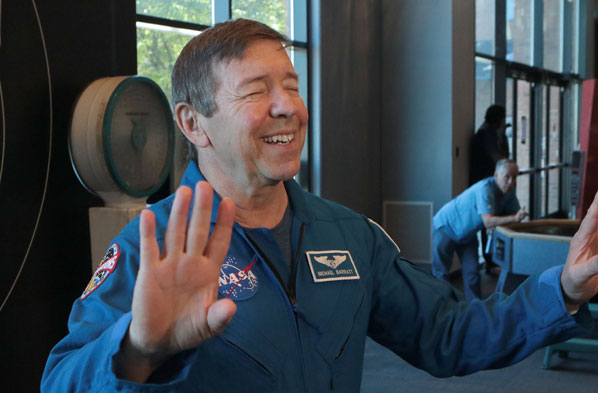
Reflecting on his journey from being an OMSI youth to a three-time space traveler – prior to his presentation in East Portland – it’s astronaut Dr. Michael Barratt.
A distinguished medical and astronaut career
Long before earning his astronaut wings, Dr. Barratt joined NASA in 1991 as a flight surgeon, playing a key role in developing medical operations for the emerging International Space Station program. His early work took him to Russia, where he collaborated with colleagues at the Gagarin Cosmonaut Training Center and the Institute of Biomedical Problems, to build systems and international relationships supporting human spaceflight.
After serving as lead crew surgeon for the first expedition to the International Space Station, NASA selected him for the astronaut corps in 2000. Over his career, Dr. Barratt has traveled into space three times. During Expeditions 19 and 20, in 2009, he helped oversee the historic transition of the space station from a permanent crew of three to six people, while conducting two spacewalks. In 2011, he flew aboard the final mission of the Space Shuttle “Discovery”.
Most recently, Dr. Barratt served as pilot of NASA’s SpaceX Crew-8 mission, launching to the orbiting laboratory in March of 2024, and spending nearly eight months aboard it conducting science and supporting operations.
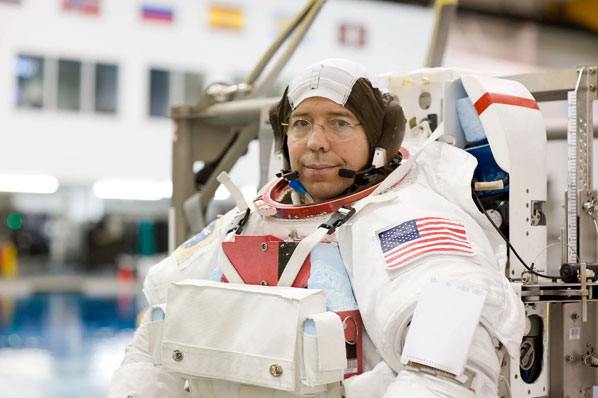
In this NASA photo, Dr. Michael Barratt is suited up, ready for a mission to low Earth orbit aboard the orbiting laboratory.
Living aboard International Space Station
Speaking from his perspective as both a medical doctor and as an astronaut, Dr. Barratt emphasized the vital scientific work taking place high above Earth.
“One of the main things is that we’re still running the International Space Station – which is something I feel very strongly about, as a physician in the life sciences wing,” Dr. Barratt remarked. “It’s incredibly productive, and I was lucky enough to spend most of 2024 up there.”
He pointed out a historical milestone that many visitors often overlook in their daily lives:
“The main thing is that people need to remember there have been people in space continually since the year 2000,” Dr. Barratt observed. “And there’s a lot of people that’ll probably be in the audience today that have never been alive at a time when we didn’t have a permanent human presence at low Earth orbit, doing this amazing science that we’re doing”.
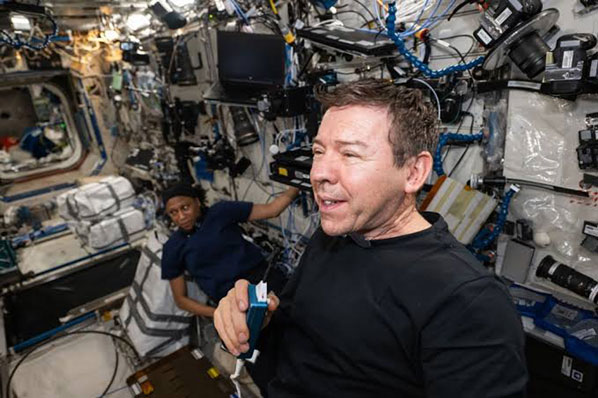
Aboard the Space Station, astronaut Dr. Michael Barratt looks pleased to be conducting life sciences research high above Earth, in this NASA photo.
Looking ahead to Artemis and moon exploration
Turning toward NASA’s future exploration plans, Dr. Barratt detailed the agency’s goal of establishing a sustained human presence beyond low Earth orbit.
“Other exciting things, we’re going back to the moon,” Dr. Barratt outlined. “We’re going to be sending people back there soon, and we’re doing it with an idea of staying, building a lunar base, and really exploring the moon to see what we can find there, and how it’s going to help us explore the solar system.”
Commenting on the test flights of the Artemis program, he described the close personal connection the astronaut office feels toward the new generation of spacecraft.
“Artemis II was huge for us,” Dr. Barratt expressed. “I mean, obviously, these are our brothers and sisters who are crew members. We’ve been watching them for years. We’ve been working on this space capsule for a long time. I think it’s safe to say we have a kind of ‘birth kinship’ with this spaceship. And to see it actually fly, and fly so successfully, was a really big thing for us – but it is a ‘first step’, above all.”
Looking beyond lunar orbit, astronaut Barratt told us: “The moon is a steppingstone to go further in the solar system, and it’s a really exciting time in that path right now.”
When asked if he anticipates making another voyage into space himself, the veteran astronaut revealed that his journey might actually not be over yet. “Well, you know, it’s never up to us to decide whether we get to go back or not, but I am back on active flight status, and I’m fully eligible for another flight,” Dr. Barratt disclosed. “So, it’s very possible.”
Before heading into the auditorium to address the eager crowd, Dr. Barratt admitted he was looking forward to exploring the museum floor himself, after his talk.
“When we’re done here, I really want to look around the museum and see some of the cool things that are going on here now, ’cuz I’ve always loved this place,” Dr. Barratt concluded.
© 2026 David F. Ashton ~ East Portland News™