INCLUDES CONSTRUCTION TOUR VIDEO | Roam inside the emerging Eastside Resource Center, and discover how Meals on Wheels People is reshaping food security and resilience for older adults across outer East Portland …
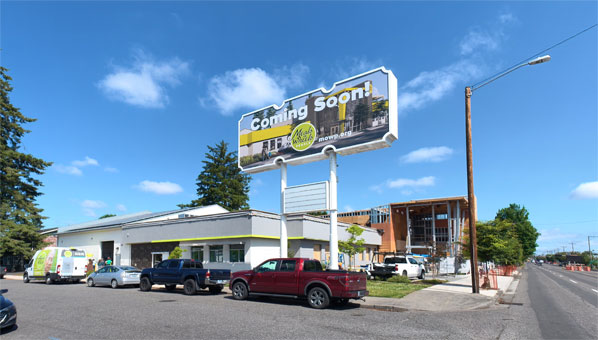
Construction is on schedule at the Meals on Wheels People Eastside Resource Center on SE 82nd Avenue of Roses, across the street from Eastport Plaza.
Story and photos by David F. Ashton
The nonprofit Meals on Wheels People (MOWP) organization welcomed visitors into its future Eastside Resource Center on S. E. 82nd Avenue of Roses, across the street from Eastport Plaza, early this summer. Instead of a typical construction tour on May 27, guests learned how leaders and partners described the facility as a new model for feeding older adults and strengthening community resilience across the metro area.
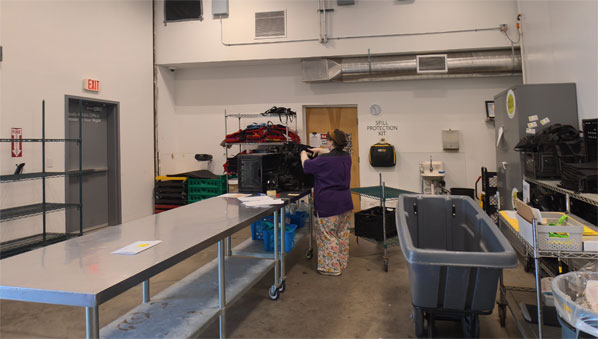
Although the kitchen wasn’t yet up and running, volunteers were packing meals in the completed distribution section of the Eastside Resource Center, still under construction around them.
Although it may not look like it from the street, the center is actually in partial operation – and construction has advanced substantially since East Portland News visited the project on June 26, 2024. To read about that visit, CLICK HERE.
Meals on Wheels People Chief Executive Officer and Executive Director Suzanne Washington welcomed guests to what will become the organization’s hub for East Portland and beyond. Standing inside the unfinished structure, Washington identified the project as the culmination of years of planning and phased construction work that started when MOWP purchased the building in 2021.
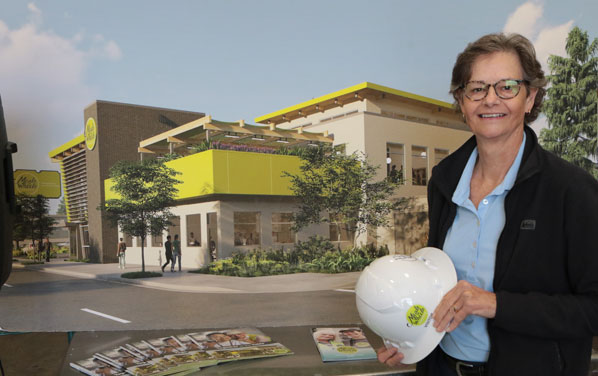
MOWP’s CEO Suzanne Washington shows an illustration of the completed Eastside Resource Center, the outer East Portland site that will serve older adults and the surrounding community.
“We’re at our Eastside Resource Center, still under construction, and it is our new hub for the whole east side,” Washington explained, adding that this new facility will allow the nonprofit to “make sure we feed all the older folks that come and need our help – not only now, but long into the future” – as the region’s aging population grows.
Three phases, one big freezer
Washington walked visitors through the project’s three construction phases. “Phase one” built out the warehouse, including the massive cold storage building that anchors the new hub.
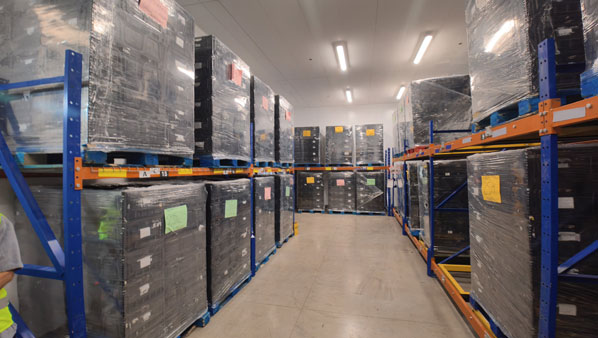
Here’s what 40,000 frozen meals look like inside the massive walk‑in freezer at the Meals on Wheels People Eastside Resource Center.
“The one main freezer will hold 45,000 frozen meals, so it’s big,” Washington told East Portland News, adding that the site will also store tens of thousands of shelf-stable meals.
“Phase two” focused on the Meals for Kids program, a new packing area, and parts of the on-site service space. That included rooms for wellness activities, and partner offices to host health and social service providers.
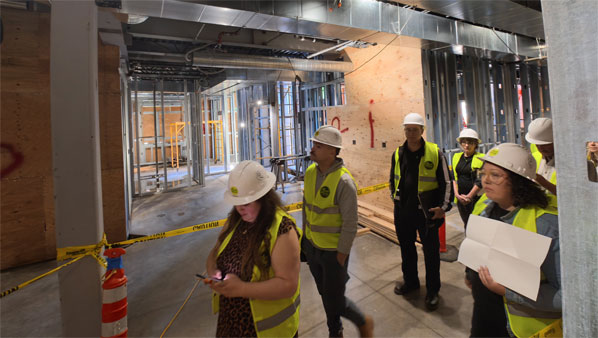
The commercial kitchen is about to be installed in this area of the Eastside Resource Center, where crews are preparing the space to handle large‑scale meal production.
Take a behind-the-scenes tour of this major construction project in our video:
Crews are now in “phase three” – focusing on the dining and service areas, finishing a full commercial kitchen, and building out the north end of the facility. When work wraps up, the roughly 17,000‑square‑foot center is expected to be fully up and running by late October, with operations ramping up by early November
Owning the building lets Meals on Wheels People reinvest in services, Washington remarked. The new hub will allow the agency to retire a diesel truck that currently shuttles meals from the main kitchen in Southwest Portland, and to move out of rented freezer space in Clackamas — savings that can “go back into feeding people”.
Built for everyday hunger, and disaster-ready
Beyond meal delivery, Washington stressed that the Eastside Resource Center is designed as a resilience hub, ready to operate when bridges are damaged, power is out, or roads are blocked.
“If we can’t get across the river, where our main kitchen is, in Southwest, we want to have frozen meals here,” she explained. “We have solar, battery power, a generator – and that freezer holds 45,000 frozen meals. Then we have another 20,000 to 30,000 shelf-stable meals. So if we can’t get across the river, we can keep on feeding people”.
Neighborhood lifeline when the lights go out
In a prolonged outage or disaster, Washington envisions the site opening its doors as a neighborhood lifeline: “We can create a place where people can come in, like a resiliency hub – to charge their phones, charge their cars, get food. We can be here for the community in times of disaster”.
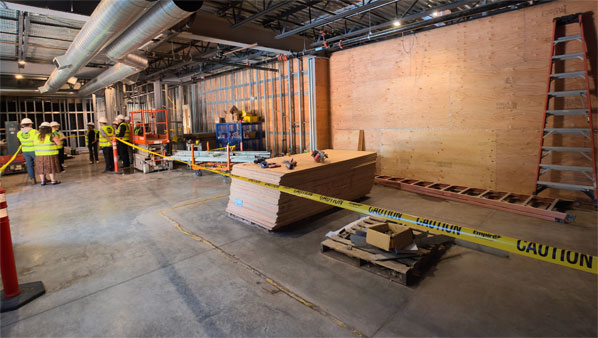
More than serving food, when completed, the Eastside Resource Center will also host visits from health and social‑service partners, who can connect older adults with additional support.
On ordinary days, the Center is meant to be just as connective. Washington described a place where older adults can drop in for a meal and then meet with health and social‑service partners, from the Veterans Administration to behavioral health providers, to local hospital systems offering foot care and other support.
“It’s meant to be: ‘Come in, and there’s all these other things that we can offer to make sure that you’re connected, you’re not isolated in your home, and you can get the help you need’,” Washington emphasized.
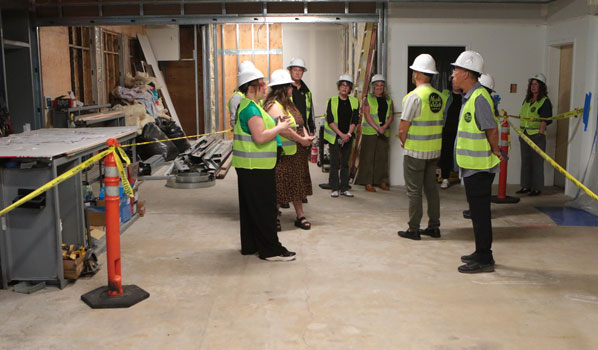
Guests start out on their construction tour of the Meals on Wheels People Eastside Resource Center, getting a first look at the emerging hub on SE 82nd Avenue of Roses.
Listening to community, not just counting meals
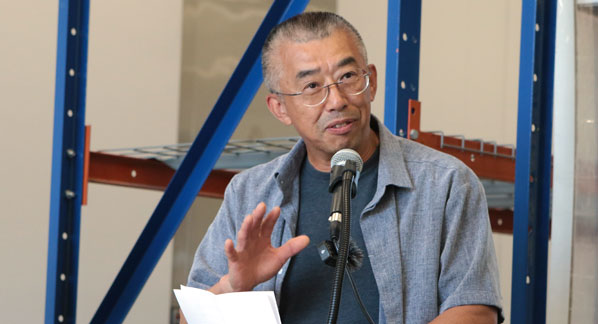
Hongcheng Zhao, President of the Oregon Chinese Coalition, remarked, “If you really want to serve the community, you treat them as your family members”, during the Eastside Resource Center tour.
Hongcheng Zhao, President of the Oregon Chinese Coalition, underscored how cultural factors shape the lives of older adults his organization serves in Chinese and broader Asian communities. Many face “barriers that often go unseen” – from language and transportation challenges to social isolation and difficulty accessing services.
“For immigrants and refugee seniors especially, access is about more than availability,” Zhao observed. “It’s about whether services are welcoming, whether they are culturally responsive; whether people feel seen, understood, and respected, when they walk through the doors.”
Zhao credited Meals on Wheels People for building the Eastside Resource Center with community input, remarking, “If you really want to serve the community, you treat them as your family members.”
State resilience leaders take note
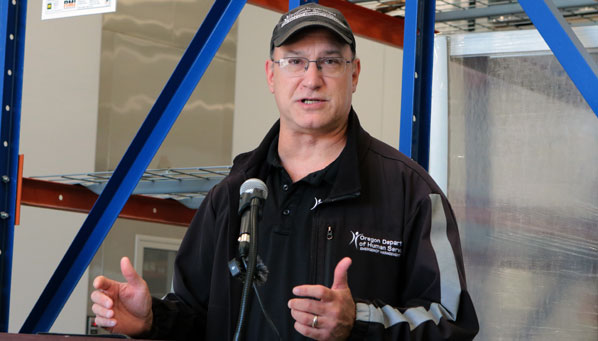
Jeff Gilbert, Emergency Coordinator with the Oregon Department of Human Services, called the Eastside Resource Center, “this beautiful site, this epicenter for resilience”, during the tour.
From the state’s perspective, the Eastside Resource Center is much more than a construction project. Jeff Gilbert, Emergency Coordinator for the Oregon Department of Human Services Office of Resilience and Emergency Management, called it “this beautiful site, this epicenter for resilience,” but emphasized that “it’s the human beings who comprise a system that creates resilience.”
Working across 18 Western Oregon counties, Gilbert looks for groups that know resilience goes beyond handing out meals – it’s “what type of meal is served, the care that goes into that meal, the support, the kindness”. He viewed the new hub as “the shining star on the hill that people can look to for guidance, direction, and a better way to have a vision of making a more resilient Oregon,” and he went on to say that “Meals on Wheels People is becoming this resilient epicenter in Portland.”
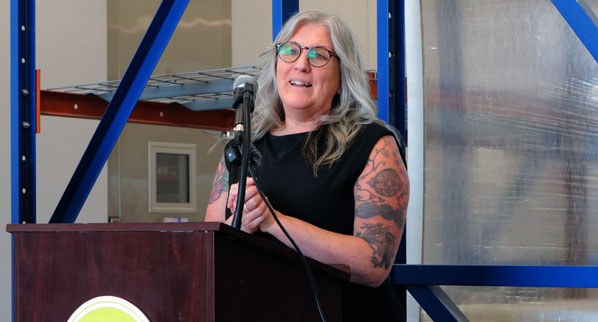
Chris Baker, of Partners for a Hunger‑Free Oregon, explains that true resilience has to be built into real places like the Eastside Resource Center.
Partners for a Hunger-Free Oregon Legislative Strategist Chris Baker said recent crises made one lesson unmistakable: “Resilience has to be built into the systems we rely on. It has to exist in real places with real capacity and real partnerships behind it. That’s what makes this place, the Eastside Resource Center, so significant.”
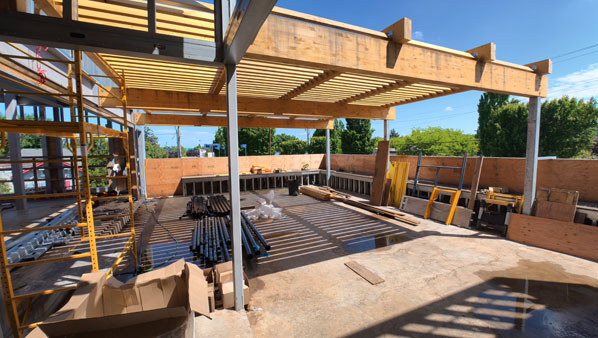
When this second‑floor pergola is finished, it will provide a shaded outdoor gathering space overlooking the neighborhood.
‘We’re almost there’ — and, how neighbors can help
Back on the construction floor, Washington said that one major task remains, as work enters its final phase: Completing the capital campaign.
“We’re 91% of the way in our total fundraising campaign, but we need the help of the community to finish it off… go to ‘mowp.org’ and you can donate. And we also still need volunteers just to get the meals out every day!”
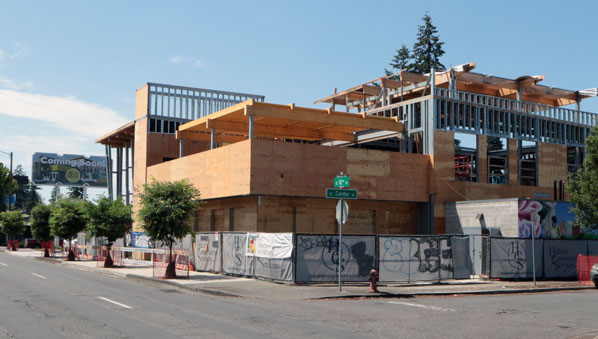
Seen from SE 82nd Avenue of Roses, the Eastside Resource Center is still under construction, but by November this area will be finished, and serving older adults across outer East Portland.
She pointed out that the Eastside Resource Center anchors Meals on Wheels People’s public “Together at the Table” campaign. As of the end of June, early supporters had contributed $24.3 million of the $26.7 million goal. With a challenge from The J.W. & H.M. Goodman Family Charitable Foundation, every one‑time gift or pledge of $5,000 or more is being matched dollar for dollar, up to $1.5 million – doubling support for the Eastside Resource Center and expanding access for older adults.
Details on the campaign, volunteer opportunities and services are online: CLICK HERE.
© 2026 David F. Ashton ~ East Portland News™