
PART 2: City Club of Portland’s ‘Meet Portland City Councilors Series’ in outer East Portland | This week, you’ll read how each of the Portland City Council District 1 Councilors approach the issues of homelessness and housing …
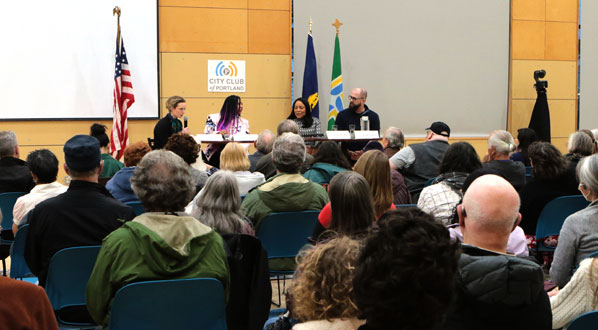
In Part 2 of this series, Councilor Candace Avalos, Councilor Loretta Smith, and Council President Jamie Dunphy share their thoughts about homelessness and housing in outer East Portland.
Story and photos by David F. Ashton
Because there was so much subject matter of interest revealed at the “Meet Portland City Councilors Series” presented by the City Club of Portland at IRCO on Tuesday evening, March 10, East Portland News is reporting the content by topic.
See “Part 1: The Summary” CLICK HERE.
Part 2: District 1 Portland City Council members
present their visions on Housing and Homelessness
At that March 10 meeting, Councilor Candace Avalos, Councilor Loretta Smith, and Council President Jamie Dunphy each offered a distinct perspective on how Portland should respond to housing and homelessness – including priorities on shelters, long‑term housing, and the use of public funds.
In brief: A shared crisis, divergent paths
While all three leaders framed housing and homelessness as urgent crises for District 1, and Portland as a whole, their proposed solutions diverged in their emphasis:
Avalos prioritized long‑term structural shifts, social housing, and public control of land, while questioning the sustainability and effectiveness of large‑scale shelter spending.
Smith focused on budget constraints, opposition to continuing the current shelter funding levels, and redirecting “found” housing funds toward eviction prevention, rent assistance, homeownership, and new projects.
Dunphy centered his remarks on clarifying the respective roles of the city and county, questioning unfunded shelter expansions, and redesigning how public housing dollars are spent and assets are managed.
Candace Avalos: Long‑Term Strategy and Social Housing
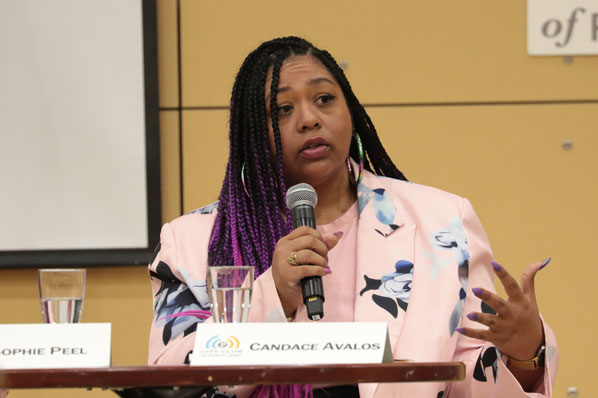
Portland City Councilor Candace Avalos centers her remarks on the need for a clear, long‑term housing strategy and a shift away from relying primarily on short‑term shelter.
Portland Councilor Candace Avalos led off by noting that she Chairs the city’s Homelessness and Housing Committee (transitioning into the Housing and Permitting Committee), with Councilor Jamie Dunphy as Vice Chair.
She said community organizations and service providers have been asking for consistent direction from city leadership: “The biggest thing… I heard was ‘we just want a vision from the council. We want to know exactly what we’re trying to accomplish as it relates to housing and homelessness’.”
Avalos co‑sponsored the Unified Housing Strategy resolution with Dunphy, describing it as a way to bring multiple Bureaus into alignment: “What we did… passing the Unified Housing Strategy… it is fundamental into how we structure this new form of government, and make sure that all of our Bureaus that touch all areas of housing are working together, and we’re setting a strategic vision.”
She expressed skepticism about maintaining large‑scale shelter operations as a primary tool to address homelessness, citing both financial and practical limitations: “I think that it’s just the unfortunate truth [that the shelter model] is just not sustainable from a funding perspective, but also from a ‘solving the problem’ perspective… people… are continuing to end up on the streets. It is only getting worse and worse, especially in East Portland.”
Avalos then drew a distinction between temporary beds and permanent homes: “At the end of the day, what’s more important is a roof over your head than a bed to sleep at night. And that’s the goal that I’m working towards.”
‘The housing market is broken’
She argued that the broader housing system is failing to prioritize people over profit: “The housing market is broken. How we build housing, not just in Portland, in America, is broken. It is dependent way too much on a bunch of rich investors who are trying to make housing just so that they can make more money, not so that people can be housed.”
To address that, Avalos voiced support for social housing and non‑market models, pointing to recent city efforts to acquire land and property: “That is why I co‑sponsored the social housing resolution. That is why I am working on trying to find alternative ways that the government can provide housing, because at the end of the day… we can’t keep doing it this way.”
She continued, “The [Portland] Housing Bureau has bought some properties… trying to take advantage of this market… and try to convert those into social housing in the future.”
Avalos also tied housing stability to protections for immigrant and refugee communities through her Protect Portland Initiative, which seeks to limit cooperation with federal immigration enforcement: “We really needed to make sure that our city employees were protected, that they understood how to engage with our communities and protect them… making sure that we have protocols… that we’re not going to allow ICE to come in and snatch up our community.”
Loretta Smith: Budget Trade‑Offs and Prevention
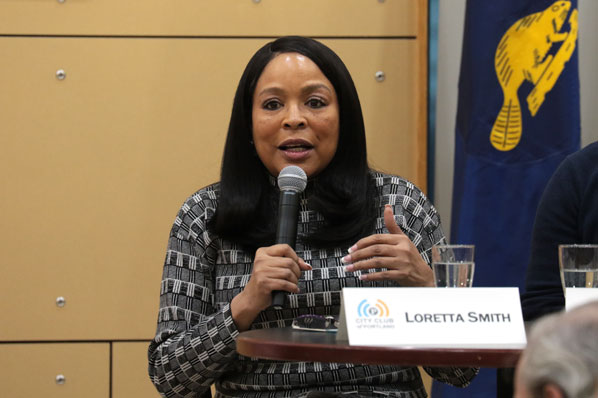
Portland City Councilor Loretta Smith frames the discussion about shelter in terms of budget primacies and exchanges, particularly around whether to continue funding the Mayor’s shelter program at current levels.
Portland City Councilor Loretta Smith said that while she supported some of the Mayor’s efforts through budget amendments in her first year, she does not back an ongoing, unfunded commitment of tens of millions of dollars for a system of city‑run overnight shelters.
Asked whether she would support fully continuing that spending, Smith answered: “No and no and no.”
She argued that the program was not fully funded, and that maintaining it at scale would require cuts to other city functions: “He did not fundraise for all of it… he failed to fund the $15 million that we put in the budget… So, no, we have to make some hard choices.”
Smith expressed concern that the city would need to lay off staff in order to sustain shelter operations she views as under‑utilized: “It is like… $53 million for the overnight shelters. If he identifies $53 million in our bigger budget that he wants to take away… then that might be do-able, but just wholesale putting $53 million in… we have to fire folks from our actual staff who do serve city services so that we can serve people who… quite frankly, the overnight shelter system is not being used to full capacity.”
She added, “Why would I fire my people at the city for people who are service-resisting?”
Concerned about underspent and mis-reported funds
Turning to the controversy over unspent or mis‑reported housing funds, Smith criticized the handling of those dollars, but also described them as a chance to refocus on prevention and stability: “They failed to tell council and the Mayor… that it was against Oregon budget law… violation after violation, year after year… But this gives us an opportunity.”
She said the money should support eviction defense, short‑term rent assistance, homeownership, tenant education, and new affordable housing projects: “We need to put those dollars towards eviction services so people in our communities…who are at risk of losing their housing and being homeless, we can offer short-term rent assistance for folks who are facing eviction.”
Smith continued, “It’s not just $41 million for rent assistance. It is also for home ownership. It is also for tenant education. It is also for building new projects, as well. It’s a mix.”
Jamie Dunphy: Clarifying Roles and Reshaping Public Investment
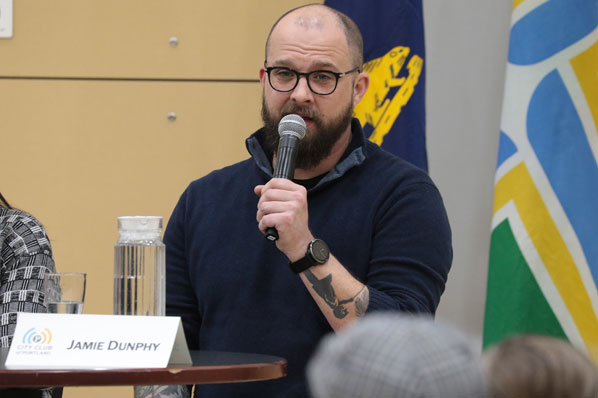
District 1 Portland City Councilor and Council President Jamie Dunphy emphasizes clarifying the respective responsibilities of the city and Multnomah County and reshaping how public housing dollars are structured.
In his response to questions on these issues, Portland City Councilor Jamie Dunphy described the city’s expansion into shelter operations as a departure from past practice: “For years, we have had this relationship with Multnomah County, in which Multnomah County handles homelessness services and the city handles public space management; but we have moved into the extremely expensive world of offering shelter in a system that duplicates what the county already does.”
Dunphy said that when the city increased its shelter work, the county reduced some of its own, leaving the city carrying more of the load: “The county decided, [in effect] ‘Well, we’re facing our own budget cuts, and the city decided to step up their own homeless shelter program, so we’ll just go ahead and cut ours.’ That’s always supposed to have been their job. It was never supposed to be ours, and now we’re left holding the whole bag.”
He called for a reset with county leadership: “We’re actually going to be having a work session with our colleagues at Multnomah County to say honestly, who is on first? What is our responsibility in this, and what is your responsibility in this?”
Calls “sidewalk camping” inhumane
On the topic of shelter operations, Dunphy said “sidewalk camping” is inhumane, but questioned models that provide only an overnight cot without a clear path to housing: “I do not want to put these folks back onto the street. I firmly believe that a tent on a sidewalk is a deeply inhumane place for any human being to spend their time.”
Dunphy elaborated, “At 6 a.m., when they kick those people out of their cot on the floor of a gym, where are they supposed to go? What are they supposed to do for the day? How are they supposed to make it so that they don’t have to be at that shelter again that night? Those questions were never answered.”
Dunphy said he is open to the Mayor’s proposed “shelter to housing continuum”, but questioned how far the city should go in funding and administering it: “We need to have a plan for the people who are in shelter and how they get into housing.” Adding, “Which park are we willing to close, in order to keep the homeless shelters open?”
He also called for changing how the city invests in affordable housing, criticizing past practices in which the city has funded projects but did not retain long‑term control or equity: “At the end of that, the city cuts a check; the private sector goes and builds that housing. We pat ourselves on the back, and we say we made affordable housing, but we have nothing to show for it.”
Lessons learned in Vienna
Citing the insight he acquired from his trip Vienna, Austria, in early September 2025 with Councilor Avalos and District 4 Councilor Mitch Green, Dunphy asserted that public entities should retain an ownership stake or land interest to keep costs low, and to protect long‑term affordability: “They hold on to the asset as a public asset for the long term… They keep the land underneath private housing, so that they can keep costs low.”
Dunphy also said publicly-funded units should not sit vacant for extended periods while there is a long waiting list: “No affordable unit that was paid for with public dollars should sit empty for more than 90 days… Going forward, any contracts that go out must have very explicit terms about how quickly we get those units filled, and how long they can sit empty.”
The moderator for this program was
Willamette Week reporter Sophie Peel.
To learn more about the City Club of Portland, see their official website: CLICK HERE.
© 2026 David F. Ashton ~ East Portland News™


