
PART 3: This week, see what each of your outer East Portland City Council District 1 members are thinking about the City’s budget, and its infrastructure …
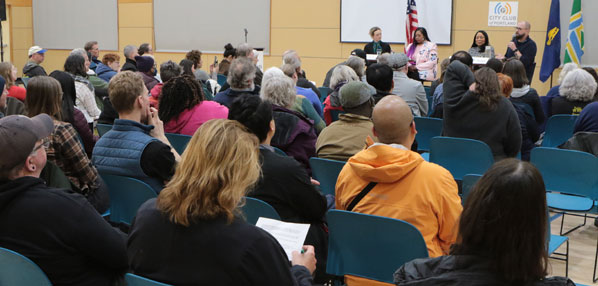
In Part 3 of this series, Councilor Candace Avalos, Councilor Loretta Smith, and Council President Jamie Dunphy share their thoughts regarding the City of Portland’s budgeting and infrastructure in outer East Portland.
Story and photos by David F. Ashton
This week, we continue presenting additional topics about which Portland City Council District 1 Councilors opined on March 10 at the “Meet Portland City Councilors Series” presented by the City Club of Portland at IRCO.
See “Part 1: The Summary” CLICK HERE.
See Part 2: “Housing and Homelessness” CLICK HERE.
Part 3: Portland’s upcoming budgeting session, and infrastructure issues in outer East Portland
At that March 10 meeting, moderated by Willamette Week reporter Sophie Peel, Councilor Candace Avalos, Councilor Loretta Smith, and Council President Jamie Dunphy each offered a detailed look at a part of the city facing pressures, in the upcoming 2026-27 budget – and what some describe as long‑deferred infrastructure needs.
The three spoke before a live audience, fielding questions that repeatedly returned to money, responsibility, and the future of East Portland.
Loretta Smith: Challenging the “budget hole” and pursuing sidewalks; questioning the $169 million gap
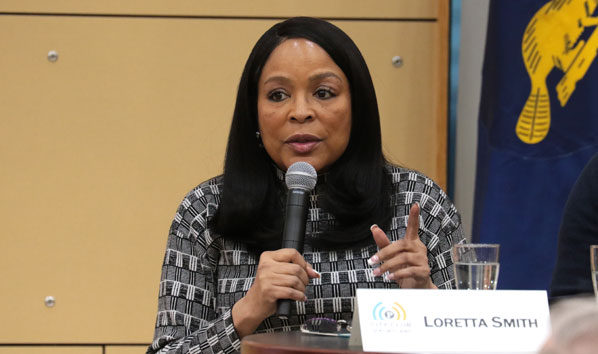
Councilor Loretta Smith comments on the city’s budget and street infrastructure.
As noted in the previous article, Councilor Loretta Smith was openly skeptical of the city’s oft‑cited $169 million budget shortfall, arguing that the number hides what she describes as unacknowledged reserves inside the broader city budget. “I don’t necessarily believe we got $169 million in the hole when we keep finding money all over the place,” Smith said. “They didn’t lose it, they hid it. And so now… I’m trying to figure out exactly how much other hidden money is in other budgets of the 26 Bureaus.”
She said Council debates are too narrowly focused on the roughly $880 million General Fund. “We have an $8.6 billion budget,” she said. “The fight with this Council is only around the 880 million that’s in the General Fund. I look wider than that. I look at the whole 8.6 billion. We are responsible for all the 8.6 billion.”
As reported in in last week’s article, Smith linked that broader lens to housing, saying that newly-surfaced housing dollars should go directly to keeping people housed.
Sidewalks, and “TUF” Fees
Smith returned frequently to basic infrastructure, especially sidewalks. She highlighted her SIP initiative – the “Sidewalk Improvement and Paving Project” – as aimed squarely at long‑annexed neighborhoods that never got promised improvements. “I initially talked about $400 million, and I wanted it to focus on District One and District Four,” she said. “When we were annexed into the City of Portland, we were promised…sidewalks done. And as you know, having safe routes to school…it’s very difficult in some neighborhoods in District One.”
To fund that work, Smith backed a Transportation Utility Fee, or “TUF,” while stressing built‑in relief. “It will fund sidewalks, it will fund paving of streets with potholes,” she said. “There is a provision in TUF that allows folks who make under $33,000 a year to pay a scaled down $12 fee. And it may be [that] they may not have to pay anything at all.”
Candace Avalos: Hard trade‑offs, immigrant protections, and “activation”
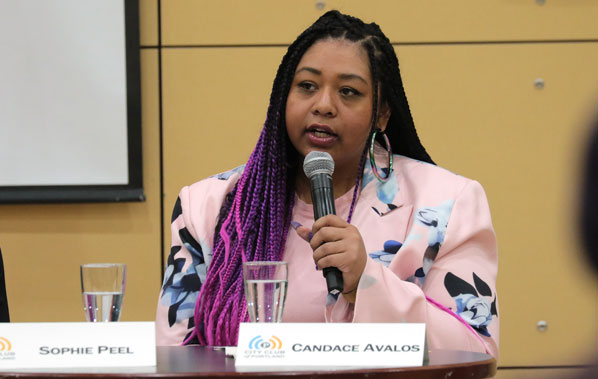
Councilor Candace Avalos talks about “hard tradeoffs” faced in this budgeting cycle.
Councilor Candace Avalos framed the budget discussion as a matter of hard tradeoffs in a small number of big Bureaus. “What’s hard about the cuts is that what we’re really looking at is a couple of particular budgets or Bureaus, right?” she said. “It’s police, it’s fire, it’s parks. That makes up the majority of our general fund dollars… So that’s the reality of where the cuts have to come from.”
Within those limits, she said she will prioritize parks and immigrant protections. “I will be advocating for keeping our parks,” Avalos said. “And I’m going to be putting forward a lot of budget amendments as it relates to immigrant protections. That’s my priority in this budget.”
She tied those choices to the city’s Unified Housing Strategy, arguing that long‑term success depends on housing more than shelters. “At the end of the day, what’s more important is a roof over your head than a bed to sleep at night,” she said. “And that’s the goal that I’m working towards.”
Community space and land for the future
She described hers as a district “craving community space” for families. “Last year I had my first annual D-1 ‘People’s Picnic’,” she said. “I had over 300 people just sign [up for the event] and not even just show up. And East Portlanders are just craving community space to bring their children. We have the most children in the city, and we have the least activities for children in our part of the city.”
Jamie Dunphy: Defining Roles and Pursuing Jobs
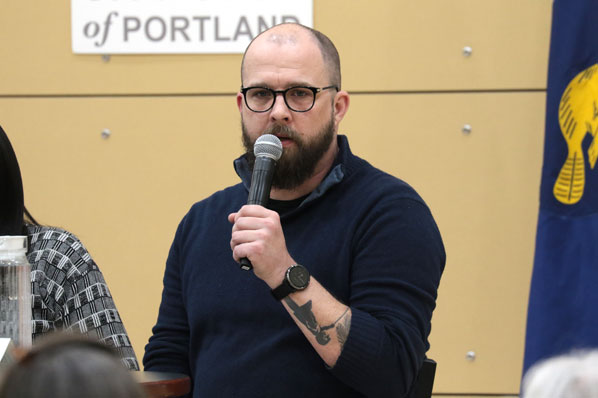
He’s uneasy with flat PBOT fees, Council President Jamie Dunphy says.
Regarding the City’s upcoming budget wrangling, Council President Jamie Dunphy focused on structural questions dealing with funding homelessness services, and the role of Multnomah County, which was covered in last week’s East Portland News article that focused in on that topic.
Dangerous streets and flat fees
On infrastructure, Dunphy recalled a night last year when three people were killed in traffic crashes within about a mile of that evening’s forum site, calling it an example of the stakes of delayed improvements. [See our coverage of the events of that tragic evening: CLICK HERE.]
Dunphy described emergency actions, such as temporary lighting and speed signs, saying they reflected a new “attention and urgency to East Portland … that the Bureau has never done before.”
He said he is uneasy about proposed new flat PBOT funding fees, including the Transportation Utility Fee, but recognized the need for more street funding. “I don’t think that flat fees are ever a good idea,” he said. “Flat fees inherently benefit the richest and punish the poorest… We know that we don’t have streets paved to start out here…we have more gravel roads in East Portland than any other part of the city. I want to know where those dollars are going to get spent…before we’re [turning to] repaving downtown or the West Hills.”
Jobs as a unifying solution
Speaking about economics, Dunphy argued that almost every challenge the district faces is tied to the need for better‑paying jobs. “We need to bring ‘traded sector businesses’ into District 1,” he said, pointing to new outer East Portland tax‑increment financing districts and existing industrial land. “We will not solve any of our problems…if we don’t bring jobs to East Portland. That is an absolute fact.”
He asserted that he sees a missed opportunity connecting outer East Portland’s construction trade unions and local high schools, where many students are unlikely to attend college. “Why do we not have direct relationships between David Douglas High School and the Iron Workers, or Centennial High School and the Teamsters?” Dunphy asked. “We need to make that connection happen.”
The three Councilors, Dunphy mentioned, were planning to convene “regular economic‑development meetings” with other local governments to pursue those opportunities.
In summary
Across the evening, a consistent theme emerged: The City of Portland, and in turn, District 1, is being asked to navigate painful budget choices while still waiting for infrastructure, services, and investment that have long been promised to outer East Portland.
How leaders resolve those tensions may determine the district’s trajectory for years to come.
To learn more about the City Club of Portland, see their official website: CLICK HERE.
© 2026 David F. Ashton ~ East Portland News™


