INCLUDES FULL MEETING VIDEO | Find out why police staffing, homeless services, and neighborhood safety took center stage, at this Lents Neighborhood Livability Association meeting …
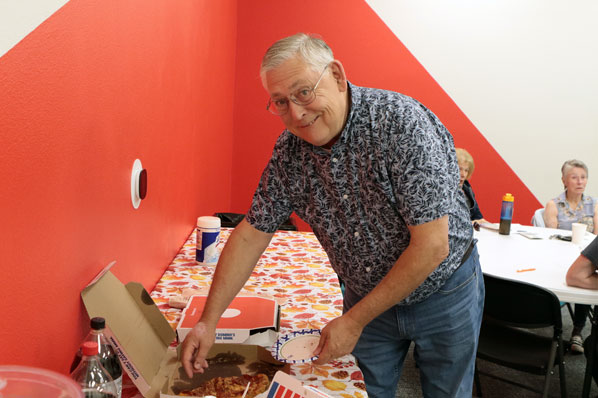
-1 At the pizza buffet, it’s “Neighbor to Neighbor” service group representative Bob Field.
Story and photos by David F. Ashton
Neighbors filled the room, as police cuts loomed
More than 20 neighbors and guests packed the Community Connection Center on Mt. Scott on June 11 for the “Lents Neighborhood Livability Association” meeting. Before the program began, people clustered around tables, shared a pizza supper, and compared notes about crime, camping, and closed stores in and around Lents.
When he arrived, Portland Police Association president Sgt. Aaron Schmautz spoke to East Portland News in a one‑on‑one interview about how the city’s shrinking police staffing and rising crime have begun to reshape daily life for East Portland residents.

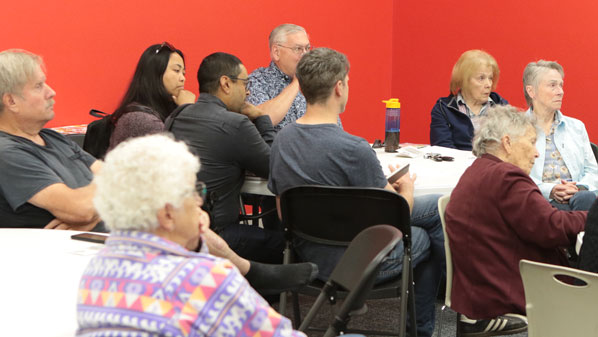
Neighbors fill the Community Connection Center on Mt. Scott for the June 11 Lents Neighborhood Livability Association meeting – focused on public safety and police staffing.
Union president tied store closures to lack of police presence
In our interview, Sgt. Schmautz pointed to a string of grocery store losses as a warning sign for the area.
He recalled the earlier closure of the Safeway at SE 162nd and Division Street in the Centennial neighborhood, then the loss of the Gateway Fred Meyer in Hazelwood – and now the Grocery Outlet Bargain Market was closing. He connected those shutdowns to theft, and the absence of visible police patrols.
With the shrinking of the Portland Police force, “We keep seeing a lack of the ability of police to provide a physical presence, and then continued rising crime,” he observed.
Schmautz told East Portland News he understood the impact on neighbors who depended on those stores for everyday shopping. He observed that public safety problems and theft not only drove up losses inside the stores, but also discouraged regular customers from coming in.
Officers have been warning city leaders for years that East Portland’s distance from downtown, and Portland’s long‑standing under‑investment in services, leave neighborhoods such as Lents and Parkrose more exposed when staffing drops, Schmautz emphasized. “The continuing concern is lack of resources, lack of ability to provide for growth.”
Meeting focused on boosting police staffing
Lents neighbor David Potts briefly introduced Schmautz as the evening’s main speaker before turning the meeting over to him.
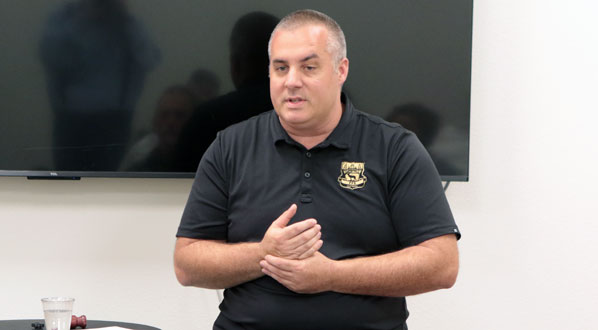
Sgt. Aaron Schmautz outlines how a decade of reductions in the police force leaves East Portland with fewer patrol officers and longer response times.
Schmautz told the room he had been a Portland officer since 2005, and now works full‑time representing officers through the Portland Police Association. He framed his remarks around a proposed ballot measure that would use excess revenue from the Portland Clean Energy Fund to hire and support more officers, rather than raising new taxes for that purpose.
Portland once employed more than 1,000 officers, and now fields fewer than 800, he pointed out, contrasting current staffing with earlier years. Neighbors now experience that shortfall as “way too long” waits for officers to arrive, and “not sufficient” outcomes when they do, he argued.
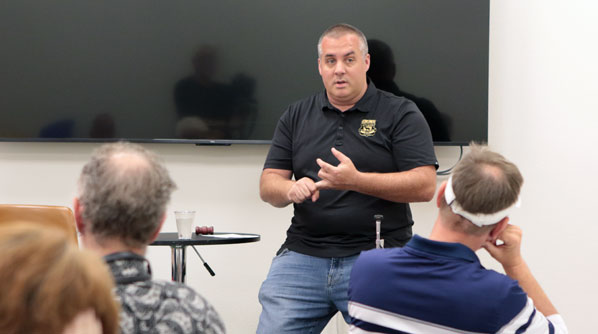
As neighbors listen, Sgt. Schmautz connects the shrinking number of officers to slower responses and fewer proactive patrols in Lents and surrounding neighborhoods.
For East Portland, Schmautz maintained, that capacity gap shows up in fewer proactive patrols, less time for community policing, and slower responses when shootings or serious calls come in east of Interstate 205.
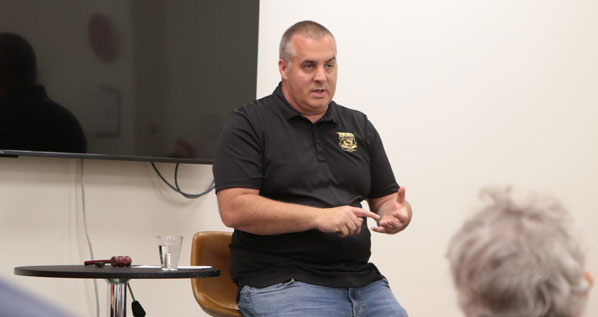
Answering a question from the audience, Sgt. Aaron Schmautz describes what happens on busy nights when there are not enough officers to handle several emergencies at once.
Residents question gaps in crisis response and everyday policing
Residents pressed for details on how shrinking police resources intersect with crisis response, homelessness, and everyday calls for service in East Portland.
- Neighbors asked how “Portland Street Response”, homeless camp clean‑ups, and traffic‑control authority fit into the broader public‑safety network; Schmautz framed police as one part of a system that also includes firefighters, paramedics, county agencies, and outreach programs.
- He underscored limits on Portland Street Response and other crisis teams – particularly in secured apartment buildings, or in situations requiring street closures – and reminded that police are still expected to secure scenes before medical or outreach workers can move in.
- Residents described recent encounters with people in crisis near major East Portland streets and freeway ramps – highlighting worries about safety at bus stops, along bike paths, and around parks.
- On the pending budget, Schmautz outlined cuts he expects to hit overtime and specialized investigative units – as well as the Public Safety Support Specialist program, whose civilian staff handled about 25,000 lower‑priority calls last year, including many stolen‑vehicle reports.
- He warned that the additional reductions will push more work back onto already short‑staffed patrol officers – meaning that when multiple major incidents occur, “one scene will be responded to, and you’ll have to just hold the other scene,” tying up resources for hours.
- For East Portland, he concluded, that could result in even longer waits for officers and fewer neighborhood‑level problem‑solving efforts, just when commercial corridors try to recover from years of vandalism, theft, and vacancies.
Union statement framed cuts as ‘moral’ choices
After the meeting, and once the Portland City Council finalized its budget, Schmautz issued a statement calling budgets “moral documents” that reveal a city’s priorities, and warning that more than $21 million in new cuts will further weaken training, vehicles, overtime, and victim services – leaving Portland with fewer sworn officers than it had a decade ago, despite today’s larger population.
He argued the city had “dug ourselves even deeper” into a public‑safety crisis, and urged residents to back efforts to restore police capacity.
Now, here’s your chance to witness the entire meeting, in this video produced by the Lents Neighborhood Livability Association:
July 9 Lents Neighborhood Livability Association meeting
They’re meeting live in person on Thursday evening, July 9, from 6:30 until 8:30 p.m. A light dinner will be served from 6:30 to 7 p.m.
Join with other neighbors to learn about addiction recovery homeless service providers, at the upcoming July meeting.
At this month’s meeting on July 9th: Hear from and meet the service providers that are helping people get off the street and into treatment. Speakers include Operations Director Andrea Hood from 4D Recovery; Executive Director Billy Anderson with Rose City Detox; and a representative from Multnomah County Homeless Services.
This meeting of interest will be in the Community Connection Center, located on the grounds of New Hope Church at 10603 SE Henderson Street. [Enter through the church’s front doors, turn right, go down the first hallway. Signs will point the way.] For more information, email lnla2018@gmail.com.
© 2026 David F. Ashton ~ East Portland News™