
Learn about the quartet of new ‘fees’ suggested by Mayor Keith Wilson, on behalf of the Portland Bureau of Transportation the the Portland City Council, at the open house in outer East Portland’s District 1 …
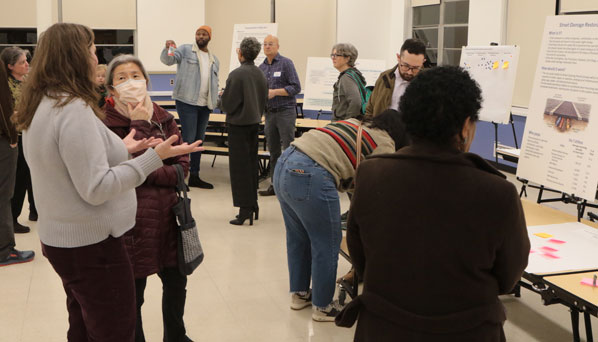
Residents of Portland City Council District 1 arrive at a meeting in the Lents neighborhood, held by the Portland Bureau of Transportation to reveal new “fee” proposals to fix the streets.
Story and photos by David F. Ashton
The Portland Bureau of Transportation (PBOT) is facing a critical funding crisis, with structural deficits projected to reach $27 million over the next two years. With “Fixing our Streets” gas tax revenues flattening, PBOT is proposing up to four new ways to increase revenue and repair streets.
That’s the message put out by Portland Mayor Keith Wilson at a District 1 “Local Transportation Funding Open House”, held on Monday, February 23 at in the Lent Elementary School Cafeteria, attended by dozens of neighbors.
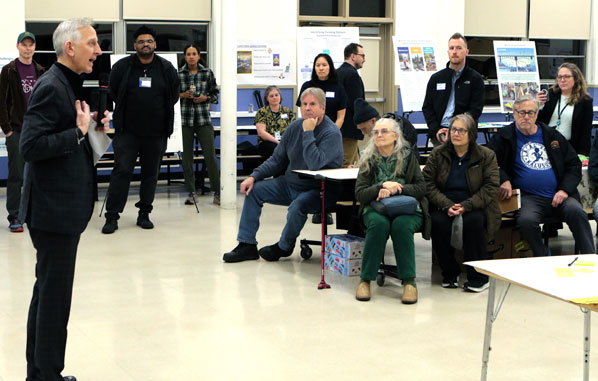
Portland Mayor Keith Wilson declares that “gas taxes are a legacy of fossil fuel”.
“I’ve explained to [the Portland City Council] and others that my goal would be is that we are not going to renew the gas tax,” Wilson proclaimed as part of his pitch. “Gas taxes are old; they’re a legacy of fossil fuel, and we cannot build a new century on last century’s technologies or funding.”
Illustrated on numerous posters at the open house, officials claim that Portland’s “transportation system” is significantly underfunded – and wearing out. Potholes, worn pavement, and unsafe crossings are piling up far faster than the city can fix them, PBOT asserts.
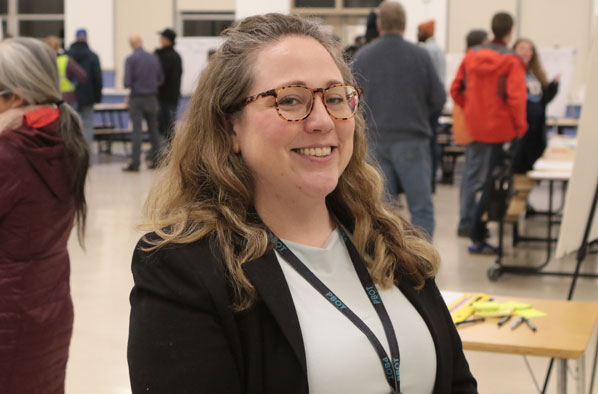
Providing background for the open house is PBOT spokesperson Hannah Schafer.
As the meeting was taking place, PBOT spokesperson Hannah Schafer told East Portland News, “We’re really hoping for Portlanders to gain a better understanding of the challenge that we are facing in dealing with this decades-long problem – one that’s become very hard to ignore.”
At a similar open house, later that week, PBOT Public Information Officer Dylan Rivera told us, “The Portland City Council and the community are expressing frustration that our resources are being diminished by inflation and other factors, and we now have less ability than ever to provide the basic maintenance and safety improvements that everyone expects.”
To close the gap, the city is floating four main ideas:
+ A fee for street use in your utility bill
+ A fee buried in utility and construction permits
+ Two different new fees on deliveries
Never called “taxes” on their website or in meetings, these “fees” were framed as small charges that can add up funding sufficient for street maintenance and safety.
A new ‘street fee’ put in utility bills
Perhaps the most important proposal PBOT calls a Transportation Utility Fee. Unlike the current gas tax, which you pay when you fill up, the TUF would show up on your water, sewer or stormwater bill. This fee has already been adopted by a number of cities and towns in Oregon, including several in the Portland area.
If you’re a renter and your landlord bundles utilities into your rent, you might not see a separate line item – but the cost could still be passed on to you. If you pay your own utility bills, the charge would be there in black and white.
The idea is to treat the street system like another basic utility. In Portland, the money would go toward basics: Filling potholes, resurfacing failing streets, maintaining traffic signals and lights, keeping up sidewalks and bike routes, sweeping streets, and running winter operations.
Early numbers suggest a typical single‑family household could pay something like $6 to $12 a month, depending on the level the City Council picks. Multifamily units would pay less per unit; businesses would pay a percentage of their utility bills. That adds up to tens of millions of dollars a year in revenue for PBOT.
For low‑income households, the city says it could use existing discount programs on water and sewer bills to reduce or waive the fee. But for most people, this would be a new, permanent monthly cost.
Neighbors question PBOT staff about the new fee proposals.
Fees tied to digging up streets
Another proposal would be less visible to you directly, but still matters: a Street Damage Restoration Fee on utilities and contractors that dig up city streets.
Any time a road surface is cut open for water pipes, sewers, gas lines or fiber, the street’s lifespan drops sharply – a even if the trench is correctly patched. City engineers say trenching can cut pavement life by more than 60 percent. In the last three years, the equivalent of 50 miles of streets have been trenched in Portland.
Under this plan, already adopted by Seattle, San Francisco, and Los Angeles, Portland would charge extra when issuing “Street Opening Permits”, based on the size of the trench and the estimated damage it causes. Those doing the trenching would pay this cost.
Depending on how this fee is set, the city says it could bring in from around $7 million to more than $20 million per year.
According to PBOT statics, the top two utilities tearing up streets are the Portland Water Bureau, accounting for 31% of the permits; and the Portland Bureau of Environmental Services with 23% of permits. This means that a bit more than half – specifically, 54% – of the permits are issued to City of Portland Bureaus, not private companies.
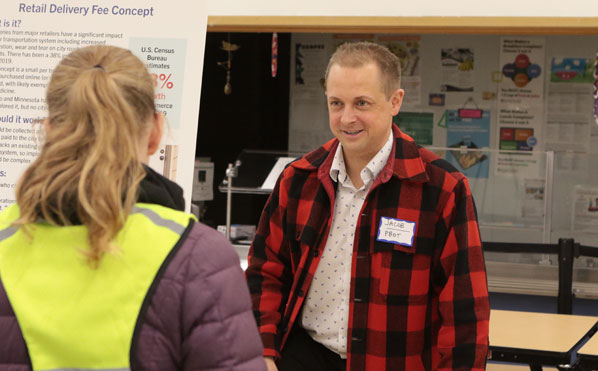
PBOT Analyst Jacob Sherman explains the “Retail Delivery Fee” concept to a neighbor.
New charges on deliveries mulled
The city is also eyeing the way Portlanders shop and eat. Since 2019, e‑commerce has grown sharply, which means more delivery trucks on local streets.
One concept, a Retail Delivery Fee, would add a charge – say 25 or 50 cents – to each retail order delivered from companies like Amazon. The fee would appear in your order total at checkout, collected by retailers and passed to the city.
The City is talking about exemptions for essentials like groceries and medicine and for small businesses below a certain revenue threshold. Still, if you rely on home delivery from big retailers, you’d likely see an additional charge on your receipt.
Draft estimates suggest a 25‑cent fee could cost the average person just over $10 a year, and raise several million dollars for the city. A 50‑cent fee would roughly double both the cost and the revenue.
A similar idea, a Third‑Party Food Delivery Fee, would apply to meals delivered through apps like DoorDash, Uber Eats and Grubhub. Think of it as a “per‑order” version of the fees the City already charges on Uber and Lyft rides. The fee would be added at checkout, collected by the app, and sent to the city.
Using rough estimates of how often Portlanders order online, a 25‑cent fee could raise on the order of $2 million a year, and a 50‑cent fee about twice that. For an individual, that works out to just a few dollars a year—if you order food online and have it delivered regularly, you’d pay; if you don’t, you won’t.
Why the city thinks this will fly
City leaders know that “new fees” – in reality taxes – can be a hard sell. They’re banking on the example of “Fixing Our Streets,” the local gas tax and truck tax package that voters have renewed three times with more than 70 percent support.
Their pitch is that any new money would follow the same rules: Clearly labeled programs (for potholes, paving, safety projects, Safe Routes to School and so on), annual audits, public progress reports, and a community oversight committee that tracks where every dollar goes.
For the average Portlander, the bottom line is straightforward: these ideas would mean paying more, whether on your utility bill, retail deliveries, or app‑ordered meals. In return, the city promises residents will get smoother, safer streets – a “clearer view” of how your money is used.
Extra layers of tax, without a vote
It appears that the new local transportation funding options are intended to be implemented before the current “Fixing Our Streets” 10-cent gas tax sunsets. “City Council is the deciding body on if they will send the [gas tax] measure back to the voters for renewal in 2028,” PBOT spokesperson Hannah Schafer noted.
“The Portland City Council’s Transportation and Infrastructure Committee voted on March 9 to bring an ordinance to the new ‘Committee of the Whole’ on April 2nd for a Transportation Utility Fee and a Street Damage Restoration Fee,” explained Schafer.
However, Schafer didn’t respond to our question if, because these funding methods are considered “fees” instead of taxes, and whither or not the public will have the opportunity to vote on them as they did for the “Fixing Our Streets” tax.
Our Editorial Observations about the Big Picture:
What’s Good, What’s Worrying
What’s Good
More reliable money for deteriorating streets
Together, these fees could bring in tens of millions a year for basics: potholes, paving, signals, sidewalks, bike routes, and winter operations.
Costs spread across more users
Drivers at the pump aren’t the only ones paying. Utility customers, utilities that trench, online shoppers, and app‑delivery users all chip in.
Closer link between use and impact
Those who trench streets pay for repairs. The fee on delivery trucks and food couriers, help cover the cost of street wear and congestion.
A familiar accountability model
The city says new money will follow the “Fixing Our Streets” playbook: clear project categories, annual audits, public reporting, and a community oversight committee.
Some built‑in equity options
The utility‑bill fee can use existing low‑income discounts; delivery fees can exempt essentials like groceries and medicine, and possibly small businesses.
What’s Worrying
In the end, residents still pay
Whether it’s on your utility bill, your rent, your Amazon cart, or your DoorDash order, most of these costs roll down to regular people and small businesses.
“Small” fees can quietly stack up
A few dollars a month here, 25 or 50 cents an order there – across multiple bills and services, it can feel like a slow drip you can’t escape.
Hits lower‑income households harder
Flat monthly and per‑order fees take a bigger share of income from people with the least room in their budgets, especially those who rely on delivery out of necessity.
Transparency depends on follow‑through
Utility fees, permit surcharges, and checkout add‑ons are easy to approve; it’s harder for residents to see exactly which projects they actually bought.
Once created, fees rarely disappear
History suggests “modest” fees tend to stick around—and sometimes grow—long after the original crisis or funding gap that justified them.
© 2026 David F. Ashton ~ East Portland News™


