Now on stage! Step inside a child’s mind as a new Portland play shows how dyslexia can turn everyday schoolwork into a battle – and why so many families see their own stories in it …
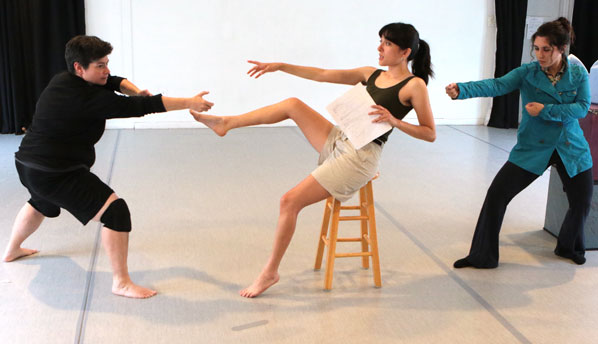
This scene, from a rehearsal of the upcoming play “The Words Will Come”, uses a physical metaphor to show Sheila’s struggle with reading – as Sheila (played by Alex Abdelwahed) is caught in a tug-of-war between Albert Einstein (played by Amy Driesler) and her older self Lala (played by Kelly Saunders).
Story and photos by David F. Ashton
At Performance Works NorthWest, in the Foster-Powell neighborhood, Portland theatre director and Sellwood resident Melody Erfani took time from rehearsing scenes with her actors of her new play for a May 12 interview and photo session with East Portland News.
The rehearsals are building toward the premiere of that new play, “The Words Will Come”, the tale of a child wrestling with words that won’t quite stay put on the page. It opens on June 4 at Shaking the Tree Theatre, running through June 28.
The piece explores dyslexia from a child’s perspective – school, language, identity, and what it feels like when the letters on the page refuse to cooperate.
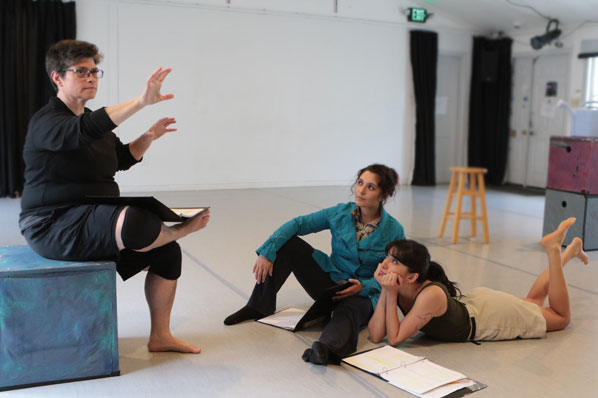
In this moment from “The Words Will Come”, Albert Einstein describes how his theory of relativity grew out of thinking and daydreaming, while Lala gently mentors her younger self, Sheila as they listen.
A family and education story
Erfani built the play around a young student whose experience with reading does not match the expectations of teachers, classmates, or even family members. The script centers on the emotional reality of trying to keep up in class when the basic tools of learning – letters and words – do not behave the way everyone assumes they do.
As she developed the work, Erfani kept encountering the same response: Nearly everyone had a story. Dyslexia affects an estimated one in five people, a number that came to life in conversations after early workshops and readings. “Every time we shared the piece, someone would come up with a family story,” Erfani recalled – parents talked about children struggling in school, and adults recognized themselves in the material, and disclosed that they had never been formally diagnosed.
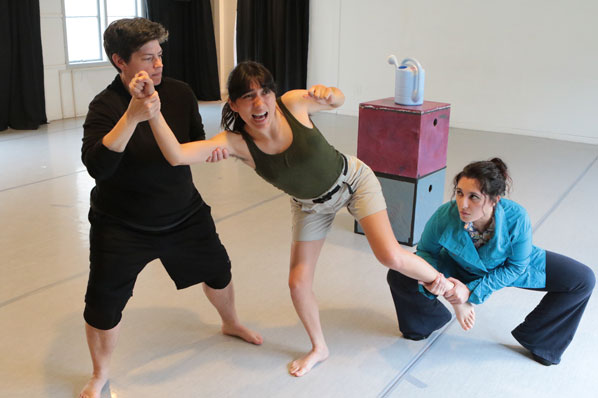
This scene, from a rehearsal of the upcoming play “The Words Will Come”, uses a physical metaphor to show Sheila’s struggle with reading – as Sheila is caught in a tug-of-war between Albert Einstein and her older self, Lala.
Her own connection to the subject goes back to childhood. “When I was young, school was really really hard, and Albert Einstein was kind of an inspiration to me – because I couldn’t be that dumb if the smartest genius was also dyslexic – so that was kind of a hopeful point for me, and it kind of developed from there,” Erfani reflected.
Those responses from the playwright pointed to a broader family and education story. The play mirrors questions that many households face: When should concerns about reading be raised, how do schools respond, and how does a child build a sense of identity when “trying harder” does not fix the problem?
Inside a child’s experience of dyslexia
“The Words Will Come” places those issues onstage, through the eyes of the child at the center of the story. Classroom, home, and imaginative scenes move between humor and frustration, giving audiences a sense of the confusion and pressure that can accompany undiagnosed or misunderstood dyslexia.
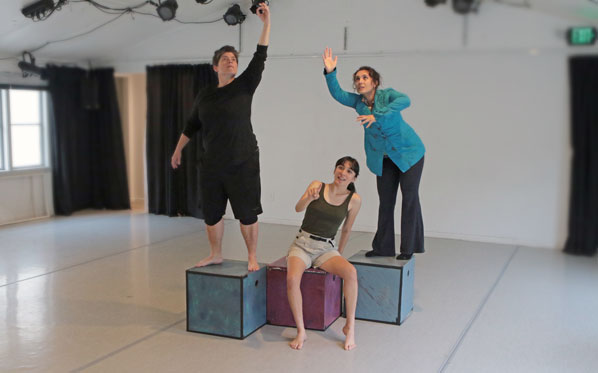
This abstract movement piece in a rehearsal of “The Words Will Come” shows Albert Einstein gazing at the stars, while Sheila is searching for what makes her “her”, and her older self, Lala is shaping the moment as a sculptor.
Although the play is rooted in one child’s story, Erfani frames it as an invitation for families to recognize themselves – and perhaps recognize one another – in the audience. For some, it may echo familiar struggles with homework and report cards; for others, it may offer a first glimpse into why a child, sibling, or parent, has always approached reading differently.
“The Words Will Come” runs June 4–28 at “Shaking the Tree Theatre”, on the northwest corner of SE 9th Avenue and Grant Street. More information and tickets are available online CLICK HERE to go to their website.
© 2026 David F. Ashton ~ East Portland News™