Neighbors, nonprofits, and city staff walk into a community center. The punchline? Plans for more trees, more canopy, more comfort, emerge …
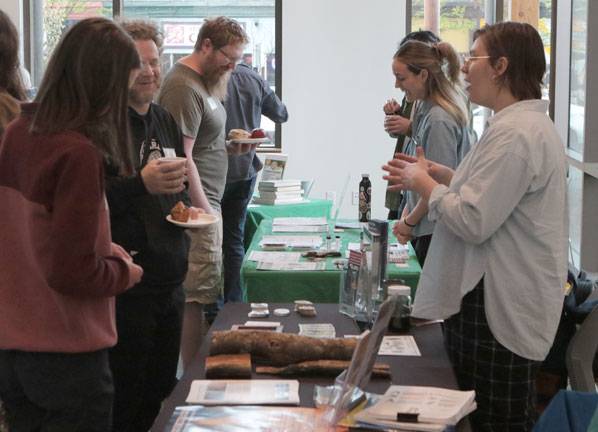
At Tree Summit 2026, professional and neighborhood tree volunteers gather to learn and share experiences about helping Portland’s urban forest thrive.
Story and photos by David F. Ashton
Community members, advocates, and local partners gathered at Mt. Scott Community Center on Saturday, April 11, for Tree Summit 2026 – a free event focused on Portland’s urban forest and climate resilience.
During the three-hour session that morning, participants explored how trees shape neighborhood health, safety, and comfort – especially during extreme heat. Organizers blended research, storytelling, and on-the-ground projects, to show what was working and what was still needed in Portland’s canopy.
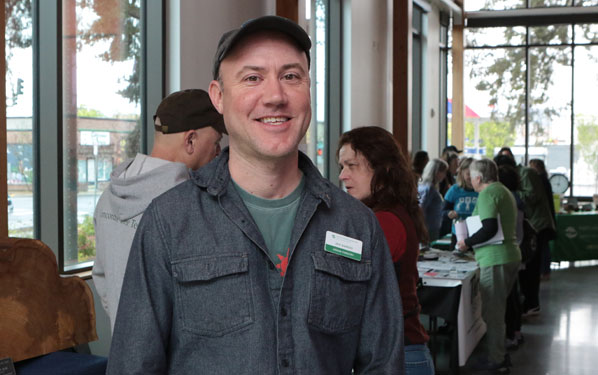
Portland Parks & Recreation Urban Forestry Science and Policy Coordinator Jeff Ramsey welcomes attendees to the Tree Summit.
Event organizer Jeff Ramsey, the Science and Policy Coordinator for Portland Parks & Recreation (PP&R) Urban Forestry, described the summit as both a classroom and a community hub.
“The Tree Summit is an annual event, and it’s free to the public,” Ramsey said. “We bring people out to hear stories of success in the urban forest over the past year, and then we leave plenty of time for connection, so that people who want more trees, more canopy, more shade can come together and organize.”
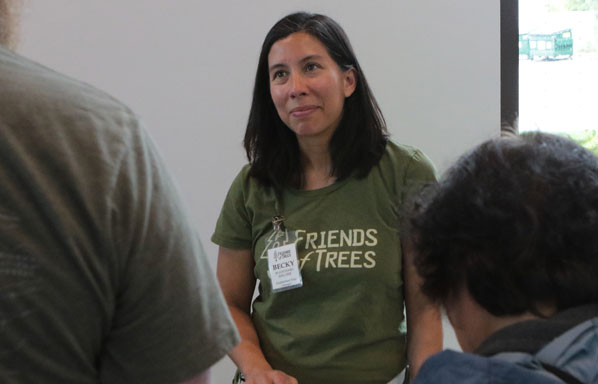
Talking with potential volunteers, here’s Friends of Trees Neighborhood Trees Manager Becky Blanchard.
Roots in a citywide tree inventory
Tree Summit 2026 has deep roots in a large volunteer effort 15 years ago, when hundreds of Portlanders went block by block to catalog every street tree in the city. Ramsey said that work did far more than just tally trunks.
“Over several years with volunteers, we built a full inventory of Portland street trees – trees that shade our walks around our neighborhoods,” Ramsey told THE BEE/East Portland News.
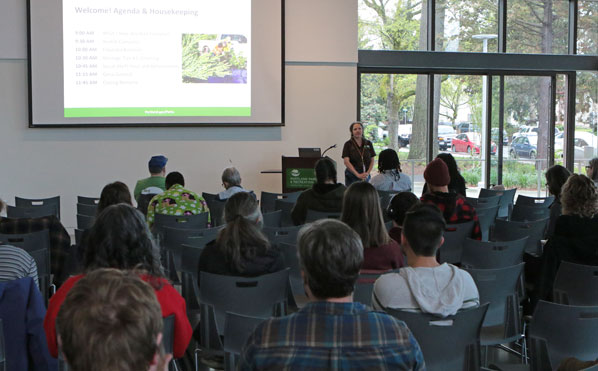
Moderating the morning’s program is PP&R Urban Forestry Botanic Specialist Biz Miller.
That inventory helped the city spot where certain species were over-planted, where new trees were most needed, and how to prepare for pests, disease, and a changing climate. The data has guided decisions on diversifying street trees, planning for hotter summers, and placing shade where it can do the most good.
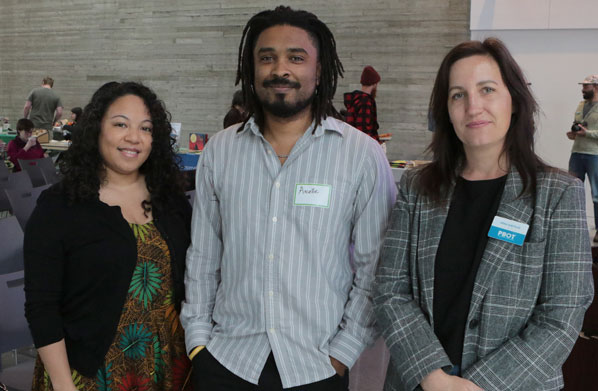
Here’s this year’s Tree Summit speakers: J’reyesha Brannon, Axcelle Campana, and Gena Gastaldi.
Three Presentations: Data, Stories, and Street Trees
This year’s program featured three main presentations that, together, painted a fuller picture of trees, climate, and equity in Portland.
1. Community stories and climate justice
“Canopy of Stories: Pairing Climate Data with Community Voice” was presented by J’reyesha Brannon, a civil/environmental engineer and 2022 Harvard Climate Justice Design Fellow. Her project wove together residents’ stories with data on tree canopy, heat, and health to illustrate how climate change is affecting frontline communities in Multnomah County. “It’s a good window into what all Portlanders are experiencing,” Ramsey said.
2. Equity in the ‘Urban Forest’
In the next session, Axcelle Campana focused on equity and tree canopy in his talk, “Community Forestry as Urban Forestry” – who is benefiting from trees, who isn’t, and how the city might close the gaps. Ramsey described his presentation as a research-driven deep dive into climate impacts and fairness.
3. Trees in the Curb Zone: A practical street project
The final presentation came from Gena Gastaldi of the Portland Bureau of Transportation (PBOT), who presented on, “Trees in the Curb Zone,” a project that partnered PBOT and Urban Forestry to find new locations for trees along city streets – including in parking zones. Ramsey commented, “We’ve been working with PBOT to find more spaces, and actually to look on the other side of the curb from where cars park, and whether or not there’s space on that side to make a cutout and add some space for trees, slow down traffic, [and] make safer routes to school.”
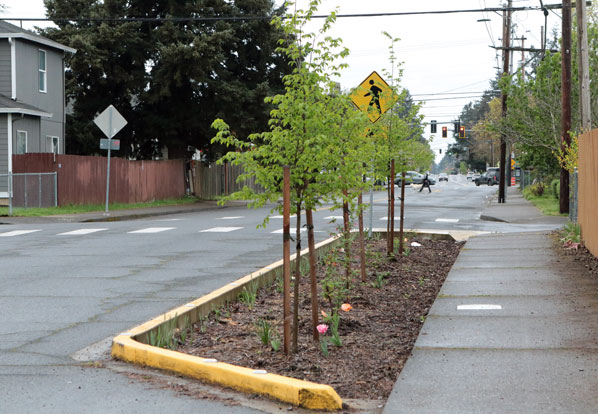
This nearby segment of S. E. Duke Street now serves as a demonstration site for this curbside approach to providing more neighborhood trees.
Social hour and community partners
Before and after the presentations, attendees mingled during a social hour and met with a range of partners and volunteer groups.
Ramsey noted that Portland enjoys “a vibrant nonprofit community” working on trees, shade, and urban greening that gives residents a one-stop chance to connect with organizations that can help them plant, care for, and advocate for more trees in their neighborhoods.
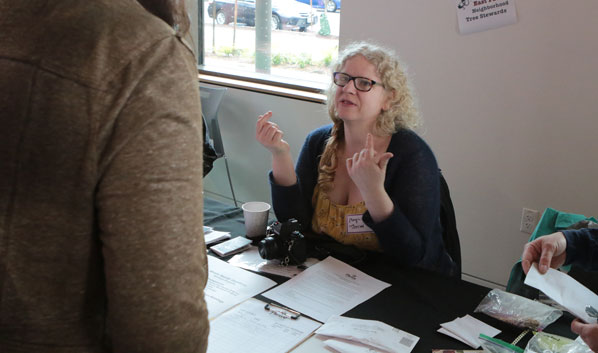
Talking up their program is Morgin Carpenter with Thrive East PDX.
More trees, more shade, more involvement
By the end of the meeting, participants had heard personal stories, examined new data, and walked through real-world examples of how trees can make streets cooler, safer, and more equitable.
As Ramsey put it, Tree Summit 2026 continued to bring together people who “want more trees, more canopy, more shade” across the city.
© 2026 David F. Ashton ~ East Portland News™