
INCLUDES VIDEO PREVIEW | Now, through February 16, discover how Native Americans know and understand their environment – through this exhibition of photos, artifacts, videos, and stories at the Oregon Museum of Science and Industry …
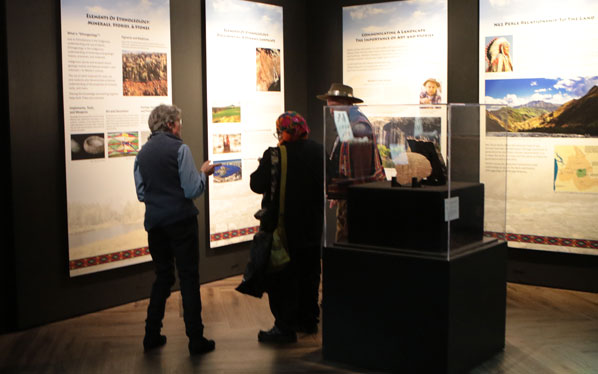
Documenting the rich geological information contained in Native American traditional stories and correlating this with modern scientific data is the focus of the new, limited-time OMSI exhibition called Heads and Hearts: Seeing the Landscape through Nez Perce Eyes.
Story and photos by David F. Ashton
When the Oregon Museum of Science and Industry (OMSI) previewed its newest exhibition – Heads and Hearts: Seeing the Landscape through Nez Perce Eyes – East Portland News was there on January 9 to meet the co-creators of this showcase that reveals how stories told by Indigenous people relate to the land on which they lived, and still live.
Take our brief video tour of this fascinating exhibition:
The Nez Perce people call themselves nimíipuu (pronounced “nee-mee-poo”), which means “the People” in the Sahaptin language. However, French traders mistook these Native Americans for tribes elsewhere with nose piercings, erroneously naming them “Nez Percé” – although the nimíipuu did not actually follow this practice.
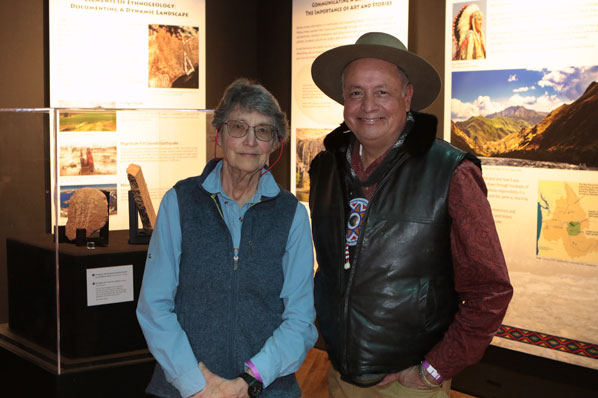
Telling about their exhibition are co-creators Ellen Morris Bishop and Roger Amerman.
“Roger Amerman and I created this exhibit originally for The Josephy Center for Arts & Culture in Joseph, Oregon, and we’re glad to be here at OMSI, able to share the information in it to more people,” co-creator Ellen Morris Bishop began.
“Roger and I are both geologists, and we’re also both artists. I’ve been interested in indigenous stories, and what they tell us about the landscape, for some time. I’ve learned how well Nez Perce traditional stories correlate with geological events and geological materials. So, this exhibit tells some of the stories of the Nez Perce and other Plateau Tribe members in a way that ‘informs the geology’ of their area. This is a subject known as *ethnogeology; it’s kind of like ‘ethnobiology’.”
Her camera was the source for much of the photography seen in these displays, and Roger Amerman did the editing and assembly of the exhibition, Morris Bishop said.
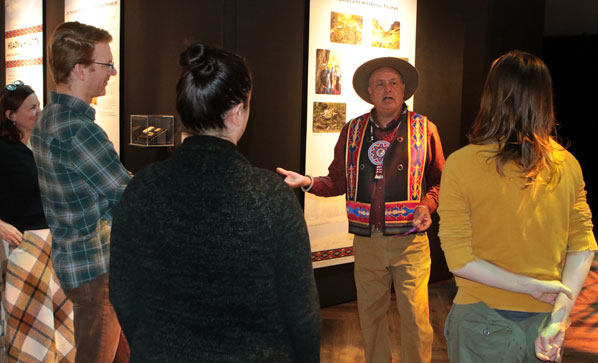
Co-creator Roger Amerman provides guests with an in-depth description of the process involved in creating this exhibition.
“I’m an enrolled member of the Choctaw Native American people, who married a Nez Perce and live on the Nez Perce reservation,” Roger Amerman remarked. “My role in creating this exhibition was to articulate the geology earth science, and merge that with traditional Indigenous knowledge about the photos, illustrations, and artifacts here.
“For example, I was able to access and understand tribal materials, stories, and resources with a much deeper appreciation, thanks to help from my relatives, such as Nakia Williamson.”
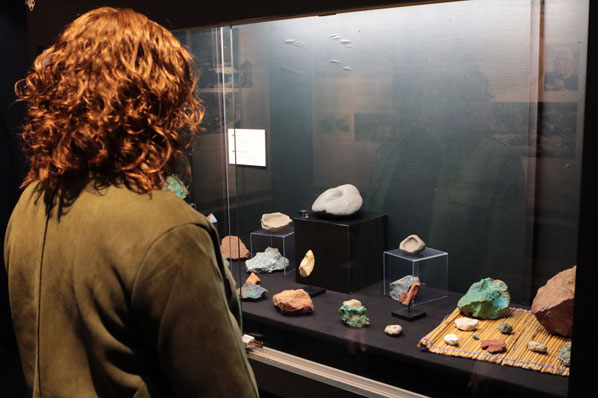
In addition to display boards, cases containing artifacts help illuminate the stories being told.
Being trained in academic mainstream geology, Amerman decried the “obliteration” of the study of Indigenous ethnogeology over the past century.
“There is a rich glossary of words associated with the Nez Perce tribe – words which describe the rocks, landforms, and geography, and how they orally map geological features like rivers and the mountains,” informed Amerman.
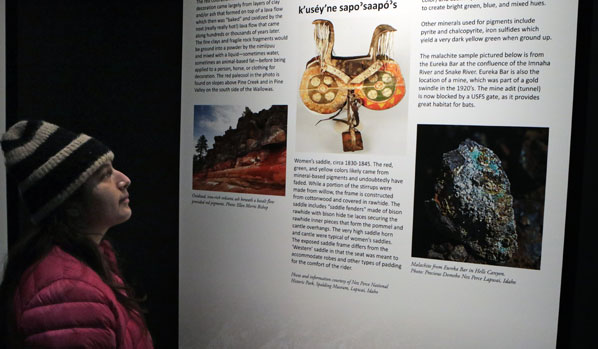
Visitor Jessica Miralrio Miralrio learns how minerals were used by the Nimiipuu to tint clothing and leather.
So, this exhibition invites visitors to experience landscapes, and discover:
Nez Perce, Cayuse, Yakama, and other Plateau Tribes’ stories documented the Lake Missoula Ice Age floods that scoured the Columbia Basin some 17,000 – 15,000 years ago, earthquakes that shook eastern Oregon, interactions with Ice Age animals, and more.
Coastal Tribes witnessed the great subduction zone earthquake of January, 1700, and have preserved accounts of earthquakes for more than 15,000 years.
The Klamath people witnessed and recorded the eruption of Mount Mazama and the creation of Crater Lake in its place more than 7,700 years ago.
“Our hope is that this exhibition is going to open up more questions in people’s minds about the topics covered here,” said Amerman.
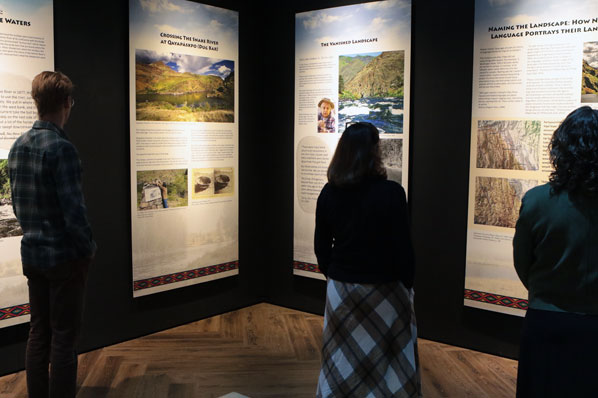
These OMSI visitors are some of the first to discover this new exhibition, on display through February 16.
Heads and Hearts: Seeing the Landscape through Nez Perce Eyes will be open at OMSI through February 16 during regular operating hours, and is included with usual museum admission.
To learn more, see the exhibition’s webpage at OMSI: CLICK HERE.
* Ethnogeology is the scientific study of how specific cultures – especially Indigenous communities – understand, use, and relate to the Earth system, integrating traditional knowledge with modern geoscience methods to create richer, place-based understandings of geology, water, and landscapes.
© 2026 David F. Ashton ~ East Portland News™


