INCLUDES FULL MEETING VIDEO | From personal recovery to political reform: Lents meeting highlights deep divides over Multnomah County homeless spending …
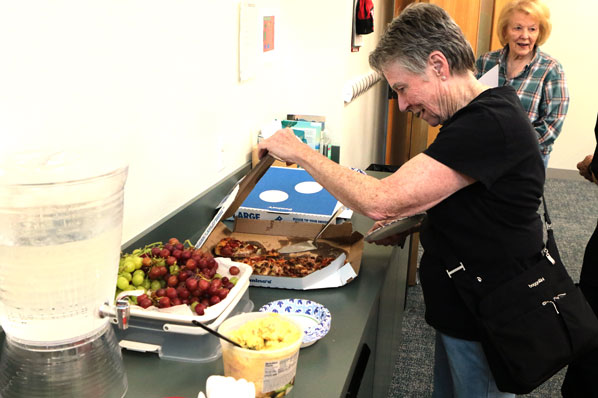
At the August Lents Neighborhood Livability Association meeting, a guest selects items from the buffet during the pre-meeting social hour.
Story and photos by David F. Ashton
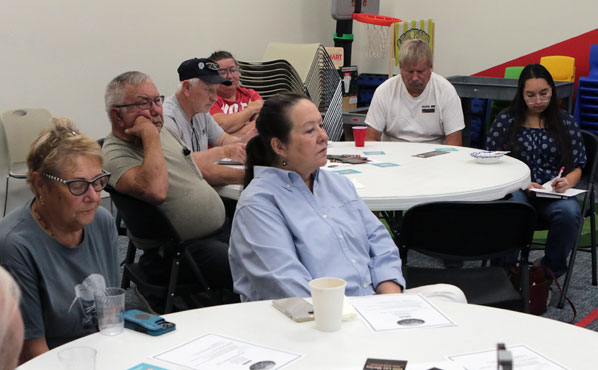
On a smoky but pleasant summer evening in August, approximately 20 neighbors gathered in the community room at the Community Connection Center – for the monthly meeting of the Lents Neighborhood Livability Association (LNLA).
While enjoying a summertime supper of pizza, potato salad, fresh fruit, cake, and ice cream – co-provided by the LNLA, Jenni’s Sacred Grounds, and East Portland News – the pleasantries quickly gave way to the pressing and heavy topics on the agenda.
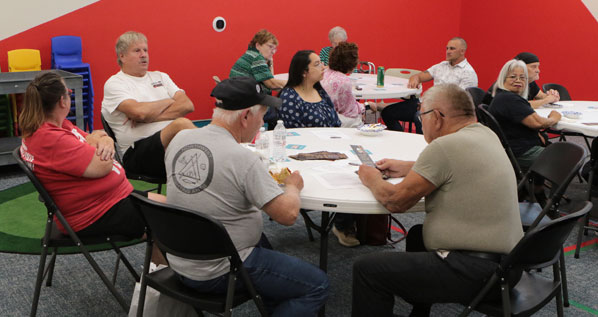
Guests settle in and socialize over a hearty summertime supper and connect with one another, before diving into the evening’s critical discussions.
LNLA Board Member David Potts officially opened the meeting, foregoing any routine announcements to give maximum time to the night’s two guest speakers.
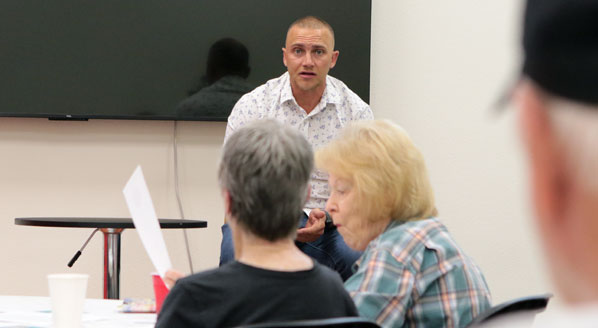
4D Recovery Executive Director Tony Vezina begins sharing his raw personal journey from being a homeless addict, to 14 years of continuous sobriety.
Tony Vezina and 4D Recovery
The first featured speaker, Tony Vezna, co-founder and Executive Director of 4D Recovery, shared his raw personal journey from being a homeless OxyContin addict on Portland’s streets to, now, celebrating 14 years of continuous sobriety as of July 20th.
Motivated to make this change by the birth of his first daughter, Vezina eventually found long-term recovery – and then dedicated the rest of his life to helping other young people find their footing.
Today, 4D Recovery serves 2,000 young adults annually across Oregon, through a three-track continuum: Outreach/intervention, clinical treatment, and transitional sober living. Vezina explained that, in fact, 80% of his staff is in recovery – bringing “lived credibility” to their work.
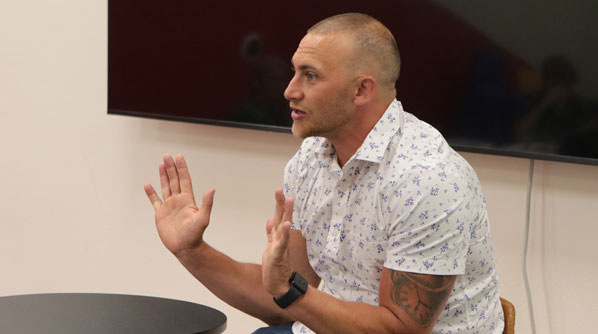
Tony Vezna decries what he calls “toxic empathy” housing.
He critiqued local “Housing First” policies as a form of “toxic empathy” that provides housing but with zero service requirements, turning the housing into a comfortable place to use drugs.
Instead, Vezina advocates for a “Recovery First” paradigm, built on loving accountability and rules:
“Don’t steal nothing. Don’t put your hands on anybody. Follow the rules.”
To learn more, neighbors were encouraged to visit them online CLICK HERE.
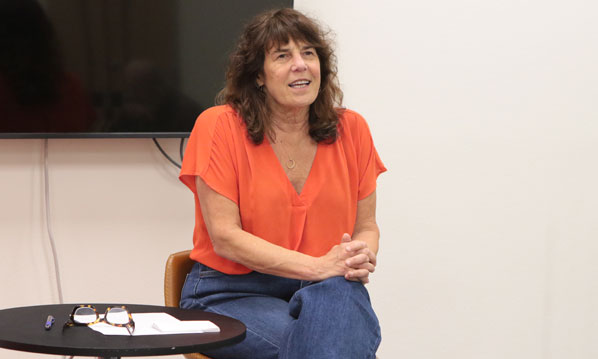
Dr. Sharon Meieran greets guests as she begins a presentation on her campaign for Multnomah County Chair.
ER Doctor’s Diagnosis: Sharon Meieran, on Multnomah County
Next, Dr. Sharon Meieran delivered a searing critique of Multnomah County operations, speaking not as an outside theorist, but as an insider with years of frustrating firsthand experience. Meieran, who served for eight years as a member of the Multnomah County Board of Commissioners, representing District 1 from January 2017 to January 2025, knows the inner workings of local government intimately.
Drawing on her unique dual perspective as a policymaker and an active emergency room physician who provides street medicine directly to Portland’s unsheltered population, she argued that the region’s worsening crisis is entirely a failure of execution, not a lack of taxpayer resources.
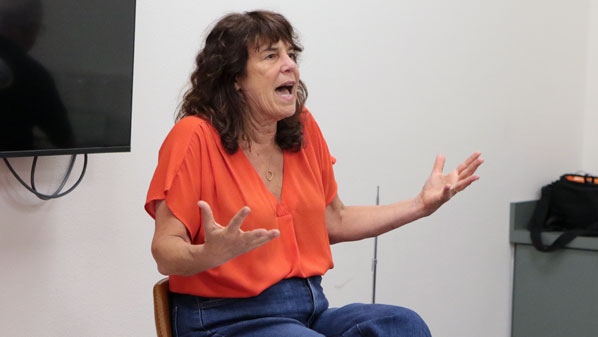
With Oregon placing last among all 50 states and the District of Columbia for overall prevalence of mental illness and substance use, Dr. Sharon Meieran charges Multnomah County with a lack of appropriate response.
Meieran highlighted that Oregon ranks 51st in the nation for mental illness prevalence, driven she says by Multnomah County’s failures. She pointed out that while the county’s homeless services budget grew from $50 million to $400 million annually over ten years, homelessness worsened threefold. She highlighted the failure of the county’s $25 million deflection center, which, according to her, has not successfully transitioned a single person into treatment over its two years of operation.
Her campaign platform, viewable at https://www.sharonforchair.com/, focuses on breaking down county department silos, conducting a third-party independent audit of homeless services on day one, and launching unified data sharing with the city.
What you can learn from this meeting’s video:
This article is but a brief summary of what’s seen in the complete video recording of the presentations and lively Q&A session, recorded and produced by the LNLA. Viewers who watch the embedded presentation – scene below – will discover:
- What is the meaning behind the name “4D Recovery” and its link to Alcoholics Anonymous’s “Big Book”?
- Why a prominent recovery leader argues that Portland’s current housing policies are crippled by “toxic empathy.”
- By how much the county’s homeless services budget grew over a decade as homelessness worsened.
- What the absolute failure of the county’s $25 million deflection center tells us about county-level metrics.
- How a staffing dispute held up by the county chair delayed critical ambulance dispatch times.
- How to strategically use Portland’s new ranked-choice voting system to protect your ballot.
Looking Ahead to September 10th
Lents neighbors are invited to attend the next LNLA meeting on September 10th from 6:30 to 8:30 p.m. at the Community Connection Center (located on the grounds of New Hope Church, 10603 SE Henderson Street; enter through the front doors, turn right, and go down the first hallway).
Join neighbors at the September 10 LNLA meeting and meet Oregon gubernatorial candidate Christine Drazan, who will share her vision for Oregon.
A light dinner will be served from 6:30 to 7:00 p.m. This month, neighbors can hear from and meet gubernatorial candidate Christine Drazan “for Oregon”. For more information, email lnla2018@gmail.com.
© 2026 David F. Ashton ~ East Portland News™