Find out why outer East Portland’s Portland Police Bureau East Precinct calls 2025 a “generally positive” year – even as “person crimes” climb; and, find out what’s next, as Portland Police prepare for a $20 million budget hit …
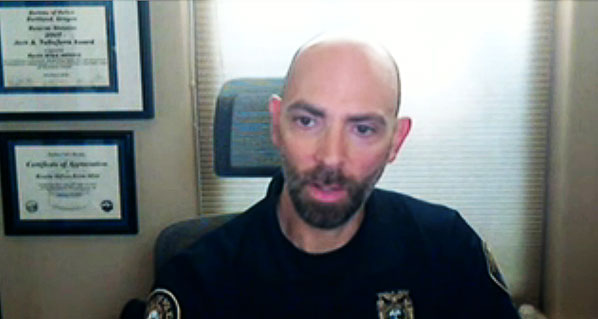
Starting and moderating the online East Precinct 2025 annual report presentation, it’s Portland Police Bureau Public Information Officer Sergeant Kevin Allen.
Story and photos by David F. Ashton
The Portland Police Bureau’s 2025 Annual Report presentation for East Precinct unfolded online on Wednesday evening June 10th – giving East Portland neighbors a dense but candid briefing on crime trends, staffing, and a steep budget shortfall coming in 2026. Facilitated by Sergeant Kevin Allen, the virtual session walked attendees through the citywide numbers, before focusing on East Precinct’s progress and pressure points.
Homicides down, property crime dips, person crimes up
Chief Bob Day opened by thanking residents for “engaging with Portland Police Bureau”, and framed the report around three main goals: Improving the relationship between officers and the community; reducing crime and fear of crime; and strengthening the police organization.
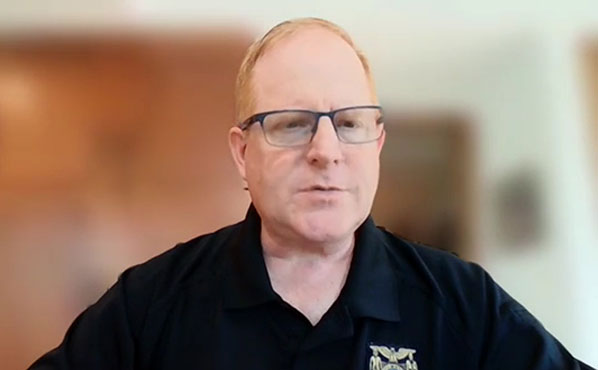
Portland Police Chief Bob Day talks through 2025 crime statistics during the East Precinct annual report presentation.
Citywide crime trends in 2025 painted a mixed but generally improving picture, according to Chief Day:
- Overall reported crime stayed roughly flat. and fell to its lowest level since 2016.
- Property crime decreased about 3%, with reductions in burglary, car prowls, motor vehicle theft, robbery, and vandalism.
- Shoplifting did climb by about 4%, but that increase was far below the 50% jump in 2024 and the 88% spike in 2023.
- Portland recorded 52 homicides – a 24% decrease from 2024.
- Firearm-related homicides dropped 35% – to 36 killings involving guns.
- Investigators cleared about 65% of homicide cases – with 34 arrests.
“These are really significant numbers that we should all be proud of,” Day told participants, describing the progress as “a community-led effort” that leans on partnerships in some of the city’s most marginalized neighborhoods.
The gains came with a tradeoff. Reported “person crimes” increased about 7% – roughly 684 more incidents – driven largely by simple assault and intimidation. That’s up about 10%, with 574 additional reports. Day acknowledged that tension: The most serious violence moved downward while less severe “person crimes” climbed.
Drugs, overdoses, and traffic safety
Drug enforcement ramped up after House Bill 4002 recriminalized drug possession. “Society crimes” rose 42%, largely because drug offenses nearly doubled. Investigations focused on fentanyl, with officers seizing 75 illegally possessed firearms and large quantities of fentanyl, methamphetamine, cocaine, and heroin – often with federal and regional partners. Overdose deaths dropped in 2025, which Day linked in part to those efforts and to harm‑reduction work by health agencies.
Traffic safety numbers also improved. 46 people died in Portland traffic crashes in 2025 – still too many, Day stressed, but fewer than in recent high-fatality years. Grant-funded missions concentrated on speed and impaired driving on high-crash streets that had been identified by the Portland Bureau of Transportation.
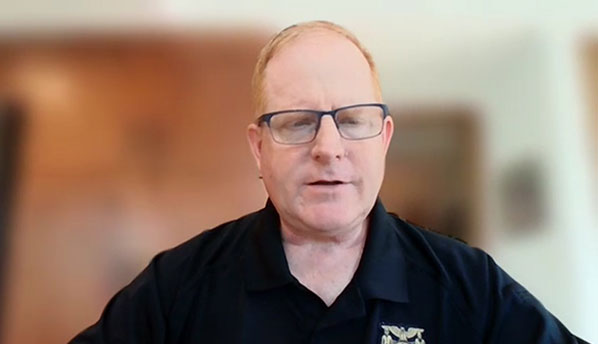
Portland Police Chief Bob Day outlines use-of-force figures, and explains who officers stop, during the 2025 annual report presentation.
Use-of-Force, stops, who gets pulled over, and why
Day spent part of the evening on two hot-button topics: Use-of-force, and who officers stop.
In 2025, Portland officers handled more than 221,000 dispatched calls, and created another 72,000 on their own.
About 14,000 people were taken into custody in 2025, and non‑deadly force showed up in roughly 3% of those arrests. Most of that involved low‑level “de minimis” force – such as guiding someone, or putting on handcuffs. Day argued that any force “deserves the highest level of scrutiny”, pointing to internal investigations, outside reviews, and a 14‑day deadline for releasing body‑camera footage after deadly-force incidents.
Officers also made more than 25,000 traffic and pedestrian stops last year, with almost half of all driver stops happening in East Precinct. Nearly all of them were for traffic violations, mostly speeding and license‑plate problems.
To check for racial bias, analysts used a “veil of darkness” study comparing day and night stops. Their review, and a separate analysis by the Oregon Criminal Justice Commission, both found no racial or ethnic group over-represented in 2025 stop data.
“Consent searches” now come with more guardrails: Officers must clearly tell drivers they can refuse, and hand out cards in five languages explaining that consent is voluntary, and can be revoked at any time.
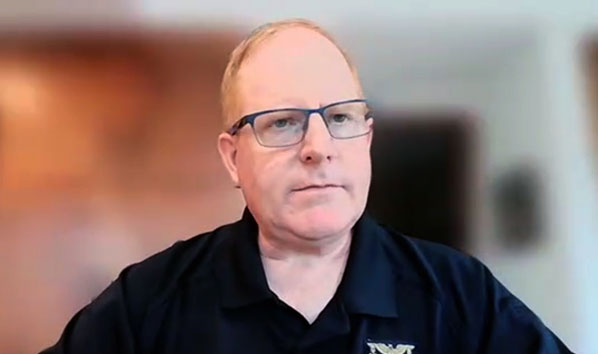
Telling about how “staffing, long a sore spot”, finally ticked up in 2025, Chief Bob Day highlights new hires and a larger academy class during the online presentation.
Hiring progress faces a sharp budget hit
Staffing, long a sore spot, finally ticked up in 2025. The Bureau hired 72 sworn officers and 36 professional staff, while 45 sworn members left the Bureau, for a net gain of 27 officers. Day highlighted stronger diversity and language skills in the new ranks, and pointed to a 22‑member academy class in September – Portland’s largest in more than 25 years.
Day underscored training as “one of our highest priorities” – describing advanced academies, annual in-service cycles, and public safety support specialist training that put hundreds of officers through recurring sessions.
Even as staffing edges up, the Bureau faces what Day called “one of its most difficult fiscal years in recent memory.” He expects about a $20 million budget shortfall in the next cycle, after Portland City Council efforts to restore funding fell short.
The cuts are likely to mean:
- Layoffs or reductions among professional staff
- Significant reductions in training
- Deep cuts to overtime which could remove 20,000 or more officer-hours from precinct work
“We can’t take a six and a half percent cut and not have to say ‘no’ to some things,” Day told the online audience. Still, he argued that recruitment trends, crime reductions in key categories and strong partnerships leave the Bureau “trending in the right direction.”
East Precinct: ‘generally positive’ trends and mission work
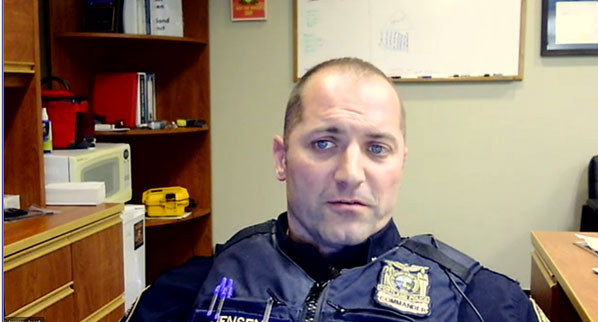
East Precinct Commander Jake Jensen takes over the presentation to walk East Portland neighbors through local crime trends and “special mission” work.
When East Precinct Commander Jake Jensen took over the presentation, he grounded his portion in local context – East Precinct serves about 40% of Portland’s population across 18 full neighborhoods, and partial areas of six more – from Gateway and Hazelwood to Lents and Powellhurst-Gilbert.
Patrol coverage depends on 97 deployable officers and 14 public safety support specialists across shifts, Jenson explained.
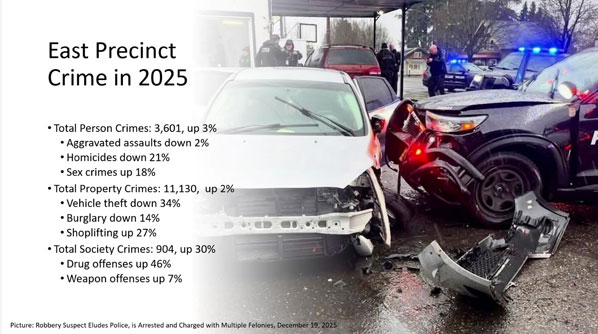
This Portland Police Bureau presentation slide outlines 2025 East Precinct crime statistics – including declines in vehicle theft and shifts in “person crimes”.
Jensen characterized 2025 crime trends in East Precinct as “generally positive”, even as some categories rose. T
he standout success came in vehicle theft:
- 2023 saw about a 20% decline
- 2024 dropped more than 40%
- And, 2025 brought another 34% decrease, down to about 1,100 stolen vehicles, from 3,500 in 2022
“Vehicle theft is now at or near historic lows,” Jensen told viewers, adding that early 2026 numbers continue to edge down. East’s increase in “society crimes” largely mirrors citywide patterns tied to renewed drug enforcement after HB 4002.
To explain how those changes take place on the ground, Jensen summarized three main mission types: Retail theft operations, crime suppression missions, and stolen vehicle operations (SVOs). The work leans heavily on partners, including the Multnomah County Sheriff’s Office, Gresham Police, the District Attorney’s office, and community groups such as PDX Stolen Cars.
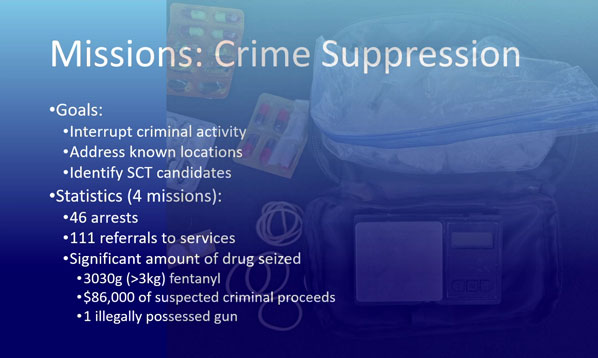
This graphic outlines the goals and objectives of crime‑suppression work in the Portland Police Bureau’s East Precinct.
Retail theft missions brought arrests, recovered merchandise, and search warrants for suspected fencing locations. Crime suppression efforts – often using the Service Coordination Team – targeted open-air drug markets and high-complaint corners. In one collaborative mission, officers seized about a kilogram of fentanyl – an effort Jensen credited in part to Assistant U.S. Attorney Scott M. Kerin, whom he called “the linchpin” of regional coordination.
The SVOs, now recognized by the International Association of Chiefs of Police, use license-plate-recognition trucks and “enrichment factors” to locate more stolen vehicles with fewer traffic stops. Jensen emphasized that ALPR data is owned by the City of Portland, accessible only to Oregon law enforcement, is only retained for 30 days, and is regularly audited.
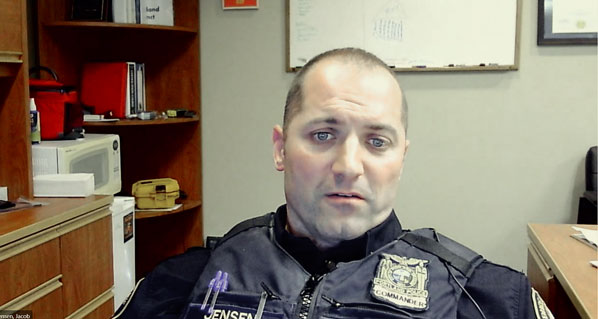
East Precinct Commander Jake Jensen offers “office hours” that invite neighbors into the precinct’s community room to share concerns and solve problems.
East Precinct “Office Hours” and mentoring the next generation
Jensen also highlighted precinct-level outreach. East Precinct hosts weekly Tuesday “office hours” from 1:30 to 2:30 p.m., when he or a ranking supervisor meets directly with neighbors in the precinct’s community room to hear concerns, and commit resources when possible. [CLICK HERE to see our story about one of Commander Jensen’s “office hours” sessions last year.]
“We’ve had a ton of success collaborating on solving problems big and small,” he told participants – adding that he expects “service quality over service quantity” from officers, despite ongoing staffing strain.

Acting Captain Robin Dunbar describes how she orients new officers in East Precinct, from Portland’s street grid, to expectations for respectful community‑focused policing.
Acting Captain Robin Dunbar described how East Precinct applies the same community‑focused approach to orienting new officers. When academy backlogs left recruits in limbo, she built a local orientation that covers Portland’s geography and 500‑block grid, radio use, chain of command, and expectations for engaging residents respectfully. Dunbar estimated that she has already run at least 60 officers through the program.
“I still, after all these years, love being a police officer,” Dunbar told the online audience, and wanted new hires to feel connected to “the profession they’re stepping into”, not just the paperwork.
Balancing cuts, crime drops and community ties
As the evening wrapped up, Chief Day tried to balance caution and confidence. “Too much optimism blinds, and too much realism paralyzes,” he reflected. The Bureau now heads into a year of fewer training opportunities and less overtime – but with a record of four years of declining gun violence; vehicle theft near historic lows in East Precinct; and a workforce that, he argued, increasingly resembles the city it serves.
“We are part of this community,” Day concluded. “It’s not the police and the community. We are part of this community, and we look forward to continuing to serve each of you to the best of our ability.”
© 2026 David F. Ashton ~ East Portland News™