INCLUDES CONCERT VIDEO HIGHLIGHTS | Discover how an all-volunteer orchestra brought 250 years of American music to life in outer East Portland, just in time for our country’s 250th birthday …
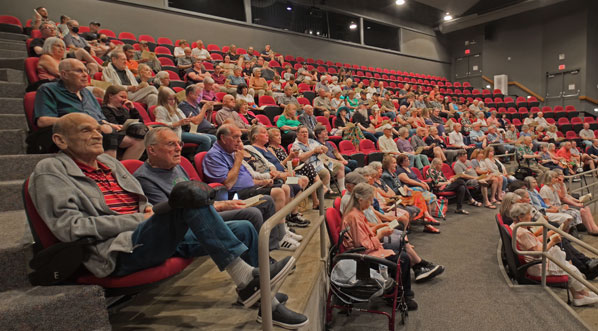
The audience in the Howard Horner Performing Arts Center is there for the “250th Birthday Celebration – 1776 to 2026” concert by the all‑volunteer East County Community Orchestra.
Story and photos by David F. Ashton
On Sunday afternoon, June 14th, the all-volunteer East County Community Orchestra presented a free “250th Birthday Celebration – 1776 to 2026” concert at the Howard Horner Performing Arts Center at David Douglas High School, in the Hazelwood neighborhood of outer East Portland.
Billed as an “Americana 250” program, the afternoon featured “a delightful selection of light classical pieces, spirited marches, and beloved show tunes performed by this dedicated 60 member volunteer orchestra”, according to the group’s publicist. The audience was invited to “come by for a lovely afternoon of great music – plus cookies and coffee at intermission!”
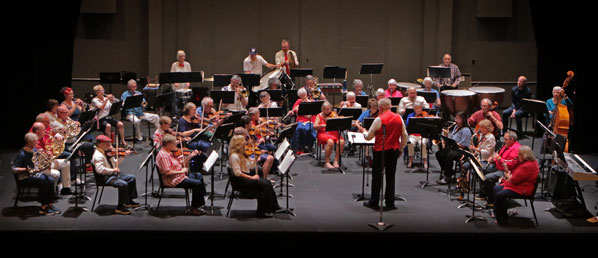
The East County Community Orchestra’s concert begins with the orchestra launching into a patriotic medley.
Program, Part 1: marches, polkas, and early jazz
Departing from the orchestra’s customary kickoff of “The Star-Spangled Banner”, this concert began with a broader, flag‑waving salute in honor of all five branches of the service.
“Armed Forces – The Pride of America” then stitched together each branch’s theme with Sousa‑style march strains, as well as the Pledge of Allegiance, and the National Anthem – and wrapping it all into a compact patriotic medley.
Shifting from martial to playful, “Tritsch-Tratsch-Polka” by Johann Strauss II bounced through the Horner Center, the orchestra capturing the light, chattering character of the 1858 Viennese favorite – a musical portrait of “chit-chat” and gossip that had toes tapping in the aisles.
From Vienna, the program moved squarely into early American song with the “St. Louis Blues” by W. C. Handy, one of the first blues numbers to cross over as a popular standard; ECCO’s reading nodded toward the classic jazz “Hamlet” tackled by the likes of Louis Armstrong and Benny Goodman, while keeping the melody front and center for listeners.
Listen to this concert as the first half is played …
The music turned meterological next with “Thunder and Lightning Polka, Opus 324”, another Strauss showpiece that crackled with sudden accents, cymbal crashes, and bass drum rumbles; the orchestra’s brisk tempo and flashing woodwinds painted a good-natured storm without ever losing control of the dance.
Closing out the first half, John Philip Sousa’s “The Liberty Bell March” rang out with historic resonance, its title inspired both by a Chicago stage spectacle, and by the composer’s own son having marched in a Philadelphia parade honoring the famous bell. In this performance, the familiar tune marched smartly down the center aisle of American memory.
Intermission: cookies, conversations, and ‘new ideas’ told
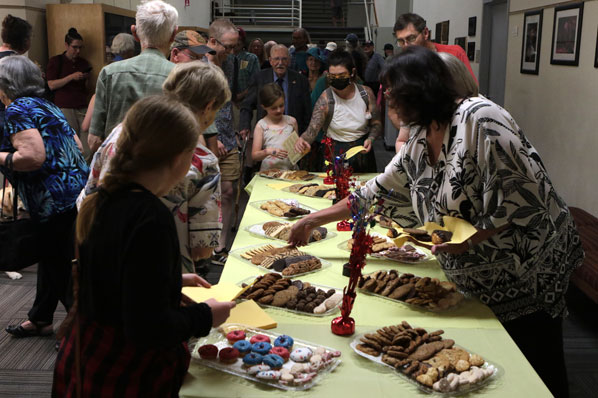
Concertgoers gather around tables laden with cookies during intermission.
At intermission, the mood migrated from the concert hall to the lobby, where audience members clustered around tables laden with cookies – lots of cookies. Guests noshed on the baked goods and sipped water on this hot afternoon as they compared favorite pieces, traded memories of past ECCO performances, and lined up for seconds, before the orchestra returned to the stage.
During the break, Conductor Dr. Roger G. Nickerson, Director of the East County Community Orchestra, reflected on how this year’s program stretched both the players and the repertoire.
“We have extra musicians today. In fact, we’ve featured two jazz pieces played by a quartet called Stumptown Saxes, accompanied by the orchestra, so we’re stepping out in some new music, some new ideas, and trying it out,” Dr. Nickerson explained, nodding toward the guest saxophonists mingling nearby.
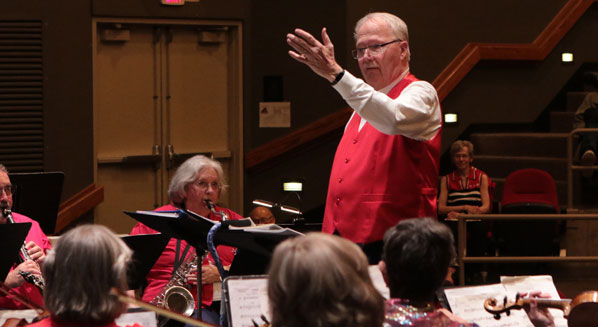
During intermission, Dr. Roger G. Nickerson takes a break from directing the East County Community Orchestra during the “250th Birthday Celebration” in the concert he characterizes as offering “quite an ensemble and a variety of music”.
He described how the “250th Birthday Celebration” theme framed the afternoon’s selections. “Today’s program is entitled ‘250th Birthday Celebration’, so I’m pulling music from everything that deals with musicians and music that would have been around 250 years ago, so we’ve got quite an ensemble and a variety of music.”
As for the ensemble itself, he reported that the volunteer orchestra is in solid musical health.
“The number of our volunteer musicians is where it should be, and so it’s working out well. And we’ve all enjoyed having the new musicians in,” he commented, as the Stumptown Saxes – “native to Milwaukie and Portland” – prepared to join ECCO for the second half.
Program, Part 2: ragtime, pasodoble and a saxophone spotlight
After the break, ECCO plunged directly into ragtime.
With “Alexander’s Ragtime Band” by Irving Berlin, the orchestra and rhythm section dusted off the 1911 hit with a bright jazzy arrangement that swung along on drum set, jazz bass, piano, and a full saxophone section, making the century-old tune beam “like the brightest sunshine”.
Color shifted to Spanish red with “España Cañí (A Spanish Gypsy Dance)” by Pascual Marquina Narro, a classic pasodoble with driving “double step” rhythms instantly conjuring bullrings and festival parades. The familiar main refrain, one of the best-known snippets of Spanish music, drew immediate recognition from the crowd.
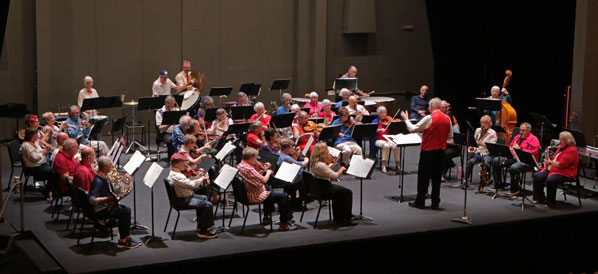
The East County Community Orchestra filled the hall with marches, polkas, and early jazz for its 250th birthday celebration of the country.
A more pastoral English-Australian flavor followed in “A Percy Grainger Portrait,” a suite that wove together “Irish Tune from County Derry”, “Children’s March”, “Mock Morris”, “Over the Hills and Far Away”, and “My Robin is to the Greenwood Gone”; the orchestra moved through these folk-inspired miniatures with warmth, letting the melodies sing without fuss.
Stumptown Saxes take center stage
The spotlight then swung decisively to the guest ensemble, “Stumptown Saxes”, featuring Lois Wagner and Mark Ortloff playing soprano, alto, and tenor saxophones, with Diane Crane on alto sax, and Becky Allen on baritone sax.
With ECCO backing them, the quartet brought easy swing to “Ain’t Misbehavin’” by Fats Waller, Harry Brooks, and Andy Razaf, turning the familiar standard into a relaxed, late-afternoon stroll that showcased the blend of the sax voices.
They followed with a “Dixieland Medley” of familiar New Orleans tunes – trading licks and harmonies, as the orchestra provided a buoyant cushion, giving the audience a taste of riverboat jazz in an outer East Portland concert hall.
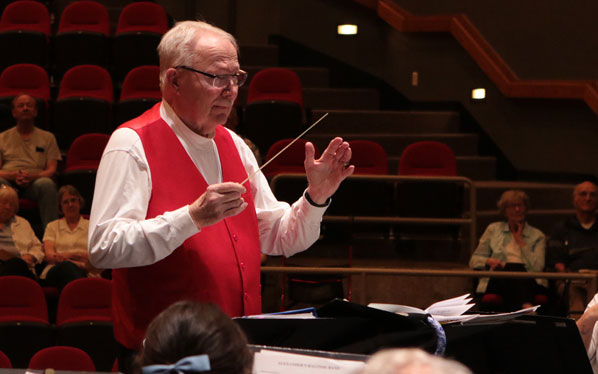
Conductor Dr. Roger G. Nickerson directs “Radetzky March” as the rousing finale of the afternoon program.
A rousing finish
For the finale, ECCO reached back to 1848 Vienna with “Radetzky March” by Johann Strauss I, a victory march first performed to celebrate Field Marshal Joseph Radetzky’s triumph at the Battle of Custoza; here, the piece took on its now-traditional role as a jubilant encore, with its cheerful tone and infectious beat leaving listeners clapping along in the Howard Horner Performing Arts Center.
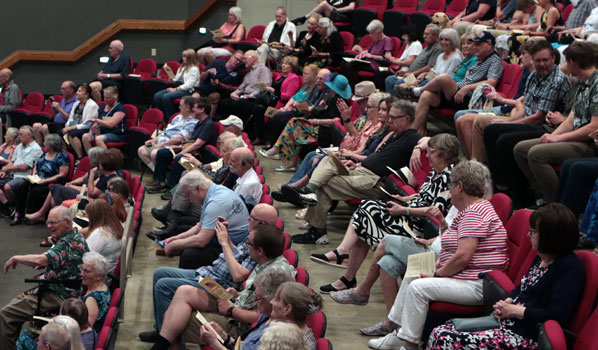
The audience clearly enjoys this afternoon concert by the East County Community Orchestra.
From Sousa marches and Viennese polkas to ragtime, pasodoble, and Dixieland jazz – with a local saxophone quartet as featured guests – the East County Community Orchestra’s “250th Birthday Celebration – 1776 to 2026” concert offered Hazelwood a lively, free tour through 250 years of American and European music on a single June afternoon.
Find out more about the East County Community Orchestra, including its performance dates – and learn how to contribute to this nonprofit community musical organization – at their website: CLICK HERE.
© 2026 David F. Ashton ~ East Portland News™