When these two outer East Portland neighborhoods set out to rid their areas of trash, they gather dumpsters full of refuse. See why these volunteers work so hard to clean things up‚

Argay Neighbor Jim Edmonds, one of the nearly 100 neighbors dropping off trash, being checked in by volunteer Bonny Scott at the Argay Clean-up day.
Story and photos by David F. Ashton
“We’ve already had 70 cars so far; it looks like we’ll probably serve 100 neighbors this year,” says Argay Neighborhood volunteer Bonny Scott, as she checks in cars at the early June neighborhood clean-up. “This is the most we’ve had in three years.”
At Shaver Elementary School, Scott is checking in Argay neighbor Jim Edmonds. He says, “This is great! It gives us the chance to clean up the yard and get rid of things.”

Argay Neighborhood Association volunteers Dana McCray and Jane Roffey-Berry don’t mind getting dirty while they help clean up their part of Portland.
Large turnout
Perhaps more important than the good weather, Argay Neighborhood’s chair, Valerie Curry, tells us, is that “we really promoted our clean-up day.”
It wouldn’t be such a successful effort, Curry says, if not for the efforts of the eleven volunteers from the Soccer Club at Parkrose High School. “These young dynamos have been unloading, tossing, pitching, slinging, arranging, and cramming trash and yard debris‚ making the best use of our dumpster space‚ for over four hours. And, they did it with good humor!”
The help of these Parkrose High volunteers was especially helpful, Curry explains, saying, “The leadership of our association presently consists of a small group of “older” neighborhood volunteers, at the moment all females who work hard for their community and who organize periodic special services for the neighborhood, such as a Neighborhood Clean-up Day.”

David Toscano and Connor Leines, two of the eleven Parkrose High School student volunteers help load out up trash in Argay.
Curry says she wants to thank the helpers by name: Matt, Josh, Connor, David, John, Jacob, Nathan, Josh (No. 2), Nick, Jose, and Christian.
“And, we also thank our steadfast neighborhood volunteers Clare & Sharon Mershon, Dana McCray, Alice Ford, Tina Scarborough, Jane Roffey-Berry, Gary Scott, and coordinator Bonnie Scott.
ROSE helps Lents neighbors
‘take out the trash’
Due to the sprawling size of the Lents Neighborhood, clean-up organizers located their dumpsters throughout their area.
“It really helps when people can take their debris and trash just down the street, instead of having to haul it to a central location,” said organizer Judy Welch.

Neighbor Nicole Yates unloads her truck, getting rid of a big old load from our back yard as clean-up coordinator Judy Welch sweeps up at one of the 13 locations.
“We’ve filled two dumpsters here; one with yard debris and one with solid waste,” says Welch.
Overall, this Lents Clean-up filled 13 dumpsters throughout Lents.
This project was partly funded by ROSE Community Development; they sponsored six of drop-box bins.
© 2007 David F. Ashton ~ East Portland News Service
What kind of neighborhood association meeting treats everyone to a delicious barbecue dinner? Take a look at this event‚ it has become a springtime tradition‚

Portland Water Bureau’s Jimmy Brown caters the Powellhurst-Gilbert Neighborhood Association meeting, highlighted by his BBQ chicken and ribs.
Story and photo by David F. Ashton
A couple of years ago, the chair of the Powellhurst-Gilbert Neighborhood Association, Glenn Taylor, talked Jimmy Brown into serving his famous barbecue as a drawing card to attract folks to their spring meeting.
At that time, Brown headed Portland’s Office of Neighborhood Involvement. Brown’s homemade barbecue chicken and ribs were the talk‚ and taste‚ of the association’s meeting.

Susan McDonald and her daughter are one of the dozens who lined up for a plate full of Jimmy Brown’s scrumptious barbecue.
Even though Brown has since moved over to the Portland Water Bureau, he’s kept the new tradition alive by‚ once again‚ serving up a dinner, including heaping portions of toothsome barbecue and all the fixings at the association’s meeting in May, their last meeting until fall.
“I love seeing folks enjoy good food, and I like to support neighborhood activities,” was the reason Brown gave us for serving the banquet.
City execs provide update
As happy diners cleaned their plates, Taylor called the neighborhood meeting to order.
Tom Klutz, Portland Water Bureau, brought news regarding Portland’s newest “hydro-park”‚ a public park built and maintained by the water bureau‚ scheduled to be developed at SE 138 Ave. & SE Center St.
“The old rusting fences are down,” Klutz reported. “We’ve brought in more boulders from Bull Run to keep vehicles out and still let people in.”
The next step for the park will be improving the land with grass, installing picnic tables, benches and a walking path around the perimeter.
“And, the park will be easily accessible by the handicapped. I thank the Powellhurst-Neighbors who have made it [the park’s development] a good process.”
The manager of Powell Valley Road Water District before it was transferred to the City of Portland, Tom Pokorny, stopped by the meeting.
“At the SE 138th Ave. well field,” Pokorny reminisced, “we used to have the Drinking Water Festival in September. And, perhaps many of you remember out ‘tapping contests’‚ our team took international honors one year. When Commissioner Leonard took over the water bureau, PWB provided two men’s and two women’s teams in the competition. By the way, the Rockwood team, a men’s and a women’s team, are going to the international championships in Toronto this year.”

In the foreground, Tom Klutz, Portland Water Bureau, listens to questions about the new “hydro-park” planned for the area‚ as his boss, Portland City Commissioner Randy Leonard (in the background), listens.
Leonard delivers “state of the water” message
“Until the city took over,” said Portland City Commissioner Randy Leonard, “my water at home came from Powell Valley. I recognized how well this water bureau served its citizens, so I invited Tom [Pokorny] to our leadership and management meetings when I was assigned the Portland Water Bureau in 2005. Tom’s participation was a turning point that helped [water] bureau develop into an organization that puts customer service first.”
Turning his attention to Powell Butte, Leonard said, “We’re putting a new home up there that will look like a log cabin. It will be an amenity, instead of an eyesore. The Water Bureau will pay a person full time to help make it secure, and work on the Butte‚ they will be a full time caretaker.”
Asked about filtration, the commissioner said, “The city has filed a lawsuit against the federal government. We are challenging their requirements. New York City has joined in the suit.”
As for long-term goals, Leonard says they plan to build an interpretive center on Powell Butte. “It is part of a five year master plan. Part of the permanent structure might be an original work cabin built at Bull Run. We’d dismantle it, bring it here, and restore it.”
Concerns about Graffiti
When Commissioner Leonard asked about neighbors’ concerns, many voiced their ire regarding the marked increase in graffiti.
“In many places here, this problem is out of control,” stated Leonard. “It is rising to the level of being unacceptable. I regularly drive Powell, Foster and Division heading to City Hall; I see it every day. I’m working on an ordinance regarding graffiti. The idea is that spray paint will be put in a secure location in stores; and buyers will sign a book when they buy it. There are civil rights challenges involved.”
As for ourselves, we thank Powellhurst-Gilbert neighbors for welcoming us to attend all of there meetings‚ especially the most delicious one of the year!
© 2007 David F. Ashton ~ East Portland News Service
Led off by Mayor Tom Potter, the parade some people thought would never happen‚ but did‚ was one that everyone enjoyed. In addition to seeing fun photos, learn about the dedicated group of volunteers whose diligent work turned this dream into a reality …
See why residents are celebrating as the first, major ROSE Community Development turns ten years old‚

These ten-year Lents Village residents say they’re proud, and happy, to have been among the first residents of the facility.
Story and photos by David F. Ashton
As hard to believe as it may seem, the affordable senior housing project on outer SE Holgate Blvd. — Lents Village — is already ten years old.
“It is great to get together with the residents who live here, and community members, to celebrate this facility,” comments the executive director of ROSE Community Development, Nick Sauvie.

ROSE board member Rick Soards and executive director Nick Sauvie congratulate the long-term residents at Lents Village Apartments.
Sauvie reminded us that ROSE (Revitalize Outer South East) Community Development Corporation is 15 years old this year. “This was the first large, new development that ROSE did. It has been tremendously successful.”
Further, there has been a lot of progress in the Lents neighborhood in the last 10 years, Sauvie adds. “ROSE has been a significant part of that. There is a huge need for affordable housing for seniors, people with disabilities, and families. ROSE is working to meet that need.”

Portland Fire & Rescue’s Lt. Richard Jones gives residents safety tips and reminds them, “When ever you need us, we’re just minutes away.”
In its 63 units, Sauvie says Lents Village accommodates persons 55+ years old who meet low-income qualifications.

Even after residing there for a decade, Lents Village resident Lynn Simmons says she feels blessed to have been selected to live in the building.
“Blessed to live here”
One of the folks we meet is Lynn Simmons, who moved in on opening day.
“I moved in here in 1997,” Simmons tells the group of celebrants assembled in their Lents Loaves & Fishes dining hall.
“There hasn’t been one day that I have regretted moving into Lents Village,” continues Simmons. “I’m happy here. All of my needs have been fulfilled. The location is good, the facility is clean, and they take good care of the property. I’m thankful to the Good Lord that I heard about Lents Village, and have been able to live here.”
Resources:
Find out more about all of the ROSE programs by going to www.rosecdc.org or by calling (503) 788-8052.
© 2007 David F. Ashton ~ East Portland News Service
See the “public art” they’re cooking up for the Lents I-205 MAX station‚ and learn why two kids were honored at this neighborhood meeting‚

Michelle Traver, public art coordinator with TriMet, and artist Kim Hablin answer questions regarding a collage‚ illustrating the art project being developed for the Lents I-205 MAX station‚ posed by the Lents Neighborhood Association board members at their general, monthly meeting.
Story and photos by David F. Ashton
Part of the I-205 MAX project includes public art at the light rail stations.
The board and members of the Lents Neighborhood Association got a sneak preview at a collage being created by artist Kim Hablin for the Lents MAX station.
“This art will be mounted at the Ramona Street cul-de-sac, at the back entrance to the Lents MAX Platform,” Hablin said.

Artist Hablin tells why she selected the images in the collage, and listens to feedback from neighborhood association members.
Hamblin said she started by doing research on the Lents area, and seeking out images from the Oregon Historical Society and other places. “There is so much to learn. I like this area a lot. The people here are really looking forward to something good. Hopefully, the art I create will play a part in their goal of strengthening their community.”
The project is in the “final design” stages, said Hamblin. It will go into production in late April.
Kids honored for thwarting car theft
Instead of looking the other way, three young Lents residents, Cameron Bell Dylan Lewis and Kyle Logan helped police track down car theft suspects and recover a vehicle.
Here’s the story: on March 11, Lents Neighborhood Association board members were holding a retreat at Clint Lenard’s house.
“We took a break and went to the corner market for a soda,” association chair, Dewey Akers, told us. “Another of our board members saw a car‚ belonging to his associate‚ that was previously stolen parked outside the store. “We tried to keep the suspected thief in the store while we called 9-1-1, but the he bolted,” Akers continued. The board members enlisted the aid of the three young men to help police track and apprehend the criminal.

Portland Police Bureau Commander Michael Crebs tells about the special golden coins about to be awarded.
So impressed was Portland Police Bureau Commander Michael Crebs, he came to the neighborhood association meeting to honor the two young men.
Commander presents commemorative coins
“I’m here tonight,” Crebs began, “because when I see young people doing the right thing, I feel good inside. It is difficult doing ‘the right thing’ sometimes. You get peer pressure not to help the police. You guys did the right thing. You helped make the community a better place to live.

Rosanne Lee, Crime Prevention Program Coordinator for Lents, awards certificates to the young men.
Holding up a golden coin, Crebs continued, “These are very special coins. It is the Portland Police Bureau coin. It was created and minted to be given to police officers and citizens who do exemplary work. I’m giving each of you a coin. Your parents can be proud of you for doing the right thing.”

Cameron Bell and Dylan Lewis show off their coins and certificates as they pause for this photo with Commander Crebs.
Then, crime prevention expert, Rosanne Lee, presented the lads with certificates, inscribed: “The Office of Neighborhood Involvement Crime Prevention Program recognizes you for assistance to members of the Lents Neighborhood Association on March 11, 2007, in apprehending car thieves. You demonstrated that participating in community policing is for people of all ages.”

Kyle Logan gets his Portland Police Bureau coin from Commander Crebs.
The youngsters seemed pleased as they accepted the coins and certificates. But, their eyes really lit up when they were also awarded tickets to the Century Theaters at Eastport Plaza by the association’s board members.
Learn more about the Lents Neighborhood Association at www.ilovelents.com
© 2007 David F. Ashton ~ East Portland News Service
They’ve been shooting this movie, starring Diane Lane, all over town. See what we saw “on location” in Eastmoreland‚

Many moviemakers try their best to keep citizens far away from their site. But, the producers of the forthcoming major film “Untraceable” welcomed neighbors to watch them shoot their movie.
Story and photos by David F. Ashton
Eastmoreland was turned into a Hollywood back-lot for three days during Spring Break, as the crew of the motion picture Untraceable moved into the neighborhood.

Spring Break traffic was slightly disrupted along SE 39th Avenue, because the street was lined with motion picture craft services trucks.
Although they were shooting in and around only one house, located on SE Carlton Street midway between SE 39th and SE 36th Avenues, trucks loaded with movie-making gear lined Eastmoreland area streets.
The production company hired “crossing guards” to direct traffic, keeping vehicles moving smoothly along SE 39th Avenue, while at the same time protecting crewmembers carrying equipment or rolling carts laden with gear.
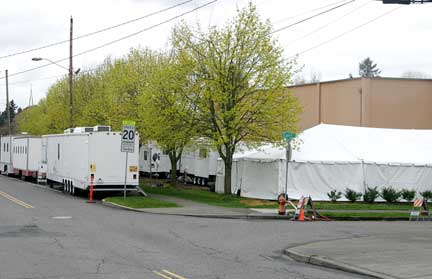
Because they were shooting the movie in a home just west of SE 39th Avenue, the portable dressing rooms and food services were set up in the Holy Family Church parking lot.
Caravan moves in before dawn
A homeowner at the corner of SE 39th Ave. and Henderson St. stood in his yard, looking at the tents and trailers across the street in the Holy Family Church parking lot.
“They came in this morning about 5 a.m.; I was getting ready to go fishing when they showed up,” he told us on March 26, the first production day in Eastmoreland.

At the home in which they were shooting, tons of movie magic making gear gave the director the exact “look” he was seeking.
Production company makes friends
While many movie producers try their best to shoo “locals” away from their production areas, the Lakeshore Entertainment production team showed up demonstrating a remarkably affable attitude.
For example, a few days before the production moved into Eastmoreland, neighbors told us a public relations person went door-to-door, telling them that the crew was about to come to their neighborhood. “She gave me her card and cell phone number,” said a resident, “and said to call if there were any problems.”
And, instead of being chased away from the home being used as a set, neighbors were invited to watch.
A production assistant, who stood in the street in front of the house, answered questions. In addition to shooting on the Broadway Bridge, he said, the crew has also shot in Irvington. “The rain does get to you. You get wet. But it wasn’t as bad as the film I was working on in Chicago‚ man, that was cold.”

When the cameras are rolling inside, workers outside disappear for a few minutes.
All quiet‚ Action!
From inside the house, we heard some shout, “All quiet”‚ a call echoed by crewmembers around the property. Crew stopped their activities. The neighborhood fell silent.
Then, we could faintly hear director Gregory Hoblit call “Action”‚ and we watched the actors perform their scene. Finally the call “Cut” rang out, and workers started preparing the next shot.
About Untraceable
Here’s the story line: In a story set in the future, an FBI cybercop must race against time to track down a ruthless online predator.
The cast includes Diane Lane as Jennifer, Dan Callahan as Trey Restom and also features Colin Hanks, Billy Burke, Joseph Cross and Mary Beth Hurt.
This thriller, also known as “Urgency“, is a Lakeshore Entertainment production to be released by Screen Gems Production Co. The release date has not yet been set.
© 2007 David F. Ashton ~ East Portland News Service
The city’s purse strings are being drawn tightly, choking funding for this outer East Portland horticultural treasure — Portland’s only botanical garden. Learn what advice volunteer supporters were given,

Portland Parks & Recreation planning supervisor David Yamashita led the panel discussion held, ostensibly, to help Leach Botanical Garden volunteers get ideas of how to operate the facility with lower city support.
Story and photos by David F. Ashton
The faces of Leach Botanical Gardens’ volunteers looked gloomy on the Saturday morning on which they were meeting, a few weeks ago.
Portland Parks & Recreation planning supervisor for the Gardens, David Yamashita, planted his message as tactfully as possible: “You will get no additional money from the City of Portland. You need to look at additional revenue sources.”
Yamashita suggested the group consider charging an entry fee, or finding a major benefactor.
“No, we don’t charge an entry fee,” protested Barbara Hamilton, a longtime volunteer. “Volunteers do a great deal of work to keep this garden running. This garden is needed here in outer SE Portland‚ especially now that the city is loading our neighborhoods with low-income housing.”
Yamashita responded that the “Friends Group” needs to start making plans. “You’ll be more effective at fundraising than we can be in the [PP&R] bureau.”
To help the Friends of Leach Botanical Gardens gather ideas about fund raising and management, Yamashita and his staff arranged for representatives for four other area gardens to be present to share their experience.
Read on and learn what the panel told Leach Garden volunteers …

Scott Vergara, Berry Botanic Garden, and Gloria Lee, Portland Classical Chinese Garden, tell about their respective horticultural operations.
The Berry Botanic Garden
The executive director of this garden, Scott Vergara, told how Berry Botanic Garden was originally a private estate, located in the Dunthorpe neighborhood between Lake Oswego and Lewis & Clark College.
“Our 30-year-old garden is virtually hidden,” Vergara began. “A ‘friends group’ has preserved its 6 acres.”
Berry faces unique restrictions, being located in a residential neighborhood. “We have no sign, extremely limited parking, and we are open by appointment only.”
The garden, Vergara said, arises from a small endowment; it gets no public resources. “Because of our seed bank, we have contracts with federal and state agencies. We collect seeds and monitor reproduction programs.”
Additionally, gate receipts, small gift shop sales, donations, grant writing, and hosting the occasional event rounds out their $500,000. “We have seven fulltime workers, but we need nine. We have 180 to 200 volunteers a year.”
Turning to structure, Vergara commented that while “bounder boards” [of directors] are necessary; “fundraising boards” are critical. “Operations boil down to two questions — those dealing with money and mission. How do you get your funding? What is your mission?”
As time goes on, he added, the mission must evolve to meet the current needs of the organization. “A clear mission helps direct the garden; too tightly defined a mission becomes too restrictive,” Vergara elucidated. “A mission must be relevant.”
With aging volunteers and board members, Vergara said one of their most critical questions is how to attract younger people to help in the garden.
Portland Classical Chinese Garden
Next to offer insight was Portland Classical Chinese Garden’s executive director, Gloria Lee.
“It’s about leadership to survival,” Lee began. “We are a totally self-sustaining entity. 80% of our visitors are from outside the city and state.”
Lee explained that their unrestricted income is from ticket sales. “But, it wasn’t enough. We hired a development director; now we’re blessed with two grants — one for horticulture, and another for ‘East-West outreach education’. For us, we are a living museum; not a botanical garden.”
The Chinese Garden’s board of directors, Lee said, will consider a new project only if its funding source is also presented. With membership growth stalled, they look to grants to increase their funding. “Our garden employs 22 full-time people,” commented Lee.
“The board members now drive the fund raising and membership activity,” Lee explained. “They hold phone-a-thons, and undertake other fund raising efforts.”
After meeting payroll, Lee told the group, their second largest budget item is advertising and promotion. “My fear is that if you become a destination, and charge for entry, you may have to budget a considerable amount for advertising. This year’s Chinese New Year Celebration advertising promotion cost $22,000.”
Lee recommended hiring staff members with multiple talents. “The secret to success is to remember that it takes passion and stamina to keep going, year after year.”

Portland Japanese Garden’s Stephen Bloom, and the Jenkins Estate’s supervisor, Allen Wells, shared their expertise with Friends of Leach Gardens.
Portland Japanese Garden
Speaking for the Portland Japanese Garden was its executive director, Stephen Bloom.
Bloom left us, and the Leach volunteers, a bit hazy about the Japanese Garden’s financial relationship with the City of Portland.
“We have 12 acres leased from the city,” Bloom stated. “The original lease was for a dollar a year, but the rate has been adjusted. Work in partnership with the city. We don’t get cash from the city. Government funding is never guaranteed.”
A Leach volunteer interjected, “But the Leach family DONATED our land to the city. It isn’t leased, or an in-kind arrangement.”
Of the Japanese Garden’s $2.4 million budget, $1.2 million comes from gate ticket sales generated by a quarter-million visitors, continued Bloom. “We work in conjunction with the city, but don’t depend on the City of Portland for funding.”
This garden has 24 fulltime and 8 part-time employees.
Bloom said they operate under two boards of directors: a Society/Policy board and an Operations/Endowment board.
“Two years ago, we bumped admission from $6 to $8 per person. As a world-class attraction, the attendance has still increased, because we focus on quality. A quality garden drives people to your institution.”
Bloom’s advice: “Sooner, than later, make a strategic plan. You need a ‘road map’ to know where you’re going. Make it inclusive, so everybody buys in. Staff members change; board members change ‚Äì the plan must stay consistent.”
The Jenkins Estate
Finally, Allen Wells, the Tualatin Hills Park and Recreation District coordinator for the Jenkins Estate in Tualatin, spoke.
“Much of Washington County is made up of special service districts,” Wells began. “The district purchased the Jenkins Estate, a 68-acre parcel scheduled to become condos and offices. The district floated a bond and secured the estate.”
Jenkins has been “run on a shoestring”, Wells said. “We have substantial reliance on volunteers and an advisory committee.”
The district focused attention on restoring the buildings,” said Wells. “Each structure has a small garden. We spent the early years discovering what was planted in those gardens.”
Because the estate didn’t come with an endowment, Wells described their facility as a “wedding chapel” on the weekends, and during the week, a corporate retreat. “Our restoration and gardening had to almost be done on a ‘swing shift’, due to the rentals.”
Leach volunteers frustrated
After all the presentations, Ernie Francisco protested, “You are all west side intuitions. The city was started on the West side. There is business and industry there to support your work. We don’t have businesses here. We feel the city needs to look at institutions, like Leach Gardens, as resources that serve the city as a whole.”
Francisco continued, “The other thing is this: As a volunteer member here, education of individuals and classes has been the overriding emphasis of our work here. You have different purposes.”
Representatives of the other gardens talked about their educational efforts, and said they saw little difference in that portion of their missions.
Finally, longtime Leach Garden volunteer Barbara Hamilton piped up: “We volunteer about 13,000 hours a year. This labor must be worth a couple hundred thousand dollars.
“The City keeps promising things, like a furnace and a new roof on the Annex ‚Äì but it never comes. We’re still fighting to get another power pole, so we can get more electricity brought into the buildings, and generate income from winter rentals.”
The Chinese Garden’s Lee responded, “You must find one individual who will champion your cause. Portland has had millions of challenges. And, there are many champions.”
We couldn’t see who made the comment, but someone sitting close to the front of the room suggested, “There are many wealthy people in nearby neighborhoods like Eastmoreland — why don’t you get them involved?”
Realizing that Eastmoreland is more than 100 blocks distant from Leach Botanical Gardens, Leach volunteers just rolled their eyes and shook their heads.
© 2007 David F. Ashton ~ East Portland News Service
Why would more than 400 volunteers tromp around Johnson Creek on a dismal winter day? Read this article, and you’ll discover why this waterway is so special to so many‚

Westmoreland residents Christine Steele and Joe Liedezeit are doing their part, cleaning the banks of Johnson Creek.
Story and photos by David F. Ashton
The invitation to this party read, “Be sure to bring your bad weather clothing and boots”. But the drippy, dreary weather on March 3 didn’t keep the more than 400 volunteers from slopping around, as they worked to improve the health of Johnson Creek.
We enquired to find out why so many people turned out for the annual “work party” sponsored by the Johnson Creek Watershed Council (JCWC).

Walt Mintkeski works at the “Bundy Site” in outer East Portland, near SE 141st Avenue and Foster Rd.
Grew up on the Creek
“Our family grew up on the Creek,” explained Walt Mintkeski, JCWC’s treasurer. “We’ve lived in the Eastmoreland neighborhood since 1975. I took my kids down to the creek.”
At the time, Mintkeski told us, Johnson Creek looked like a storm sewer ‚Äì perhaps even a sanitary sewer. Instead of grousing, he started a group called Friends of Johnson Creek to do something to improve its condition. “About the same time, the City of Portland started an effort to plan for Johnson Creek. That evolved into the Johnson Creek Watershed Council.”
Gradually, Mintkeski observed, the public is seeing Johnson Creek as a valuable public asset. “It is a wildlife corridor, a waterway. Through our efforts, we making Johnson Creek into a place we can respect and of which we can be proud. There’s a lot of recreation and wildlife potential here.”
Clean-up stretches from Gresham to the Willamette
Mintkeski said that more than 400 volunteers, at ten different sites, were working along the Creek that day.

Inner SE Portland residents Yarrow Murphy and Gibran Ramos say worked at the 169th and Foster site.
Volunteers went to work where they were needed. Brooklyn area residents Yarrow Murphy and Gibran Ramos drove out to help at the SE 169th Ave. and Foster Rd. work site.
“We’re graduate students,” Yarrow said studiously. “It’s nice to get out and do something other than study. We planted trees and picked up some trash. It was great. I feel good about it.”
Gibran added learnedly, “It was a good break from studying. I like getting out and being in nature. It felt good to plant trees and make the site look a little nicer.”

JCWC “chili chef” Marty Urman checks her vats of steaming hot potage.
Chili feed warms workers
After working in the rain for hours, volunteers were invited to several sites for hot lunches. They dug into bowls of freshly made chili, accompanied by breads and cookies.
We stopped in at JCWC headquarters located in Milwaukie, and talked with chief chili chef Marty Urman.
“I do graphic arts work for the council,” Urman reported, “but I’m volunteering today. I made about 20 gallons of chili. We’re feeding eighty hungry volunteers at this site.”

Ready for some hot chili is METRO Counselor Robert Liberty.
“We got to see things we planted last year near Crystal Springs, commented District 6 METRO Counselor Robert Liberty, as he prepared to tuck into a bowl of red. “I was on the mulch ‘bucket brigade’ this year. We were sinking in our boots ‘up to here’. But, we had a lot of people who were helping out.”
We asked Liberty why he volunteered for the clean-up.
“Why volunteer?” he responded. “I want Johnson Creek to be a living creek. I’d like to see someone pull a Steelhead out of it some day.”
© 2007 David F. Ashton ~ East Portland News Service
Discover what Mayor Tom Potter heard when he listened to Woodstock residents during his inner SE Portland Saturday session 
Talking with Mayor Tom Potter are Woodstock “observers” Ruthann Bedenkop of the Woodstock Neighborhood Association, and Jane Glanville, President of the Woodstock Community Business Association.
Story and photos by David F. Ashton
Once a month, you can find Mayor Tom Potter somewhere in Portland, listening to all who want to share their concerns with him.
Potter didn’t have to travel far on February 24 ‚Äì he this “Ten Minutes with Tom” session was not far from his home, at Pappaccino’s Coffee Shop on S.E. Woodstock Blvd.
“This was pretty exciting,” said Ruthann Bedenkop, president of the local business association. “The conversations seemed very open. It made me feel like our government was accessible.”
Mayor’s observations
We caught up with Mayor Potter as he was concluding his session with citizens, and asked him what he learned.
“We talked about issues ranging from the war in Iraq to fluoridation, to urban growth boundaries, to public safety, mental health issues; and the federal homeland exercise ‘TOP OFF’ with the federal government, how we could respond to a major emergency,” Potter summarized.
“I just found out that one of the adult shops in the area is closed and they’re putting in a bakery. That is a good thing.”

Mayor Potter listens to concerns about poor street condition during his Woodstock visits.
Hears of potholed roads
“A woman told me about her street ‚Äì it really needs repair. In our discussion, I told her that Portland has 2,400 miles of paved streets; 600 miles of those need maintenance. Yet, our largest funding source for paving streets is the state gas tax. It hasn’t been raised in years. Vehicles are more gas efficient, and fewer people are driving cars. While driving less is better for our air quality, it is harder on the City’s pocket book.”
The mayor said he’ll pass on the concern to Commissioner Sam Adams, who oversees PDOT.
Speed bumps on his street?
Recalling the group of neighbors trying to get speed bumps placed on their ‚Äì and the mayor’s ‚Äì street, we asked Potter what he thought of the idea.
“People do speed. I know some of the neighbors have talked to Transportation. But, the Commissioner of Transportation, Sam Adams, said they may not be able to put them on SE 41st Avenue, because it is an alternate route for emergency vehicles.”

Not all topics brought up to him concern local issues, Mayor Potter says.
National issues discussed
Not all of the topics people bring up to him, he said, are local.
“Several people talked about the Iraq war. They say it detracts from things we should be doing here. For example HUD provides a lot of money to local communities for local housing. Their budget was cut over 1.5 billion. We took a hit of $6 Million into affordable housing. We had to make that up. If it hadn’t gone for war, we could have used it for housing.”
Regarding Woodstock
Having interviewed the Mayor following several of his East Portland sessions, we asked how people act to him, when they can speak freely.
“Almost to a person, those who come talk with me are kind. They usually have issues on their minds they want to talk about. They understand that government can’t do everything. We do as much as we can.
“People from other areas treat me as well as they do here. I love Woodstock. I love living here. It is great neighborhood with nice people. I’m 15 minutes from my office. From the comments I heard, people do like living in Inner Southeast Portland.”
© 2007 David F. Ashton ~ East Portland News Service
Neighbors in Parkrose realize how their concerted efforts pay off. Read this story to see what they’ve accomplished lately ‚Ķ

Portland City Commissioner Dan Saltzman listens to, and speaks to, members of the Parkrose Neighborhood Association.
Story and photos by David F. Ashton
The city didn’t want to build it, but neighbors wouldn’t be denied a City park. “Our neighborhood is called ‘PARKrose’, you know,” said Marcy Emerson Peters, chair of the neighborhood association.
Their meeting last month was both a celebration of their past successes, and the opportunity to bend the ear of Portland City Commissioner Dan Saltzman.

Enjoying pizzas at the Parkrose Neighborhood Association meeting are Dwain Lamb and Jim Bradley.
Those who attended this special meeting were treated to a pizza feed and ice cream. To some, news that a community garden was approved was the best dessert.
Community Garden at Senn’s
Doug Brenner of the Portland Parks Bureau told the group that construction of a community garden was about to commence at Senn’s Dairy Park on NE Prescott St.
“We’d like to get the garden in by April or May,” Brenner said. “The Parks Department will do most of the construction, but neighbors are needed to help.”
The improvements will include putting in pathways and raised beds to help the mobility-challenged. This will be the City’s 31st Community Garden, commented Brenner.
Saltzman added, “You’ve been persistent; I’m pleased to see this garden coming in. We need more Community Gardens. As Parks Commissioner, these projects are on the top of my list.”

Neighborhood chair, Marcy Emerson Peters shares many of the projects the association is undertaking in Parkrose. In the background, Mary Walker takes notes.
Marcy Emerson Peters told the group that plans to install playground equipment are slowly moving forward. She also lauded the crime-reduction activities in the area ‚Äì including the new “foot patrol” along Sandy Blvd.
Challenges “adult oriented” proliferation
Resident, and public safety advocate, Mary Walker grilled Commissioner Saltzman: “Would you consider putting non-family-oriented businesses away from our schools and daycares, and do more that is being done now? We know Oregon is big on individual rights. But we also have a right to live in decent neighborhoods.”
Saltzman’s response: “You have dealt with this for a long time. You are sophisticated enough to know a particular use can’t be discriminated against.
“Through zoning, we can say a certain parcel of land on Sandy Blvd. should be used for either residential or business purposes. But, if it is a legally-operating business, we have no ability to regulate it on commercially-zoned property.”

Neighbor Jim Loennig shares his concern about the need to revitalize the area of Parkrose just south and east of Portland International Airport.
Proposes better use of South Parkrose land
A lifetime resident of the area, Jim Loennig, told the group how he grew up in Parkrose. Bringing up a large map, he added, “Instead of talking about history, I’d like to talk for a moment about the future.”
Land just south and east of Portland International Airport, Loennig contended, could be better used. Today, he said, it is occupied by junkyards and squatting transients.
“If you ‘up-zoned’ it,” Loennig argued, “you could get tax increment financing. I’d like to see connectivity, like down NE 109th Ave. If the city can enhance the area, put in more streets and lights, there will be fewer places for transient camps.”
Crime: neighbors’ chief concern
Detailed crime maps of Parkrose provided by the Portland Police Bureau show that the most-reported crime in the area is car prowls [break-ins], followed by home burglaries. Next down the list are crimes related to drugs and prostitution.
A pair of new Parkrose neighbors, visiting the association meeting for the first time, said they came to talk about crime.
Specifically, they gave details regarding a “chronic-nuisance house” on NE Prescott Street. They described fights, drug deals, and car prowls. “We wonder if moving to Parkrose was a mistake; we don’t think it will get any better.”
Armed with crime-prevention information and resources provided by the neighborhood association, the couple learned how, by sharing their concerns, they can work together to reduce the problem on their street.
Join with your neighbors
If you live in Parkrose, plan now to attend the next meeting of the Parkrose Neighborhood Association. Their general meeting starts at 7:00 PM at Our Savior Lutheran Church, 11100 NE Skidmore St.
© 2007 David F. Ashton ~ East Portland News Service
If you’re sick and tired of crooks and drug addicts reducing the quality of life in outer East Portland, learn about this special meeting on March 20 ‚Ķ

Rosanne Lee, East Portland Crime Prevention Program Coordinator, encourages Powellhurst-Gilbert’s Glenn Taylor to attend the March 20 organizing meeting for the new Foot Patrol.
Story and photo by David F. Ashton
They don’t carry guns and bust crooks.
But citizen volunteer members of a “Foot Patrol” do wear identifying vests, and battle crime with notebooks and pens.
Rosanne Lee, East Portland Crime Prevention Program Coordinator, explains, “Their purpose is to record what they see ‚Äì but, more importantly, to be a visible presence in the community.”
Lee says she’s in the process of developing a group of volunteers to assist Portland Police Bureau’s East Precinct officers to provide a “community presence at ‘hot-spots’ in various neighborhoods. They also do outreach for the precinct for special projects, like car prowl education.”
After two hours of training, the volunteers decide how to organize, Lee tells us. “This is a new idea; we’ve never organized a Foot Patrol on a precinct-wide basis. And, East Precinct covers a lot of territory. We’re breaking new ground.”
Come check out the Foot Patrol on March 20
Learn more about this do-it-yourself crime reduction program. The few hours you volunteer each month can make a real, positive difference in your community and neighborhood.
The organizing meeting is Tuesday, March 20 from 6 to 7 p.m. at the East Precinct Community Room, 737 SE 106th Avenue.
© 2007 David F. Ashton ~ East Portland News Service
Board members thought holding a special event might attract a few more residents to their organization. See how many people their shindig attracted …

Eastmoreland Neighborhood Association board member Bert Sperling (center) listens to concerns of homeowners at their open house social hour.
Story and photos by David F. Ashton
The expansive, clubhouse room looked rather empty a few minutes before 7:00 p.m., the appointed hour marking the start of Eastmoreland Neighborhood Association’s first open house event, on Thursday evening, February 15th.
The association’s president, Gretchen Sperling, told us they’d mailed invitations to every home in their area, for their event at Eastmoreland Golf Course Bar and Grill, hoping to attract new faces to their organization.
They didn’t all arrive at once, but over the next ten minutes, the room was well populated. By the time Sperling began her formal introduction, more than 45 people had arrived and taken a seat.

The Eastmoreland Neighborhood Association’s president, Gretchen Sperling, gets their first open house event underway.
Speaks to a growing audience
“Our vision is to encourage more participation in our neighborhood,” Sperling began. “We’re inviting more people into the conversation.”
Around the country, she said, when people talk about livability, Portland usually comes to the top of the list. “One of the reasons this happens is because of our incredible neighborhoods. We have so many different ways to live together.”
She explained that the reason for holding this open house was that the neighborhood association’s board members wanted more input from the neighbors they serve. “Issues are getting so complicated, we aren’t comfortable making critical decisions ‚Äì without inviting more people into the conversation.”
Sharing Eastmoreland issues
Asked to inventory issues with which the association was currently dealing, Sperling discussed:
-
Maintenance of the garden – the group is working to establish an endowment for the continuing care of the Eastmoreland Garden which welcomes people to the neighborhood right across from where the meeting was being held, at the Eastmoreland Golf Course Grill.
-
Concern and care for the tree canopy – how a committee cares for the health of the lush canopy of trees, including tree inoculation and Dutch elm disease.
-
Railroad noise issues – other neighborhoods are starting to participate in this issue. The 1955 injunction was upheld by a federal judge several years ago and now the Union Pacific is to comply with the terms of that agreement;
-
Reed College’s use of Parker House ‚Äì how the capacity of use was greater than the neighborhood would like to see. A hearing officer found in favor of the neighborhood; but the college is reapplying for conditional use permit.
-
Off-leash dog use at Duniway School ‚Äì dealing with the concerns of dogs running free, and the owners who don’t pick their pets’ waste.
-
Crime issues ‚Äì how it has increased in the neighborhood; police say it is coming from “fearless” meth addicts who come down Springwater Trail. “They have no fear, and break into homes even with people home. They’ll climb up trees and over flat roofs to gain entry in second stories.” Several second-story break-ins had recently been reported near S.E. Knapp Street and 35th.

Mike Fisher, VP; Bert Sperling, board member; former president John Reiersgaard, and Gretchen Sperling, association president, were four of many board members on hand to meet and greet their neighbors.
Although Sperling told us the event was to be an informal meeting, neighbors new to the association asked questions on a wide variety of topics, including why the promised Inner Southeast MAX line has not yet been built.
Ending the meeting, Sperling invited the crowd, now numbering more than sixty, to address their specific concerns individually with the committee chairs and board members present at the meeting.
“Come to our regular meetings each month, on the third Thursday, at the Duniway School library. But, you don’t even have to come to the meetings to be involved! There are many subcommittees that would like to have your participation.”

Diane Rynerson buys a tree walk map from Dan Dettmer, a volunteer on the Eastmoreland Tree Committee.
After the meeting, Sperling said, “I’m thrilled to see so many people show up, and show interest in our community. I’m tickled. I’m hopeful this will translate into better attendance at our monthly meetings. I’m cautiously optimistic.”
When March 22nd comes around, perhaps David Perkinson, whom we met as he looked over an exhibit showing the diversity of Eastmoreland trees, will be back. He told us, “My first meeting, although I’ve lived here for 16 years. Maybe I’ll come to another one.”

The large turnout surprised — and pleased — the neighborhood association’s board.
© 2007 David F. Ashton ~ East Portland News Service